Stochastic Gradient Descent and Machine Learning - Lecture 1
Explore optimization methods, gradient descent, Newton's method, and convexity in machine learning. Gain insights into iterative algorithms and their applications in statistical physics and data analysis.

Understanding, Interpreting and Designing Neural Network Models Through Tensor Representations
Explore tensor representations for neural networks, enhancing interpretability, expressive power, generalization, and robustness in deep learning models through spectral methods and innovative architecture design.

Approximation Power
Explore deep learning's approximation capabilities, focusing on theoretical foundations and practical implications for neural network design and performance optimization.

Statistical Learning Theory and Applications - Class 6
Explore statistical learning theory with focus on Newton's method, recursive computation, and online methods for efficient problem-solving and data analysis.
Measurement Induced Entanglement Transitions in Quantum Circuits with Decoherence - Ehud Altman
Explores measurement-induced entanglement transitions in quantum circuits, focusing on characterization methods, dynamical symmetry, and connections to classical models. Discusses implications for non-equilibrium many-body physics.
Filters and Other Potions for Early Vision and Recognition
Explore early vision and recognition techniques, including filters, deep networks, and multiscale processing. Learn about spacetime oriented filters and tensor factorization for improved visual analysis.
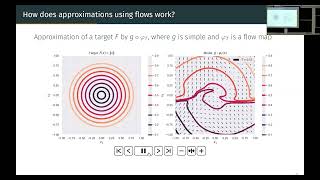
Learning, Approximation and Control in Dynamical Systems
Explore connections between machine learning, approximation theory, and control systems in this symposium talk by Qianxiao Li from the National University of Singapore.
Numerical Analysis for Hamiltonian Simulation and Hamiltonian Learning
Explore numerical analysis for Hamiltonian simulation and learning, covering accuracy measures, semiclassical Schrödinger equation, and efficient algorithms for learning interacting N-qubit local Hamiltonians.
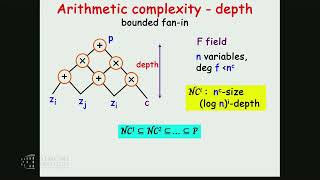
Faster Parallel Algorithms for Basic Linear Algebra Problems
Explore advanced parallel algorithms for fundamental linear algebra, enhancing computational efficiency in mathematical problem-solving.
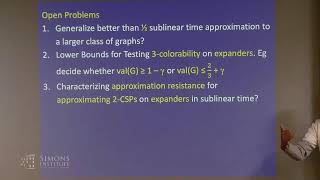
Sublinear Time Algorithms for Max-Cut Approximation on Expander Graphs
Explore random walks on graphs to achieve better-than-1/2 approximation for max-cut on expanding and clusterable graphs, using sublinear time algorithms.
Hierarchical Component-Based Modeling with ModelingToolkit.jl
Explore hierarchical component-based modeling using ModelingToolkit.jl for efficient simulation of complex systems. Learn to build, simplify, and analyze large-scale models with Julia's SciML ecosystem.
Grow Your Own Planet
Explore how simulations advance our understanding of the Universe, from basic orbits to complex gas flows. Learn about state-of-the-art hydrodynamics programs and their applications in astronomy.
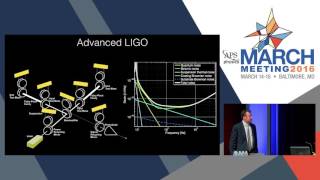
The Observation of Gravitational Waves from a Binary Black Hole Merger
Explore the groundbreaking detection of gravitational waves from binary black hole merger, its implications for general relativity, and the future of gravitational-wave astronomy.
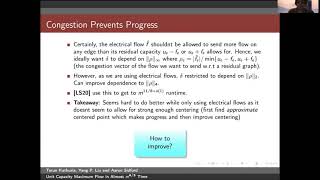
Unit Capacity Maxflow in Almost m - 4/3 Time
Explore advanced algorithms for solving unit capacity maxflow problems, featuring innovative techniques and improved time complexity.
Monitoring - The Math Behind Bad Behavior
Explore mathematical approaches to analyze vast system monitoring data, focusing on techniques to surface interesting patterns and insights from millions of measurements per second.
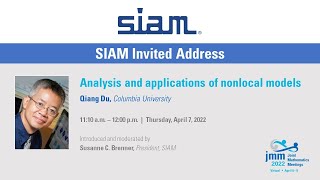
Analysis and Applications of Nonlocal Models
Explore nonlocal models in mathematics, their analysis, and applications. Learn about nonlocal vector calculus, operators, and numerical solutions for finite-range interactions.
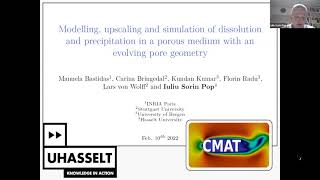
Modelling, Upscaling and Simulation of Dissolution and Precipitation in a Porous Medium with an Evolving Pore-Scale Geometry
Explore modeling and simulation of dissolution and precipitation in porous media, focusing on evolving pore-scale geometry and its impact on Darcy scale properties. Learn upscaling techniques and numerical approaches.
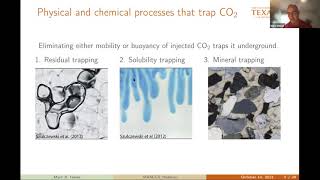
Solutal Convection in Porous Media
Explore solutal convection in porous media, challenging conventional theories with experimental findings and numerical simulations to understand flux patterns and mixing processes.
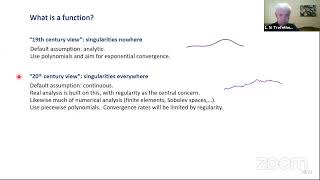
Rational Functions
Explores recent advances in rational approximation theory for numerical computation, focusing on "AAA" and "lightning" algorithms for solving PDEs in complex domains with singularities.
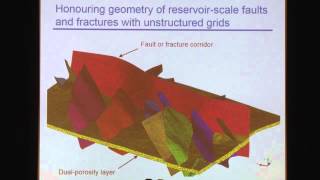
Numerical Simulation of Fractured Reservoirs
Explore advanced techniques for simulating fractured reservoirs, including dual-porosity models, unstructured grids, and probabilistic approaches to enhance flow prediction and reservoir management.
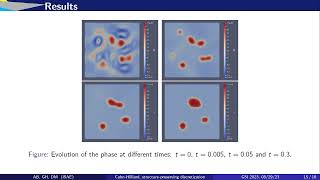
Structure Preserving Discretization of the Cahn-Hilliard Equations Recast as a Port-Hamiltonian System
Explore structure-preserving discretization of Cahn-Hilliard equations recast as port-Hamiltonian systems, advancing numerical methods in mathematical physics.