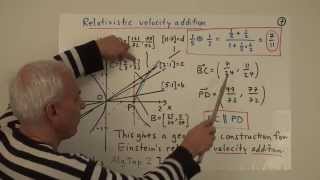
Relativistic Velocity and Core Circles in Rational Geometry - Lecture 4
Exploring relativistic velocity and core circles in rational geometry, extending Paul Miller's protractor concept to projective quadrance and comparing Euclidean and relativistic geometries.
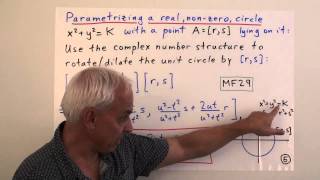
The Projective Line, Circles and the CQQ Theorem - Part 2
Explores advanced geometry concepts including general circles, complex numbers, and the Cyclic Quadrilateral Quadrea theorem, emphasizing projective parametrization and transformations in the complex plane.
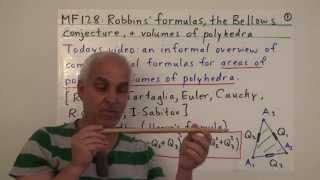
Robbins' Formulas, Bellows Conjecture, and Polyhedra Volumes - Rational Geometry Math Foundations 128
Explore modern developments in polygon area formulas, cyclic pentagon theories, and 3D generalizations of Heron's formula. Discover connections between quadrances, polyhedra volumes, and algebraic geometry.
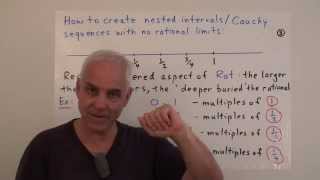
Axiomatics and the Least Upper Bound Property in Real Numbers - Math Foundations 121
Explores flaws in axiomatics for real numbers, examines rational number structure, and introduces the least upper bound property, challenging conventional mathematical foundations.
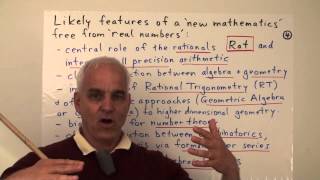
Mathematics without Real Numbers - Rethinking Foundations
Exploring the future of mathematics without real numbers, emphasizing finite and concrete approaches. Challenges traditional concepts of infinity and limits, proposing a revolutionary shift in mathematical thinking.
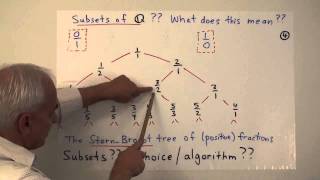
Difficulties with Dedekind Cuts - Real Numbers and Limits in Mathematics
Explores challenges in Dedekind's approach to real numbers, questioning the effectiveness of cuts in establishing a logical foundation for real number theory and arithmetic.
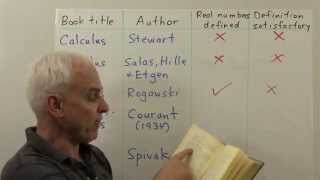
The Mostly Absent Theory of Real Numbers - Math Foundations 115
Explores flaws in standard treatments of real numbers in calculus and analysis textbooks, challenging conventional thinking and advocating for a more rigorous mathematical foundation.

Real Numbers as Cauchy Sequences - Limitations and Challenges - Math Foundations 114
Explores logical weaknesses in using Cauchy sequences to define real numbers, challenging traditional approaches and highlighting ambiguities in fundamental mathematical concepts.
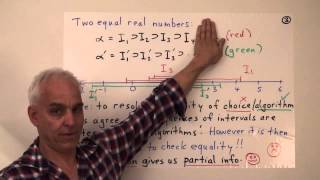
Real Numbers and Cauchy Sequences of Rationals - Math Foundations 113
Explore Archimedean real numbers and Cauchy sequences, examining their definitions, properties, and applications in mathematical analysis and approximation theory.

Real Numbers and Cauchy Sequences of Rationals - Math Foundations 111
Explores Cauchy sequences of rational numbers as a foundation for real numbers, discussing limits, equivalence classes, and the logical challenges in this approach to constructing the real number system.
Algebraic Number Theory and Rings - Math History II
Explores 19th-century algebraic number theory, focusing on extension fields, abstract rings, and algebraic integers. Discusses Gaussian integers, unique factorization, and foundational challenges in the field.
Historical Development of Group Theory - From Number Theory to Geometry
Explore the historical development of group theory, from its roots in number theory and algebra to its impact on geometry, covering key concepts and influential mathematicians.
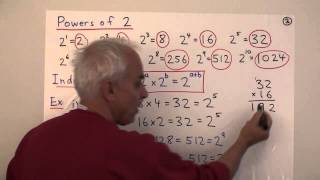
Index Laws and Powers of 2 - Year 9 Mathematics
Explore index laws and powers of 2, from ancient Indian chess to practical applications. Learn the reasoning behind these mathematical concepts and practice solving problems to develop fluency and problem-solving skills.
Applications of the Dot Product to Planar Geometry - Part 2
Explore advanced applications of dot product in planar geometry, including linear functionals, point-normal form of lines, vector projections, isometries, and rotations.
The Rational Number Line and Irrationalities - Famous Math Problems 19b
Geometric approach to modeling the continuum using the rational number line. Explores properties, projective view, and introduces irrationalities through Euclidean geometry and polynomial equations.
The Most Fundamental Problem in Mathematics - Famous Math Problems 19a
Explore the fundamental problem of modeling the continuum in mathematics, examining its historical significance, practical applications, and implications for various mathematical areas.
Are All True Mathematical Statements Provable? - Famous Math Problems
Explores the philosophical question of mathematical truth and provability, challenging conventional views with explicit examples of likely true but unprovable mathematical statements.
Japanese Temple Problems - Famous Math Problems 14
Explore Japanese temple geometry problems, focusing on a 13-year-old's 1847 challenge. Compare classical and rational trigonometry approaches, revealing surprising algebraic insights and symmetries in triangle geometry.

The Collatz Conjecture - Famous Math Problems - Lecture 2
Explore the intriguing Collatz conjecture, its variants, and strategies for tackling this famous unsolved mathematical problem. Learn about base-2 arithmetic and number theory applications.

Multiplication Tricks and Practice - Elementary Mathematics
Discover helpful multiplication tricks and practice problems for elementary math. Learn strategies for multiplying by 10, 5, 3, and 9, and apply these skills to solve word problems effectively.
More Multiplication: The 10x10 Table - Elementary Mathematics Explained
Strategies for mastering the 10x10 multiplication table, emphasizing understanding over rote memorization. Includes tips on using patterns, symmetry, and the commutative law to aid learning.