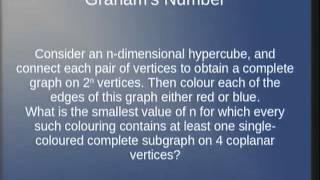
Numbers - From Merely Big to Unimaginable - Lecture 9
Explore the fascinating world of enormous numbers, from prime distribution to complex functions, and delve into advanced mathematical concepts like Ackerman operators and Ramsey Theory.
Stirling Numbers and Pascal Triangles - Foundations of Linear Algebra
Explore Stirling numbers and Pascal triangles in linear algebra. Learn about falling and rising powers, change of basis, and applications to polynomial sequences. Gain insights into combinatorial and number theoretic interpretations.
Arithmetic with Negative Multisets and Integral Polynumbers - Math Foundations 232
Explores advanced arithmetic using negative msets and anti-objects, introducing integral polynumbers and Laurent polynomials in a pure algebraic context, revolutionizing traditional algebra understanding.
Negative Numbers from Antimultisets - Math Foundations 231
Explore negative numbers through antimultisets, drawing parallels with particle physics concepts. Discover a new arithmetic perspective based on elementary principles.
Clock Mathematics and the 12-Tone Chromatic Scale - Connecting Music Theory and Mod 12 Arithmetic
Explores the connection between mathematics and music through the 12-tone chromatic scale, clock geometry, and mod 12 arithmetic, offering a fresh perspective on music theory and mathematical notation.
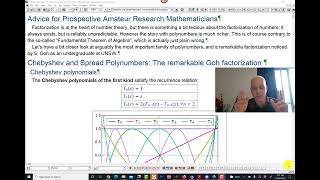
Chebyshev and Spread Polynumbers - Exploring the Goh Factorization
Explore polynomials in number theory, focusing on Chebyshev and spread polynomials. Learn about the Goh factorization and its implications for modern mathematics and computation.
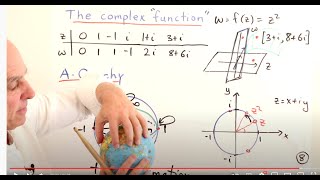
Bernhard Riemann and the Complex Sphere - Geometric Thinking in Mathematics
Explore Riemann's geometrical thinking on the complex sphere, from abstract discussions on mathematical space to practical applications in complex analysis and higher-dimensional geometry.
How to Set Up Fractions III - Canonical Forms via the Euclidean Algorithm
Explore the Euclidean Algorithm's role in creating canonical forms for fractions, connecting ancient Greek geometry to modern arithmetic and improving fraction manipulation skills.
How to Set Up Fractions - Famous Math Problems 24
Rigorous exploration of fraction theory, covering fundamental operations, comparisons, proofs, and arithmetic laws. Emphasizes the importance of robust number systems in mathematics.
Tips and Tricks for Computing Cyclotomic Polynomials - Famous Math Problems 20d
Explore techniques for computing cyclotomic polynomials, including the Euler totient function and prime power decomposition. Learn to tackle complex calculations like Phi_1001.
Difficulties with Real Numbers as Infinite Decimals - Part 1
Explores challenges in defining real numbers as infinite decimals, examining advantages and drawbacks of the infinite choice approach, and discussing historical debates on arithmetic laws and mathematical foundations.
The Number Theory Revival - From Diophantus to Fermat
Explore the revival of number theory, from Diophantus to Fermat, covering key concepts like combinatorics, algebraic curves, and famous theorems in this comprehensive mathematical journey.
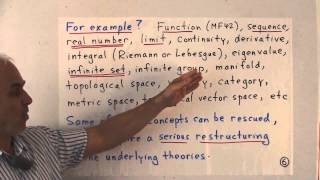
Logical Weaknesses in Modern Pure Mathematics - Real Numbers and Limits - Math Foundations 87
Explores logical weaknesses in modern pure mathematics, focusing on inconsistent rigor and problematic definitions. Challenges conventional views and invites discussion on foundational issues in mathematics.
Multiples and Number Names - Elementary Mathematics Explained - Lecture 9
Explore number multiples, their names, and geometric representations. Learn simplified naming systems for numbers up to 200, bridging addition to multiplication through visual and conceptual understanding.
Inconvenient Truths About the Square Root of 2 - Real Numbers and Limits
Explores the concept of sqrt(2), its historical significance, and modern approaches, challenging traditional views on irrational numbers and highlighting logical issues in mathematical analysis.
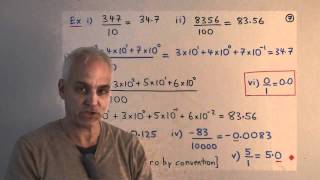
Visualizing Decimal Numbers and Their Arithmetic - MathFoundations 67
Explore decimal numbers as special rational numbers, their visualization on a number line, and arithmetic operations. Learn precise definitions and unique properties of decimals in mathematics.
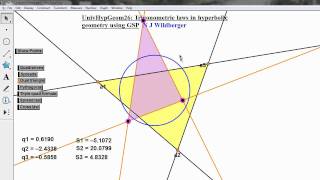
Trigonometric Laws in Hyperbolic Geometry Using Geometer's Sketchpad - Universal Hyperbolic Geometry 26
Explore trigonometric laws in hyperbolic geometry using Geometer's Sketchpad. Learn about Pythagoras' theorem, Triple quad formula, Spread law, and Cross law with practical examples and custom tools.
Pure and Applied Geometry - Understanding the Continuum - Universal Hyperbolic Geometry 20
Explores the distinction between pure and applied geometry, challenging traditional views on real numbers and the continuum. Offers a rational number-based approach to understanding geometric concepts and continuums.
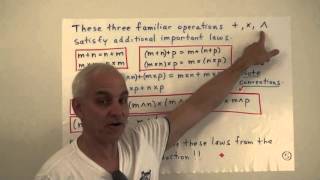
Complexity and Hyperoperations in Arithmetic - Data Structures Math Foundations 174
Explore complexity in arithmetic, from basic operations to advanced hyperoperations. Learn about number representation, operation hierarchies, and the intricacies of mathematical complexity.
A Disruptive View of Big Number Arithmetic - Math Foundations 173
Explore the challenges of big number arithmetic, its impact on mathematical understanding, and the limitations of traditional approaches to infinity and proof techniques.
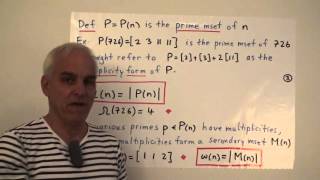
Unique Factorization, Primes and Multisets in Number Theory - Math Foundations 160
Explore elementary number theory through multisets, examining unique factorization, primes, and integral msets. Learn how prime msets connect to fractions and other number theory concepts.