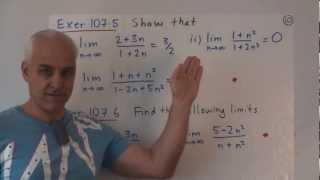
Inequalities and Limits in Real Numbers - Math Foundations 107
Simplified epsilon-delta limit definition for rational polynumbers, with visual interpretation and practical examples. Comprehensive review of inequalities for natural numbers, integers, and rational numbers.
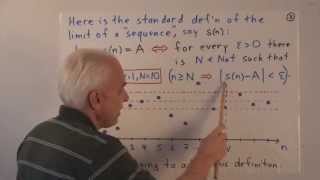
Understanding Limits in Real Numbers - Math Foundations
Simplified definition of limits for rational polynumber sequences, challenging traditional epsilon-delta approach. Introduces scale and start numbers for bounding differences, offering a more intuitive understanding of limits.
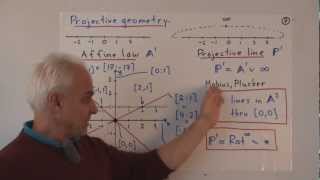
Extended Rational Numbers in Practice - Real Numbers and Limits
Explore extended rational numbers, their applications in mathematics, and connections to projective geometry. Gain insights into graphing polynomials, parametrizing circles, and visualizing infinity in novel ways.
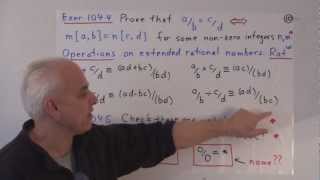
Rational Number Arithmetic with Infinity - Extended Rational Numbers and Limits
Explore arithmetic operations on integral points, extended rational numbers, and the intriguing concept of 0/0. Gain insights into projective geometry and homogeneous coordinates in this mathematical journey.
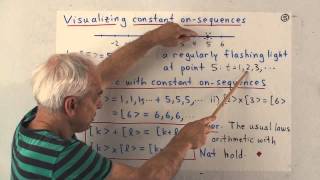
Building On-Sequences: From Constant to Polynumber - Math Foundations 100
Explores the concept of on-sequences, starting with constant and polynumber types. Covers arithmetic operations, visualization techniques, and connections to the Online Encyclopedia of Integer Sequences.
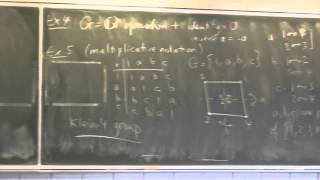
Introduction to Group Theory
Brief overview of group theory focusing on commutative groups, covering key concepts, examples, and the Fundamental Theorem of Finite Commutative Groups.
The Multiplication Table - Elementary Mathematics Explained - Lecture 14
Comprehensive guide to the multiplication table for beginners, covering properties, memorization techniques, and practical applications through practice and word problems.
Infinite Sequences - Understanding Finite and Ongoing Sequences in Mathematics - Math Foundations 99
Explore the concept of infinite sequences, focusing on natural numbers, primes, and Catalan numbers. Examine the distinctions between finite and ongoing sequences, and delve into various definitions and formulas.
What Is a Sequence? - Real Numbers and Limits in Mathematics
Explore the mathematical concept of sequences, from basic definitions to complex examples. Learn about natural numbers, primes, and rational numbers in sequence form, with insights on specification and description.
The Magic and Mystery of Pi - Real Numbers and Limits
Explore the history, formulas, and philosophical implications of pi, from ancient calculations to modern computations, challenging traditional views on its nature and role in mathematics.
Coloured Spreads and Generalizations in Rational Trigonometry - Lecture 1
Explore colored spreads theorem, planar dot products, and geometric interpretations of quadrances in blue, red, and green geometries. Gain insights into rational trigonometry and linear algebra concepts.
Integral Row Reduction and Hermite Normal Form - Math Foundations 223
Explores integral row reduction algorithm for finding a basis of integral linear space, paralleling Euclid's algorithm. Introduces Hermite normal form for msets of vexels in abstract algebra context.
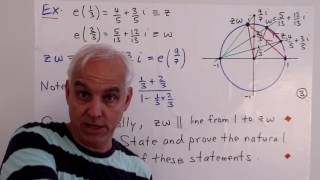
Rethinking Roots of Unity in Complex Algebra - Math Foundations 218
Explores complex roots of unity, challenging traditional views and highlighting logical difficulties in their definition and existence, emphasizing rational parametrization and algebraic approaches over infinite processes.
Fundamental Theorem of Algebra Reexamined - Math Foundations 217
Reexamines the Fundamental Theorem of Algebra, proposing new formulations based on rational complex arithmetic and quadrance, avoiding assumptions about continuity and real/complex numbers.
The Fundamental Dream of Algebra - Math Foundations 216
Challenging the Fundamental Theorem of Algebra, this video explores its flaws and proposes new thinking in mathematics, connecting to broader issues in the field.
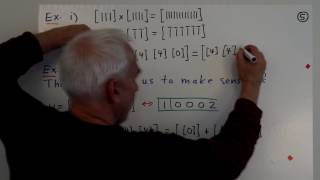
Numbers as Multipliers and Particle-Antiparticle Duality - Data Structures Math Foundations 210
Explores numbers as multipliers for sets and introduces particle/antiparticle duality, extending multiplication from natural numbers to integers in mathematical set theory.
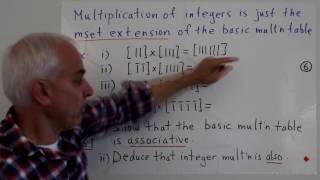
A New Trichotomy for Integer Arithmetic - Math Foundations 206
Novel approach to integer arithmetic using marks, anti-marks, and nothing. Explores symmetry between natural and negative numbers, foundational arithmetic of integers, and the role of multisets in organizing mathematical objects.
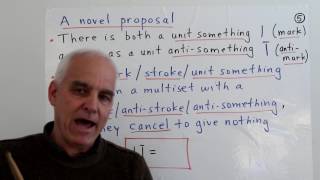
Negative Numbers, Multisets, and Modern Physics in Mathematics - Math Foundations 205
Exploring a new approach to arithmetic with integers using multisets and insights from modern physics, revolutionizing our understanding of negative numbers and mathematical foundations.
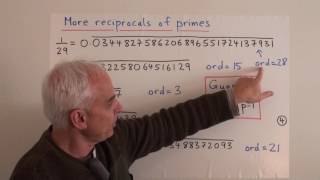
Reciprocals, Powers of 10, and Euler's Totient Function - Math Foundations 202
Explore decimal expansions of fractions, their connection to modular arithmetic, and Euler's totient function. Gain insights into repeated decimal cycles and their relationship with powers of 10 mod n.
Mission Impossible: Factorizing Large Numbers - Math Foundations 200
Explores the challenge of factoring a large number, questioning the Fundamental Theorem of Arithmetic and discussing complexity issues in mathematics. Examines the tension between idealism and constructivism in pure math.
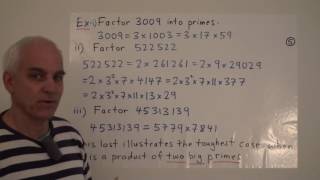
Unique Factorization and Its Difficulties - Data Structures Math Foundations 199
Exploring unique factorization, its challenges with large numbers, and modern factoring techniques. Discusses implications for internet security and computational complexity.