Automated Reconstruction of Synaptic-Resolution Neural Wiring Diagrams
Explore automated reconstruction of neural wiring diagrams using advanced techniques like generative adversarial networks and crowdsourcing, with applications in connectomics and targeted brain data discovery.
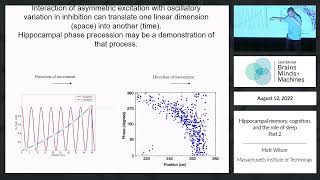
Hippocampal Memory, Cognition, and the Role of Sleep - Part 2
Explore hippocampal memory, cognition, and sleep's role through phase processing, decoding, spatial navigation, and neural mechanisms in this comprehensive lecture.
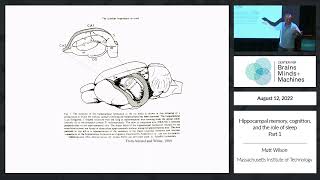
Hippocampal Memory, Cognition, and the Role of Sleep - Part 1
Explore hippocampal structure, memory coding, and electrophysiology techniques. Delve into working hypotheses and data interpretation in neuroscience research.
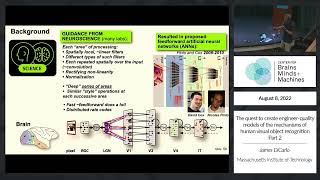
The Quest to Create Engineer-Quality Models of the Mechanisms of Human Visual Object Recognition - Part 2
Explore advanced neural models and mechanisms of human visual object recognition, including linear decoders, adversarial attacks, and individual variability in visual processing.
Faces
Explore primate face recognition, from neural substrates to computational principles, examining face cells, processing systems, and recognition architectures in this comprehensive overview.
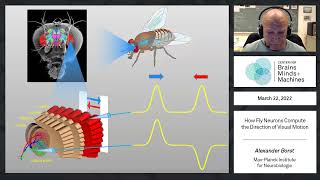
How Fly Neurons Compute the Direction of Visual Motion
Explore how fly neurons process visual motion direction, focusing on cellular mechanisms, biophysical models, and recent discoveries in Drosophila's neural circuits for motion detection.
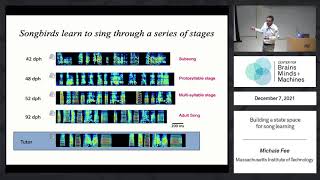
Building a State Space for Song Learning
Explore how songbirds develop neural sequences for vocalizations, examining the role of auditory memory in shaping motor circuits and facilitating song learning through reinforcement mechanisms.
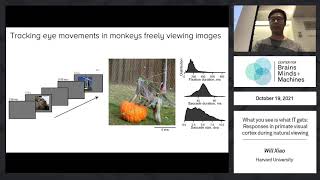
What You See Is What IT Gets - Responses in Primate Visual Cortex During Natural Viewing
Explores primate visual cortex responses during natural viewing, revealing how neurons in the interior temporal cortex react to faces and repeated fixations, providing insights into our stable visual perception.
Parallel Systems for Social and Spatial Reasoning Within the Brain's Apex Network
Explore parallel systems for social and spatial reasoning in the brain's apex network, examining cognitive architecture, neural mechanisms, and evolutionary origins through fMRI experiments and theoretical frameworks.
Recurrent Neural Networks for Cognitive Neuroscience
Hands-on tutorial exploring RNNs in cognitive neuroscience through coding exercises. Learn to train and analyze RNNs for various tasks, with lecture and workshop components using Google Colab Notebooks.
Faces and Social Interactions
Explore primate social intelligence, face perception, and neural mechanisms behind facial recognition and social interactions.
What Are the Computations Underlying Primate vs. Machine Vision?
Explore primate and machine vision computations, comparing face recognition, image processing, and neural networks. Gain insights into computational neuroscience and visual perception illusions.
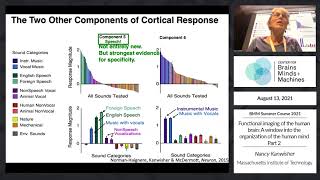
Functional Imaging of the Human Brain- A Window into the Organization of the Human Mind
Explore brain imaging techniques, functional specialization, and neural networks in understanding human cognition. Insights on face recognition, predictive models, and the organization of mental processes.
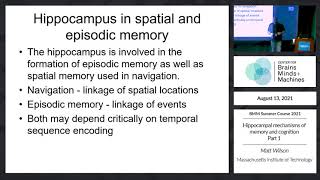
Hippocampal Mechanisms of Memory and Cognition - Part 1
Explore hippocampal mechanisms underlying memory and cognition, including structure, storage, retrieval, brain oscillations, and spatial firing patterns.
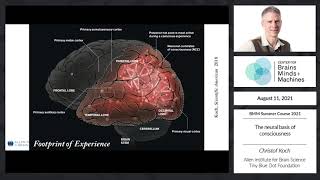
The Neural Basis of Consciousness
Explore the neural foundations of consciousness, examining brain structures and theories with neuroscientist Christof Koch in this thought-provoking lecture.
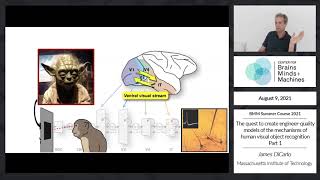
The Quest to Create Engineer-Quality Models of the Mechanisms of Human Visual Object Recognition - Pt1
Explore the mechanisms of human visual object recognition, focusing on systems-level models, reverse engineering, and the ventral visual stream's role in perception and AI applications.
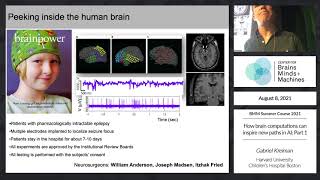
How Brain Computations Can Inspire New Paths in AI - Part 1
Explore how brain computations inspire AI advancements, covering visual illusions, neural connectivity, and deep learning networks to uncover new paths in artificial intelligence research.
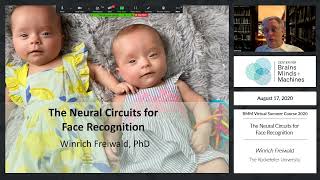
The Neural Circuits for Face Recognition
Explore neural circuits for face recognition, including a newly discovered temporal pole region. Learn about face processing systems, computational principles, and their implications for visual intelligence.
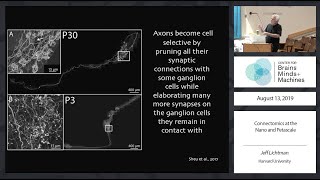
Connectomics at the Nano and Petascale
Explore the intricate world of neural connections from nano to petascale, delving into motor memory, brain structure, and cutting-edge neuroscience research techniques.
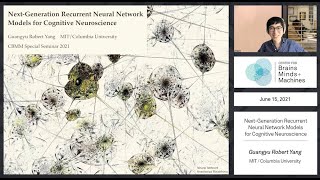
Next-Generation Recurrent Network Models for Cognitive Neuroscience
Explore next-gen recurrent neural networks for cognitive neuroscience, addressing challenges and combining biological knowledge with computational goals for improved brain and mind understanding.
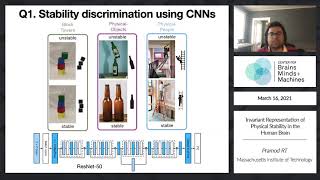
Invariant Representation of Physical Stability in the Human Brain
Explore how the human brain represents physical stability, from infant intuition to neural computations, and its applications in robotics and computer vision.