
Differences Between Neural Networks and the Brain
Explore the similarities and differences between neural networks and the brain in this panel debate featuring leading experts in neuroscience and artificial intelligence.

Explore MIT Today - Reverse Engineering the Mind - Brain and Cognitive Sciences
Panel discussion exploring brain science, AI, and human intelligence, covering neural processing, learning, robotics, brain-computer interfaces, and ethical considerations in cognitive research.
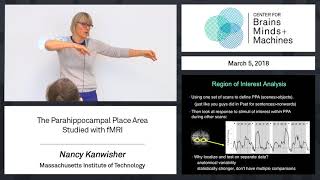
The Parahippocampal Place Area Studied with fMRI
Explores the parahippocampal place area's role in scene recognition using fMRI, discussing methodological considerations and replication in cognitive neuroscience research.
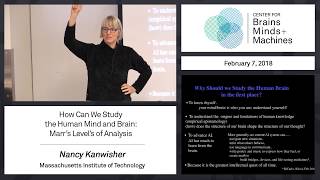
How Can We Study the Human Mind and Brain? - Marr's Levels of Analysis
Explore Marr's levels of analysis for studying the human mind and brain, focusing on computational theory and its application to color vision and other cognitive processes.

How the Brain Pays Attention
Explore selective attention, executive control, and visual recognition in this comprehensive examination of cognitive processes and their impact on human behavior.
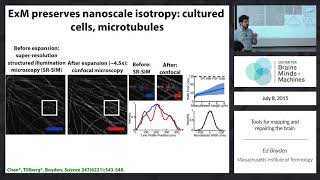
Tools for Mapping and Repairing the Brain - Part 1
Explore cutting-edge tools for brain mapping and repair, focusing on expansion microscopy. Learn how this innovative technique enhances our understanding of neural circuitry and advances neuroscience research.
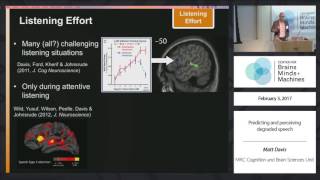
Predicting and Perceiving Degraded Speech
Explore speech perception challenges, cochlear implants, and predictive coding in this talk on improving speech understanding and perceptual learning for degraded speech signals.
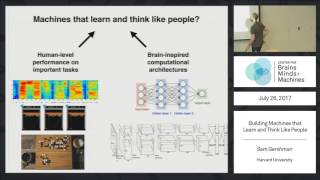
Building Machines that Learn and Think Like People
Explore computational neuroscience and AI inspired by human cognition, covering intuitive theories, compositionality, and learning to learn for more human-like artificial intelligence.
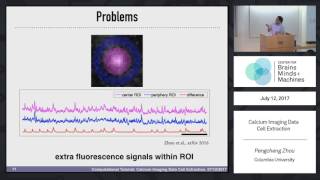
Calcium Imaging Data Cell Extraction
Learn advanced techniques for extracting neuronal signals from calcium imaging data using CNMF-E, a matrix factorization approach. Improve signal quality and detection in microendoscopic recordings of deep brain activity.
Spike Timing in Motor Control
Explore spike timing in neural motor codes, focusing on vocalization and breathing in songbirds. Learn about information encoding in neurons and its impact on animal behavior.
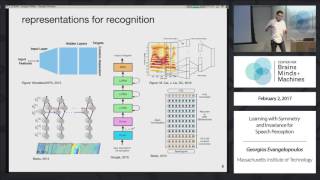
Learning with Symmetry and Invariance for Speech Perception
Explore symmetry and invariance in speech perception, focusing on acoustic variability, feedforward models, and invariant representations. Learn about word orbits, phone representations, and acoustic modeling techniques.
Multidisciplinarity in Systems Neuroscience
Explore interdisciplinary approaches in systems neuroscience, focusing on hippocampus function in memory and navigation, and the thalamus's role in information transfer to the neocortex.
Big Science, Team Science & Open Science to Understand Neocortex
Explore the human brain's complexity through big science, team science, and open science approaches, focusing on neocortex understanding and innovative research methods.
Introduction to Neuroscience
Explore neuroscience fundamentals: neurons, action potentials, synapses, cortical structures, and visual processing. Gain insights into brain function and sensory perception.

Large-Scale Organization of Object Knowledge
Explore the organization of object knowledge in the brain, focusing on visual cortex structure and how we categorize everyday items like groceries.
Topological Treatment of Neural Activity and the Quantum Question Order Effect
Explore topological features in neural activity and the quantum question order effect, examining their implications for understanding complex systems and information processing.

Nancy Kanwisher: History of Neuroimaging Research on Face Recognition
Explore the evolution of neuroimaging research on face recognition, from early studies to modern fMRI techniques, and discover key findings in this fascinating field of cognitive neuroscience.
Learning in Recurrent Neural Networks
Explore recurrent neural networks, covering continuous and spiking models, effective connectivity, and philosophical implications in computational neuroscience.
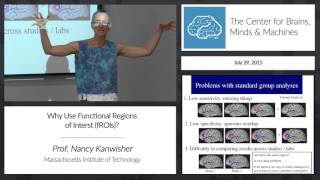
Why Use Functional Regions of Interest - fROIs
Explore the advantages and applications of functional Regions of Interest (fROIs) in neuroimaging research, enhancing statistical power and biological interpretability.
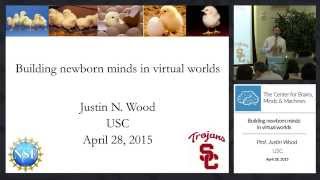
Building Newborn Minds in Virtual Worlds
Explore the development of high-level vision in newborns through innovative controlled-rearing experiments, revealing insights into invariant object recognition and computational models of visual cortex.
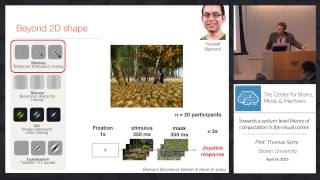
Towards a System-Level Theory of Computation in the Visual Cortex
Explore computational models of visual processing in primate cortex, combining neuroscience and AI to understand perception and develop advanced computer vision systems.