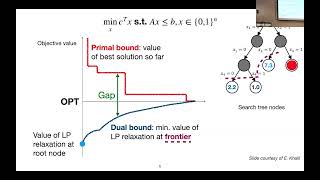
Mixed-Integer Programming: 65 Years of History and the Artificial Intelligence Challenge - DS4DM Coffee Talk
Explore the evolution of Mixed-Integer Programming, from its 1958 roots to modern AI integration, and its impact on solving diverse optimization problems.

Maximization of Neumann Eigenvalues under Diameter Constraint
Explore Neumann eigenvalue maximization under diameter constraints, delving into advanced spectral geometry concepts and mathematical analysis techniques.
On the Subrank of Generic Tensors
Explorez les limites supérieures et inférieures du sous-rang des applications bilinéaires et tenseurs d'ordre supérieur génériques. Découvrez les mesures des multiplications indépendantes réductibles.
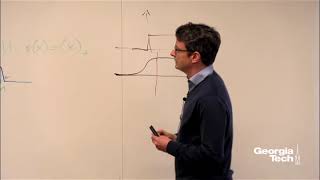
Mathematics for Deep Neural Networks: Advantages of Additional Layers - Lecture 3
Explore the mathematical advantages of deep neural networks over shallow networks, focusing on localization, approximation capabilities, and the Kolmogorov-Arnold theorem.
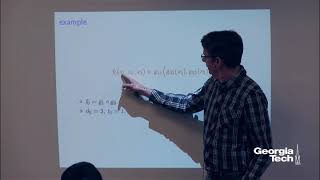
Mathematics for Deep Neural Networks: Energy Landscape and Open Problems - Lecture 5
Explore the energy landscape of deep neural networks and future challenges in statistical theory, focusing on gradient descent methods and important developments.
Sharp Oracle Inequalities for Non-Convex Loss - Lecture 1
Explore sharp oracle inequalities for non-convex loss in M-estimation, focusing on regularization techniques and sparsity-inducing penalties like the l₁-penalty in Lasso.

Mathematics and Machines: Navigating New Frontiers
Explore the intersection of mathematics and machine learning, examining how computers transform mathematical research and their potential future impact on the field.

Minimal Surfaces and the Isoperimetric Inequality
Explore the generalization of the isoperimetric inequality to submanifolds in Euclidean space, focusing on minimal submanifolds and their sharp isoperimetric properties.

Integrating Mechanistic Models with Computational Statistics and Machine Learning - New Insights in Biology
Explore integrating mechanistic models with computational statistics and machine learning for new insights in cell and developmental biology. Tackle challenges in analyzing complex quantitative data.

Skew-Symmetric Approximations of Posterior Distributions - Colloque des Sciences Mathématiques du Québec
Explore unified skew-normal distributions as conjugate priors for discretized Gaussian linear regressions, enhancing Bayesian inference and computation in regression models across various fields.
An Exploration-Agnostic Characterization of the Ergodicity of Parallel Tempering
Explore non-reversible parallel tempering's ergodicity in complex distributions, examining its efficiency and comparing it to classical methods through theoretical analysis and simulations.
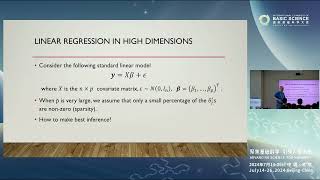
Variational Approximations for Bayesian and Semi-Bayesian Inferences
Explore variational approximations in Bayesian inference, focusing on group-variable selection and heteroscedastic Gaussian processes. Learn efficient parameter estimation and process forecasting techniques.
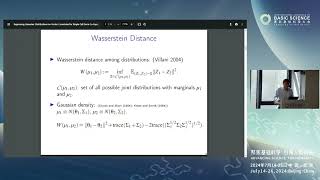
Regressing Multivariate Gaussian Distribution on Vector Covariates for Co-expression Network Analysis
Explore Fréchet regression for analyzing gene co-expression networks using population-level single-cell data. Learn to test associations between covariance matrices and covariates.
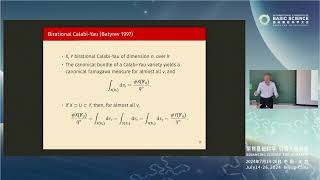
Rationality Problems in Algebraic Geometry - ICBS 2024
Explore geometric ideas and constructions in the study of rationality of higher-dimensional algebraic varieties, focusing on recent developments and challenges.

Hypergraph Decompositions and Their Applications
Explore hypergraph decompositions and their applications in combinatorics with Oxford Professor Peter Keevash, known for solving the Existence Conjecture for Combinatorial Designs.

Chinese Restaurant Process and Statistical Inference
Explore Chinese Restaurant process and statistical inference with Prof. Kiranmoy Das, covering Bayesian modeling and longitudinal data analysis applications.

Causal Effects via Regression with Python Code - Part 5
Explore regression-based techniques for computing causal effects, including linear regression, double machine learning, and metalearners. Gain practical insights with Python code examples.
Rectifiable-Reifenberg and the Regularity of Stationary and Minimizing Harmonic Maps
Explore sharp rectifiability results for singular sets of minimizing harmonic maps, with uniform Minkowski bounds and integrability. Analyze quantitative stratification and dimension-reduction techniques.
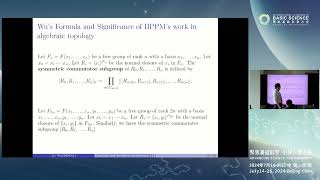
Topology and Artificial Intelligence - Applications and Recent Progress
Explore recent advancements in algebraic topology and AI, including language models for homotopy groups and statistical modeling for complex networks and diseases.
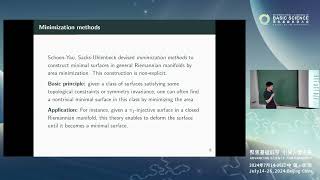
Generic and Random Behavior of Minimal Surfaces
Explore minimal surfaces in Differential Geometry, focusing on recent quantitative findings under genericity and randomness conditions. Discover spatial equidistribution and hyperbolic properties.
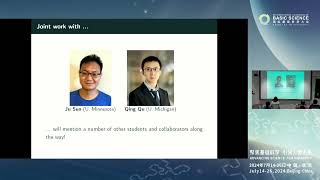
Geometric Analysis of Phase Retrieval
Explore geometric analysis of phase retrieval, examining nonconvex heuristics and proving benign geometric structure for efficient signal recovery using iterative optimization methods.