
Monte Carlo Methods
Explore Monte Carlo methods for probabilistic AI, covering key concepts and applications in this comprehensive tutorial from ProbAI 2024.
SDEs Are All You Need for Latent Variable Models
Explore stochastic differential equations for latent variable models, focusing on applications in probabilistic AI and machine learning.
Bayesian Workflow
Learn Bayesian workflow techniques for probabilistic modeling, from problem formulation to model evaluation and iteration, enhancing your data analysis skills.

A Taste of Conformal Prediction - Principles and Recent Advances
Explore conformal inference methods for exact prediction intervals, covering basic principles and recent advancements in quantitative and categorical label applications.

Sampling through Exploration Exploitation in Markov Chain Monte Carlo
Explore an innovative Markov chain Monte Carlo algorithm combining global proposals and mobile moves for efficient, parallelizable sampling in various applications.

The Bridge from Mathematical to Digital and Back
Explore the evolving landscape of computational analysis, signal processing, and machine learning. Gain insights on bridging the gap between mathematical and digital communities.
When Your Big Data Seems Too Small: Accurate Inferences Beyond the Empirical Distribution - Part 2
Explore advanced techniques for accurate distribution inferences with limited data. Learn to de-noise empirical distributions, estimate population spectra, and recover low-rank matrix approximations.
Infer Global, Predict Local - Bias-Variance Theory for Protein Genotype-to-Phenotype Mapping
Explore bias-variance theory in protein genotype-to-phenotype mapping, focusing on global inference and local prediction techniques.

Regularising Manifolds Using Ricci Flow
Explore Ricci flow's applications in deforming and regularizing manifolds, including its use in identifying topology and proving geometric theorems.

Transitioning into AI Roles - Roadmap, Resources, and Mistakes to Avoid
Practical guide for transitioning into AI roles, covering learning roadmap, essential skills, and common pitfalls. Offers insights on getting started and overcoming challenges in the field.

On the Applications of Topology
Explore topological methods for analyzing complex data sets, focusing on persistent homology and mapper, with applications in computer vision, biology, and medicine.

ME3255 - Quantitative Descriptions on Monte Carlo Models
Explore Monte Carlo models through quantitative descriptions, enhancing understanding of statistical simulation techniques and their applications in engineering and science.

ME3255 - Building Moore's Prediction and Using Monte Carlo Buckling Analysis
Explore Moore's prediction and Monte Carlo buckling analysis techniques for advanced engineering applications. Enhance structural design skills.

Unsupervised Alignment of Graphs and Embeddings: Fundamental Limits and Computational Methods
Explore unsupervised alignment techniques for graphs and embeddings, examining fundamental limits and computational approaches for data analysis and machine learning applications.

Global Solutions to Quadratic Systems of Stochastic Reaction-Diffusion
Explorez les solutions globales des systèmes quadratiques de réaction-diffusion stochastique en dimension deux, avec un accent sur les perturbations à quatre espèces.

Zeros of Random Power Series with Stationary Gaussian Coefficients
Explore zeros of random power series with stationary Gaussian coefficients, comparing to i.i.d. case and analyzing expected zero count in disks as radius approaches convergence.

Mathematics as a Translation Task - The Importance of Training Distributions
Explore how mathematical problems can be framed as translation tasks, focusing on the impact of training distributions on model performance and transformer model mechanics.

How Machine Learning Can Help Mathematicians
Explore AI's potential in mathematics: from language models guiding problem-solving to automated theorem proving, with real-world examples and future perspectives.
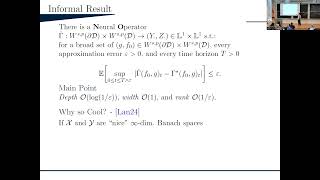
Exponential Expression Rates for Neural Operator Approximation to Solution Operators of FBSDEs
Explore exponential expression rates in neural operator approximations for FBSDE solution operators, advancing mathematical finance understanding.

How to Read Math in Deep Learning Papers - A 5-Step Process
Learn a 5-step method to decipher mathematical formulas in deep learning papers, enhancing your understanding and intuition of complex AI concepts.
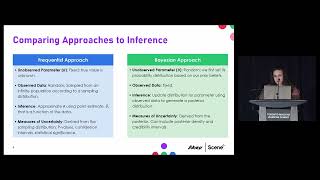
Building a Measurement System for Personalization - A Bayesian Approach
Explore Bayesian approaches for measuring personalization effectiveness, optimizing customer assignments, and designing MLOps-inspired measurement platforms for complex hierarchical experiments.