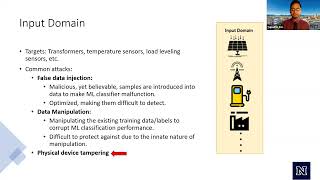
Vulnerability of Machine Learning Algorithms to Adversarial Attacks for Cyber-Physical Power Systems
Explore vulnerabilities in machine learning algorithms for cyber-physical power systems and learn about potential adversarial attacks and their implications.

Machine Learning Papers in Virtual Reality - IEEE VR 2022
Cutting-edge machine learning research in VR, covering topics like stereoscopic photography, adversarial attacks, 360° depth estimation, scanpath generation, autism screening, and projector deblurring.
MLSecOps - Automated Online and Offline ML Model Evaluations on Kubernetes
Explore MLSecOps on Kubernetes: Automate real-time and offline ML model evaluations using KServe, Knative, Apache Kafka, and Trusted-AI tools for enhanced security and monitoring in production environments.

Provably Secure Machine Learning Algorithms - Designing Reliable AI Systems
Exploring vulnerabilities in machine learning systems and developing provably secure algorithms to defend against statistical attacks in high-dimensional settings and non-convex models.

Securing ML Workloads with Kubeflow and MLOps - Pwned By Statistics
Learn to secure machine learning workloads using Kubeflow and MLOps. Explore techniques like model extraction, hidden data attacks, and leakage detection to protect your ML pipelines and models.
Shadow Vulnerabilities in AI/ML Data Stacks - What You Don't Know Can Hurt You
Explore hidden security risks in AI/ML data stacks, focusing on open-source vulnerabilities, RCE issues, and security anti-patterns. Learn about new checkpoint formats and runtime-based detection methods using eBPF.
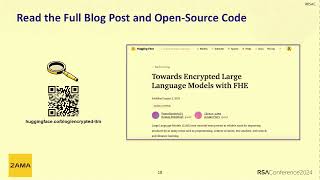
IP Protection and Privacy in LLMs - Leveraging Fully Homomorphic Encryption
Explore how Fully Homomorphic Encryption addresses IP protection and privacy concerns in Large Language Models, with a live demonstration of this innovative hybrid approach.

Machine Learning Gradients in Molecular Simulations
Explore ML gradients in molecular simulations, including surrogate functions, active learning, and differentiable programming for enhanced scientific modeling and optimization.

Security Considerations for Services Using AI Models
Explore security risks in AI-powered services: AI SBOMs, supply chain attacks, input manipulation, and data poisoning. Learn crucial safeguards for robust AI implementation.
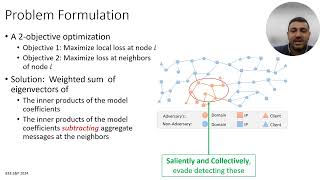
Multi-Instance Adversarial Attack on GNN-Based Malicious Domain Detection
Explore multi-instance adversarial attacks on Graph Neural Networks for detecting malicious domains, enhancing cybersecurity defenses against sophisticated threats.
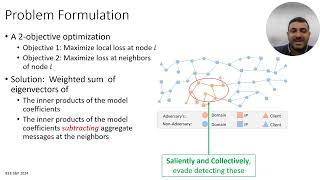
Multi-Instance Adversarial Attack on GNN-Based Malicious Domain Detection
Explore multi-instance adversarial attacks on Graph Neural Networks for detecting malicious domains, enhancing cybersecurity defenses against sophisticated threats.
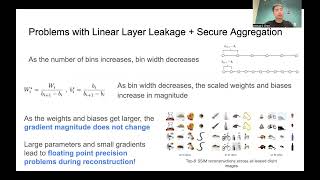
LOKI: Large-Scale Data Reconstruction Attack Against Federated Learning Through Model Manipulation - 2024
Explore a large-scale data reconstruction attack against federated learning, focusing on model manipulation techniques and their implications for privacy and security.
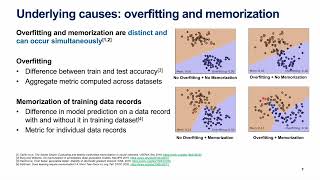
Unintended Interactions Among ML Defenses and Risks - 2024
Explore unintended interactions between machine learning defenses and risks, uncovering potential vulnerabilities and implications for AI security and robustness.
Secure AI: Integrating OWASP Principles in Machine Learning Model Development
Explore integrating OWASP principles into machine learning model development to address vulnerabilities, ensure data privacy, and safeguard AI systems from potential threats, ensuring robustness and confidentiality.

AI CTF Solutions - DEFCon31 Hackathon and Kaggle Competition
Comprehensive walkthrough of AI hacking techniques used in DEFCon31 CTF competition, covering various attacks on machine learning models, including adversarial examples, prompt injection, and model inversion.

One Pixel Adversarial Attacks via Sketched Programs
Explore a novel approach for one-pixel adversarial attacks using program synthesis, achieving state-of-the-art success rates with fewer queries and transferable programs for neural network classifiers.
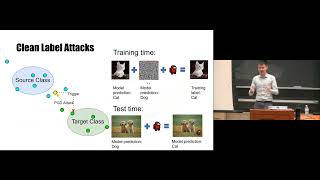
Clean Label Poisoning Attacks: From Classification to Speech Recognition
Explore poisoning attacks in speech recognition, from adversarial manipulations to innovative defenses. Uncover strategies, mechanisms, and future research in AI security.
From Text to Flaws: Vulnerabilities in Applications with Generative AI and LLMs
Explore vulnerabilities in generative AI applications, understand LLM functionality, and learn practical countermeasures to protect your AI-powered software from potential attacks.
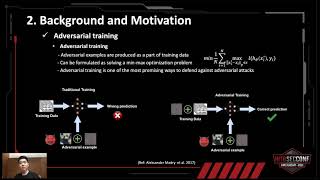
Model Robustness Will Hurt Data Privacy?
Exploring the trade-off between AI model robustness and data privacy, revealing how adversarial training may increase vulnerability to privacy attacks and data reconstruction from gradient information.
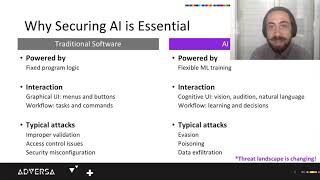
Practical AI Red Teaming - A Facial Recognition Case Study
Practical insights into AI red teaming for facial recognition systems, exploring vulnerabilities, attack methods, and defense strategies in real-world environments.
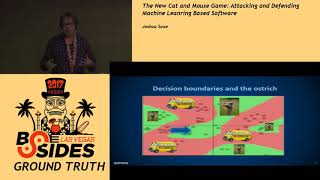
The New Cat and Mouse Game - Attacking and Defending Machine Learning Based Software
Explore techniques for attacking and defending machine learning-based software, including practical demonstrations and insights from academic literature.