
Deep Learning - Adversarial Attacks and GANs - Lecture 4
Explore adversarial attacks and Generative Adversarial Networks (GANs) in deep learning. Learn from Stanford experts about these advanced techniques and their applications in AI.
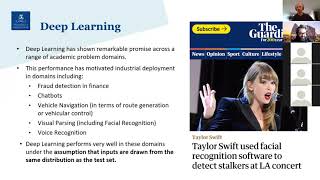
Getting Robust - Securing Neural Networks Against Adversarial Attacks
Explore adversarial attacks on machine learning, their impact, and defense strategies. Learn to incorporate adversarial considerations in research and development for more robust AI systems.

IC Layout Security - Hardening Integrated Circuit Designs Against Adversaries
Explore IC layout security: proactive design hardening against adversarial activities in complex supply chains. Learn challenges, strategies, and implications for modern electronics.

Trust Region Based Adversarial Attack on Neural Networks
Explore trust region optimization for adversarial attacks on neural networks, covering various attack methods and their applications in computer vision and object detection.
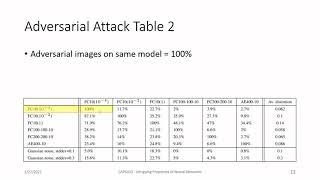
Intriguing Properties of Neural Networks - Spring 2021
Explore intriguing properties of neural networks, including adversarial attacks, transfer, training overlap, and semantic information in units. Analyze weaknesses and spectral instability.

Introduction to Adversarial Attacks in Machine Learning - Lecture 1
Introduction to adversarial attacks on AI systems, covering real-world examples, attack methods, and defense strategies for various applications like face recognition and object detection.

Motion-Excited Sampler: Video Adversarial Attack with Sparked Prior - Spring 2021
Explore video adversarial attacks using the Motion-Excited Sampler technique, covering problem formulation, methodology, gradient estimation, and results analysis.
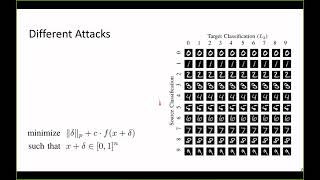
Evaluating Neural Network Robustness - Targeted Attacks and Defenses
Explore neural network robustness evaluation, including targeted attacks, metrics, and defense strategies. Learn about FGS, SMA, and new approaches for assessing and improving AI system security.
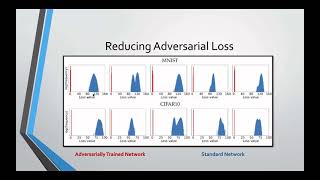
Towards Deep Learning Models Resistant to Adversarial Attacks - CAP6412 Spring 2021
Explore strategies for developing robust deep learning models that can withstand adversarial attacks, focusing on minmax functions, saddle points, and experimental results.

Security Audits for Machine Learning Attacks
Explore common machine learning security attacks and learn effective remediation strategies to protect your models from harmful outcomes and data exposure. Enhance your organization's security practices.
Multi-granular Adversarial Attacks Against Black-box Neural Ranking Models - Lecture 1
Explore multi-granular adversarial attacks on black-box neural ranking models in information retrieval, examining vulnerabilities and potential defense strategies.

Robust Generalization in the Era of LLMs - Jailbreaking Attacks and Defenses
Explore jailbreaking attacks on LLMs, their vulnerabilities, and defense strategies. Gain insights into robust generalization and evaluation methods for production language models.

MIT 6.S191 - Deep Learning Limitations and New Frontiers
Explore deep learning limitations, adversarial attacks, uncertainty quantification, and AutoML in this lecture. Gain insights into neural network challenges and emerging frontiers in AI research.

Deep Learning Limitations and New Frontiers
Explore deep learning limitations, new frontiers, and advancements in AI, including uncertainty estimation, adversarial attacks, and meta-learning, with insights on future developments and applications.

How Apple Scans Your Phone and How to Evade It - NeuralHash CSAM Detection Algorithm Explained
Detailed exploration of Apple's CSAM detection system, analyzing its technical aspects, privacy measures, and potential weaknesses. Covers NeuralHash, private set intersection, and threshold secret sharing.
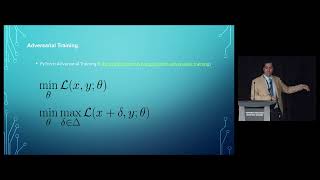
Privacy and Security of Large Language Models - Risks and Mitigation
Explore security and privacy risks of large language models, including data leaks and adversarial attacks. Learn mitigation strategies and ethical considerations for AI development.
Creating an AI Security and Incident Response Team
Learn to establish and operate an AI Security and Incident Response Team (AISIRT) to address AI/ML system issues, detect problems, and differentiate between various threats.

Invisible Infiltration of AI Supply Chains: Protective Measures from Adversarial Actors
Explore protective measures against adversarial actors infiltrating AI supply chains. Learn to secure data, models, and pipelines, implement security controls, and mitigate risks in AI systems.
Security for AI Basics - Unconventional Strategies and Humor
Explore unconventional AI security strategies through humorous scenarios, from dancing self-driving cars to gossiping chatbots, in this entertaining and informative 101 talk.

DoH Deception: Evading ML-Based Tunnel Detection with Black-Box Attack Techniques
Explore vulnerabilities in ML models for DoH tunnel detection, demonstrating successful evasion techniques and highlighting critical features to avoid in model development.
Considerations on AI Security
Explore key considerations for AI security in this TROOPERS24 conference talk, covering potential risks, vulnerabilities, and strategies for safeguarding AI systems.