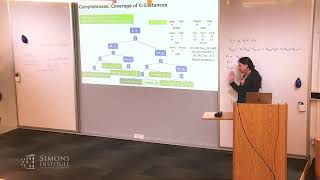
Understanding Queries by Conditional Instances
Explores methods for generating representative database instances to illustrate query satisfaction, aiding in query debugging and comprehension through abstraction and characterization.
Focusing on Refinement Typing - A Logically Principled Foundation
Explore a logically principled foundation for SMT constraint generation in refinement type systems, combining focalized call-by-push-value, bidirectional typing, and value-determined indexes.
The Complex(ity) Landscape of Checking Infinite Descent
Explore the complexity of checking Infinite Descent in cyclic proof systems, examining various criteria and their parameterized time complexities to improve automatic verification techniques.
Proof Theory Impressionism - Blurring the Curry-Howard Line
Exploring approaches to bridge the gap between proof assistants and production languages, focusing on Rust and its potential for incorporating provable system capabilities.
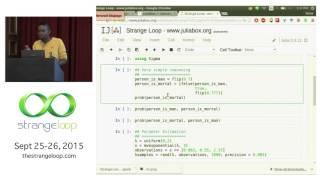
Probabilistic Programs Which Make Common Sense
Explore probabilistic programming as a step towards machines with common sense. Learn about Sigma, a language for functional probabilistic models, and its applications in automated reasoning and inference.
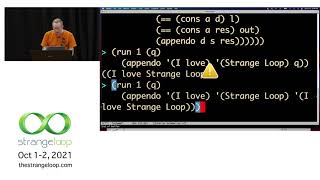
Strange Dreams of Stranger Loops
Explore self-referential and introspective concepts through running code in this talk on reflective programming, strange loops, and relational reasoning.
Breaking the Giants With Logic
Explore logic-based vulnerabilities in major platforms, focusing on duplicates and business logic flaws. Learn techniques to identify and exploit these weaknesses through real-world case studies.
Practical Non-Malleable Codes from I-More Extractable Hash Functions
Explore practical non-malleable codes using I-more extractable hash functions, covering security, error correction, and applications in cryptography and data integrity.
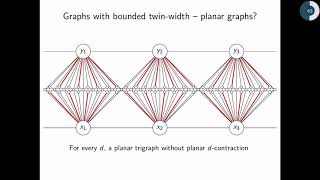
Twin-width I - Tractable FO Model Checking
Explore tractable FO model checking using twin-width, covering trigraphs, contraction sequences, and dynamic programming for efficient graph analysis.
Propositions as Types
Explore the profound connection between logic and computation, delving into the Propositions as Types principle and its impact on theorem provers, programming languages, and computing frontiers.
Creative Coding - Why "Doing Nothing" Doesn't Mean You're Not Working
Explore the creative process in programming, cognitive skills for successful coding, and why downtime is crucial for problem-solving and innovation in software development.
The Future of Education - How AI Revolutionises the Classroom
Explore a student's perspective on AI's impact on education, discussing potential changes to learning methods and the classroom experience in the digital age.
Math for Game Programmers - Solving Nintendo's CodinGame Challenge
Explore Mike Acton's problem-solving approach for a challenging Nintendo-sponsored CodinGame puzzle, focusing on mathematical techniques and testing strategies for game programmers.
A Logic and an Interactive Prover for the Computational Post-Quantum Security of Protocols
Explore a logic and interactive prover for computational post-quantum security in protocols, enhancing understanding of cryptographic security in the quantum era.
Weeks of Debugging Can Save You Hours of TLA+
Explore TLA+ for reliable system design through a hands-on approach, solving a subtle concurrency issue to demonstrate its power in preventing critical failures and reducing debugging time.
How We Learned Security from Steve
Learn Minecraft security concepts from experts, covering survival, expansions, trust, and building with logic in multiplayer environments.
The Fitness-Beats-Truth Theorem - Some Philosophical Reflections
Philosophical exploration of the Fitness-beats-truth theorem, examining veridicality, mathematical representation, and potential self-refutation in the context of perceptual and cognitive models.
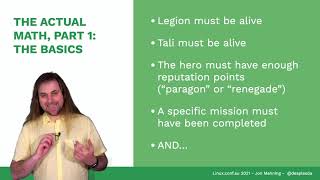
Let's Use an Automated Theorem Prover to Verify Video Games - I Swear This Is More Fun Than It Sounds
Explore using Z3 theorem prover to detect and fix bugs in video game systems. Learn to apply formal logic for diagnosing problems and discovering impossibilities in complex game mechanics.
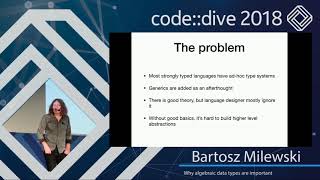
Why Algebraic Data Types Are Important
Explore type theory, category theory, and logic in functional programming, focusing on algebraic data types and their role in enhancing code reliability and expressiveness.
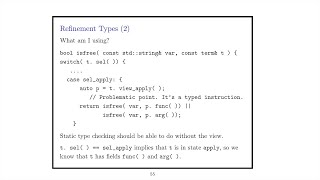
Trees for Logic and Parsing in C++
Explore efficient implementation of recursive tree-types in C++ for logic and parsing, with insights on construction, inspection, and replacement of subtrees.
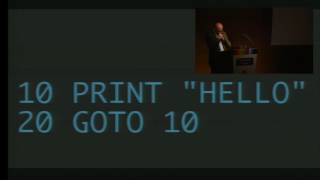
Minds, Machines and Python
Explore AI through logic and language using simple Python programs, focusing on loops, self-reference, and tangled hierarchies as key concepts in understanding intelligence and learning.