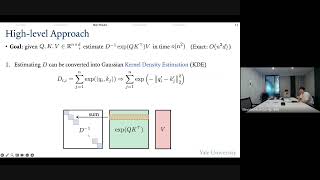
Accelerating Transformers via Kernel Density Estimation - Google TechTalk
Explore efficient Transformer acceleration using kernel density estimation. Learn innovative techniques for handling long sequences and improving performance in deep learning models.
DGEMM on Integer Tensor Cores - NHR Perflab Seminar
Explore double-precision matrix multiplication using Int8 Tensor Cores and the Ozaki scheme, focusing on high-precision computation with lower-precision hardware for machine learning applications.
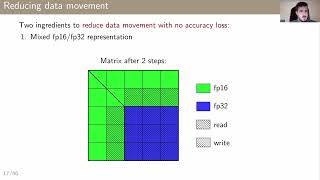
Mixed-Precision Computing: An Overview
Explore mixed-precision computing techniques for high performance and accuracy. Learn about refinement, modularity, and adaptivity in algorithms combining multiple precisions.

When Data Driven Reduced Order Modeling Meets Full Waveform Inversion - Rothschild Lecture
Explore innovative approaches to velocity estimation in wave equation inverse problems, focusing on data-driven reduced order modeling and its application to full waveform inversion.
Is C++23 std::mdspan a Zero-overhead Abstraction? - Lecture
Explore C++23 std::mdspan's efficiency as a zero-overhead abstraction for multi-dimensional arrays through matrix and image operations, comparing assembly output to low-level implementations.
Very Few Parameter Fine-Tuning with ReFT and LoRA
Explore advanced fine-tuning techniques ReFT and LoRA for efficient parameter optimization in transformer models. Learn implementation, comparison, and practical tips for improved model performance.

Simple Factorization and Other Properties of D-Dimensional Unitaries
Explore d-dimensional unitaries, their factorization properties, and average characteristics in quantum computing. Gain insights into constructing and analyzing higher-dimensional quantum transformations.

Mehler's Formula, Branching Processes, and Compositional Kernels of Deep Neural Networks
Explore deep neural networks through compositional kernels and branching processes. Gain insights into activation functions, network limits, and memorization capacity. Learn about eigenvalues and a new random features algorithm.

The Geometry of the Deep Linear Network
Explore the geometric principles underlying deep linear networks, uncovering their mathematical foundations and implications for machine learning algorithms.
Strassen's Matrix Multiplication Algorithm - Concept and Time Complexity
Explore Strassen's Matrix Multiplication algorithm, its concept, and time complexity in the context of Divide & Conquer strategies for efficient matrix operations.

Computing Generalized Ranks of Persistence Modules via Unfolding to Zigzag Modules
Efficient algorithm for computing generalized ranks of persistence modules using unfolding to zigzag modules, with applications in algebraic topology and data analysis.

Python Apple MLX Tutorial: Introduction to Machine Learning on Apple Silicon
Learn MLX framework for Apple Silicon: GPU operations, transformers, language models, and generative AI concepts. Applicable to PyTorch and NumPy users.
Koszul Duality on Quantizations of Bionic Symplectic Varieties
Explore Koszul duality in quantizations of bionic symplectic varieties, focusing on localization theorems, DQ-modules, and geometric category O. Gain insights into recent advancements in filtered Koszul duality.
Stability of Spectra Under Riemannian Manifold Coverings
Delve into advanced mathematical concepts exploring eigenfunction stability in Riemannian coverings, focusing on the relationship between manifold spectra and their pull-back properties.
Introducing a Matrix Class to the C++ Standard Library
Explore the proposal for a standardized matrix class in C++, addressing crucial needs in games, AI, machine learning, and finance through enhanced linear algebra functionality.

Introduction to Figma - How to Use Figma 101
Learn essential Figma features for developers: tools, layers, frames, colors, typography, plugins, and more. Gain practical skills to enhance your design workflow and collaborate effectively with designers.
Introduction to Scilab for Beginners - Arrays, Conditional Statements, Loops, and Functions
Learn Scilab basics: mathematical operations, arrays, matrices, conditional statements, loops, and functions. Ideal for physics, math, and engineering students seeking numerical computation skills.

The Geometry of the Deep Linear Network - Part 2
Explore the intricate geometry of deep linear networks, delving into advanced mathematical concepts and their applications in machine learning architectures.
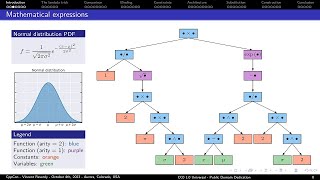
Symbolic Calculus for High-performance Computing From Scratch Using C++23
Explore symbolic calculus implementation in C++23 for high-performance computing. Learn techniques for compile-time derivatives, integrals, and optimized linear algebra computations.
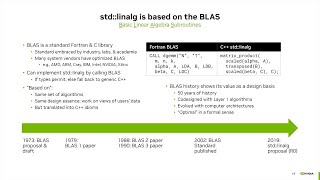
Linear Algebra Coming to Standard C++ - std::linalg
Explore std::linalg, a new C++ library for efficient linear algebra computations using modern C++ idioms. Learn its benefits, implementation, and potential impact on C++ development.
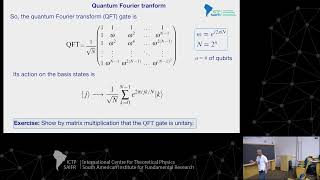
Quantum Algorithms: From Basics to Differential Equations - Lecture 3
Explore quantum algorithms, progressing from foundational concepts to advanced applications in solving differential equations.