Performance Matters: New Tricks for Old Dogs - Lecture 1
Explore performance-oriented C++ techniques, including faster erasure methods, cache-friendly linked lists, and efficient random-access containers. Suitable for both newcomers and experienced developers.
Matrix Computation in Wolfram Language
Explore advanced linear algebra capabilities in Mathematica and Wolfram Language, including recent additions and future developments.
On the Spectrum of the Poincaré Operator in Ellipsoids
Explore the Poincaré operator's spectrum in ellipsoids, examining fluid motion, wave operators, and eigenvalue asymptotics in rotating incompressible fluids.
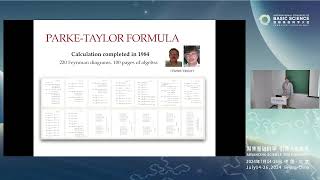
The Amplituhedron - Connecting Scattering Amplitudes and Quantum Field Theory
Explore the connection between scattering amplitudes and the Amplituhedron, a novel mathematical concept generalizing convex polytopes into Grassmannians.
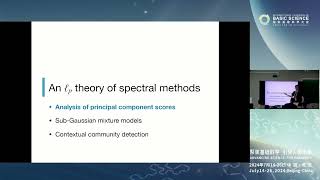
An ℓp Theory of PCA and Spectral Clustering
Explore an advanced $\ell_p$ theory of PCA, improving upon vanilla PCA for heteroscedastic noises and yielding optimal bounds for spectral clustering and community detection.
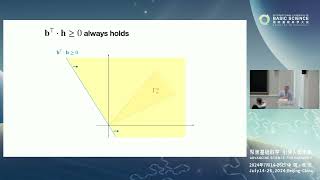
A Geometrical Interpretation of Universally Quantified Inequalities and Its Applications to Mathematics
Explore a geometrical interpretation of universally quantified inequalities and its applications across mathematics, focusing on Shannon entropy and connections to various mathematical branches.
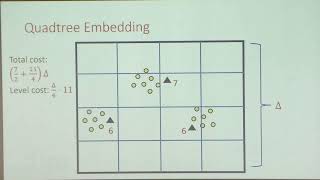
Fast Streaming Euclidean Clustering with Constant Space
Explore streaming algorithms for k-median and k-means clustering, achieving constant space complexity independent of data size and aspect ratio. Improve space and update time for approximate subspace embeddings.
A Quasi-Monte Carlo Algorithm for Smooth Kernel Evaluation
Explore a novel data structure for density queries, combining discrepancy theory and LSH to build sparse coresets and enhance smooth kernel evaluation algorithms.
Euclidean Capacitated Vehicle Routing in Random Setting - A 1.55-Approximation Algorithm
Explore a 1.55-approximation algorithm for Euclidean capacitated vehicle routing in random settings, presented by Zipei Nie.

Using Vector Databases with LLMs - Part One
Explore vector databases for LLMs, enhancing audio and visual data processing, recognition, and search capabilities.
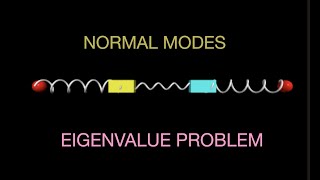
Normal Modes for Coupled Oscillators Using the Eigenvalue Problem
Discover how to find normal modes for coupled oscillators using the eigenvalue problem, with a practical Python testing program included.
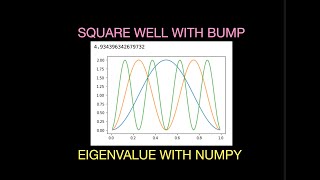
Solving the Square Well with a Bump Using Python and NumPy - Eigenvalue Problem
Solve the infinite square well with a bump potential using Python and NumPy. Learn finite difference method, matrix construction, and eigenvalue problem solving for quantum mechanics.
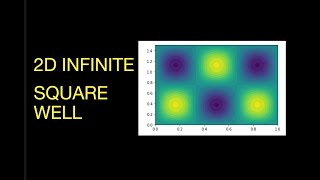
Quantum Mechanics: Particle in a 2D Box with 3D Plot
Explore quantum mechanics through a 2D particle in a box, from theory to Python visualization. Master concepts like time dependence, normalization, and degeneracy with step-by-step explanations.
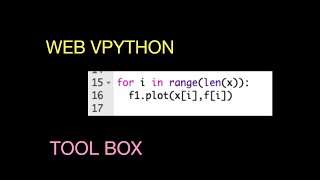
The Important Python Concepts for Physics Using Web VPython
Master essential Python concepts for physics simulations using Web VPython, including graphing, functions, loops, vectors, and the Euler method for pendulum motion.
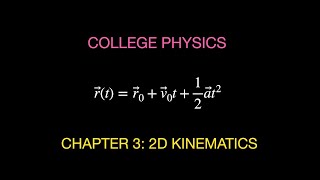
Physics Summary - Chapter 3: 2D Kinematics
Explore 2D kinematics: vectors, graphical representations, components, vector operations, and applications to motion, including projectiles and relative velocity.
Postulates of Quantum Mechanics - Part II: Quantum Observables and Time-evolution
Explore quantum observables and time-evolution in quantum mechanics, delving into advanced postulates and theoretical concepts.
Quantum Gates and Circuits - Part 1
Explore quantum gates and circuits, focusing on fundamental concepts and their applications in quantum computing. Learn to manipulate quantum states and build basic quantum circuits.
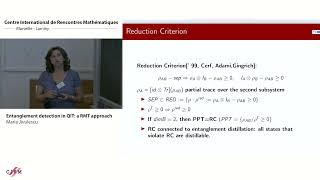
Entanglement Detection in Quantum Information Theory: A Random Matrix Theory Approach
Explore entanglement detection in quantum information theory using random matrix theory. Gain insights into advanced mathematical approaches for quantum systems analysis.
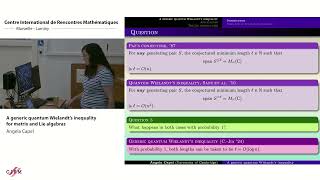
A Generic Quantum Wielandt's Inequality for Matrix and Lie Algebras
Explore quantum Wielandt's inequality for matrix and Lie algebras in this mathematical conference talk by Angela Capel, delving into advanced concepts and applications.
Infinite Algebras and Intertwining Networks for Calogero Models
Explore infinite algebras and intertwining networks in Calogero models, focusing on symmetric observables, W algebras, and newly discovered vertical intertwiners for multi-particle systems.
Bethe Ansatz in 2D Conformal Field Theory
Explore Bethe ansatz equations in 2D conformal field theory, examining their relation to W algebras and affine Yangian symmetry. Gain insights into quantum integrability beyond Virasoro algebra.