
Master AI Efficiency with LoRA - Optimize Fine-Tuning for Large Language Models
Optimize AI fine-tuning with LoRA: Learn selective parameter updates, preserve model integrity, and adapt models efficiently across tasks. Gain practical insights for streamlined, resource-efficient AI projects.
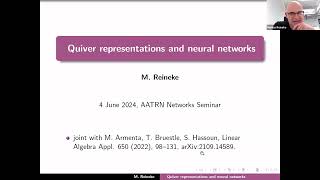
Quiver Representations and Neural Networks
Explore quiver representations in linear algebra and their application to neural networks, examining moduli spaces and network function spaces.
Arbitrary Tensor Network Algorithm: Theory, Methods and Applications
Explore arbitrary tensor network algorithms for complex systems modeling, covering theory, methods, and applications in probabilistic graphical models and quantum circuit simulations.
Geometry of Tensor Networks and Tensor Invariants
Explore geometric aspects of tensor networks and invariants, focusing on their applications in mathematics and theoretical physics.
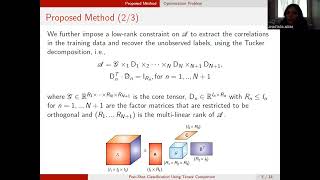
Few-Shot Classification Using Tensor Completion
Explore tensor-based modeling for enhanced classification performance, especially with limited training data, outperforming traditional methods.
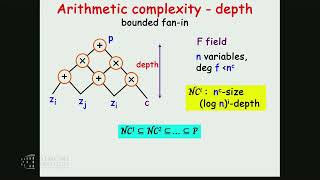
Faster Parallel Algorithms for Basic Linear Algebra Problems
Explore advanced parallel algorithms for fundamental linear algebra, enhancing computational efficiency in mathematical problem-solving.
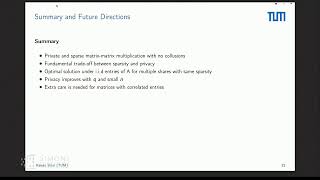
Sparsity and Privacy in Distributed Matrix Multiplication
Explore advanced techniques for distributed matrix multiplication, focusing on sparsity and privacy considerations in large-scale computations.

Coded Matrix Computation: Numerical Stability, Partial Stragglers, and Sparse Input Matrices
Explore advanced techniques for high-dimensional matrix computations in distributed systems, addressing numerical stability, partial stragglers, and sparse input matrices.
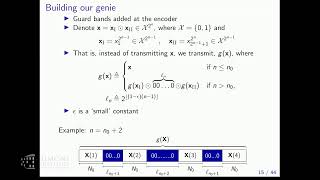
Polar Codes for IDS Channels
Explore polar codes for IDS channels, addressing numerical instability, partial stragglers, and worker computation time in sparse matrix scenarios. Learn recent contributions to overcome these challenges.
Construction and Decoding of Short Codes
Explore advanced techniques for constructing and decoding short-length codes, including staircase matrix codes, ordered statistic decoding, and innovative algorithms for polar codes.
Dual of Evaluation Codes in Error-Correcting Theory
Explore the mathematical concept of dual codes in error correction, focusing on evaluation codes and their properties in coding theory.

Scalable MatMul-free Language Modeling - Paper Explained
Explore innovative MatMul-free language modeling techniques using quantization and recurrence, achieving comparable performance to traditional models while significantly reducing computational costs and memory usage.
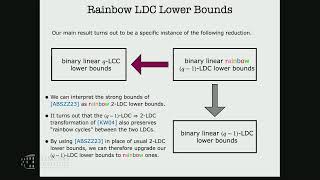
Near-Tight Bounds for 3-Query Locally Correctable Binary Linear Codes via Rainbow Cycles
Explores advanced bounds for 3-query locally correctable binary linear codes, improving previous results using rainbow cycles in edge-colored graphs and covering radius of dual codes.
Algebra in Algorithmic Coding Theory
Explore algebraic techniques in algorithmic coding theory, focusing on error-correcting codes and their applications in computer science and information theory.
Thermalization of Quantum Memories - A Tensor Networks Approach
Explore thermalization of quantum memories using tensor networks, focusing on 2D Kitaev's quantum double models and their Gibbs state representation as PEPS.
Classical and Quantum Subjectivity in Uncertainty and Belief Systems
Explore uncertainty in subjective logic, from Markov networks to quantum quasiprobabilities, gaining insights on computational irreducibility and belief spaces.

Exploring Random Quantum Circuits: A New Implementation Method
Discover a novel method for constructing random quantum circuits, comparing its properties to traditional approaches and exploring its potential for quantum hardware implementation.

Linear Structure of High-Level Concepts in Text-Controlled Generative Models
Explore the linear structure of high-level concepts in text-controlled generative models, focusing on embedding, representation, and semantic encoding for precise model control.
Accelerating Sparse Matrix Computations with Code Specialization
Explore techniques for optimizing sparse matrix computations through code specialization, enhancing performance in numerical algorithms and scientific computing applications.
De/Re-Composition of Data-Parallel Computations via Multi-Dimensional Homomorphism - PLDI 2024
Explore a systematic approach for efficient (de/re)-composition of data-parallel computations using Multi-Dimensional Homomorphisms, applicable to various architectures and outperforming state-of-the-art solutions.
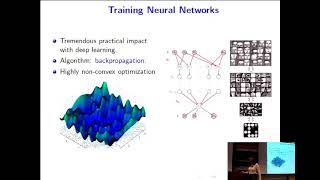
Guaranteed Training of Neural Networks Using Tensor Methods - 2015
Explore guaranteed neural network training using tensor methods. Learn about overcoming non-convexity, risk bounds, and combining unsupervised learning with supervised tasks.