Unsupervised Feature Learning with Matrix Decomposition - Aedin Culhane, PhD | ODSC East 2018
Explore unsupervised learning techniques for high-dimensional data analysis, focusing on matrix factorization methods and their applications in oncology and precision medicine.
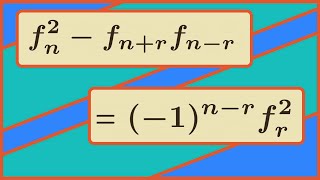
Catalan's Identity for Fibonacci Numbers
Explore Catalan's identity for Fibonacci numbers through matrix properties, building on previous proofs of Cassini's and d'Ocagne's identities in this mathematical deep dive.
The Sensitivity Conjecture: A Proof from the Book and Connections to Physics
Explore the elegant proof of the Sensitivity Conjecture, its implications for theoretical computer science, and connections to physics concepts like Majorana fermions.
David Gross: Stabilizer Formalism & Quantum Error Correction Through the Lens of Tensors
Explore advanced quantum error correction techniques, focusing on the stabilizer formalism and its applications in quantum fault tolerance, using tensor-based approaches and group theory.
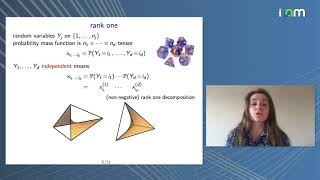
Tensors in Statistics and Data Analysis
Explore tensors in statistics and data analysis, covering probability tensors, biological measurements, and signature tensors for time-series data. Learn about decompositions and algebraic properties in this comprehensive overview.
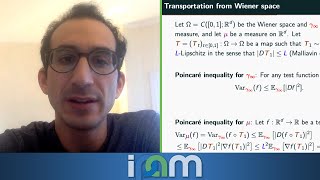
The Brownian Transport Map - IPAM at UCLA
Explore Lipschitz transport maps between probability measures, focusing on the Brownian transport map's construction, properties, and applications to Euclidean functional inequalities.
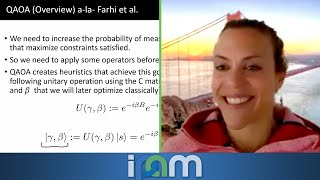
Quantum Approximate Optimization Algorithm and Local Max-Cut - IPAM at UCLA
Explore quantum optimization algorithms, focusing on QAOA's application to LocalMaxCut. Discover insights on quantum supremacy and the performance comparison between local algorithms and QAOA on various graph instances.
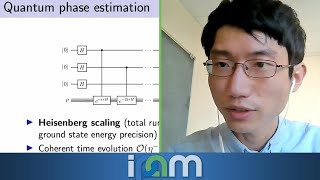
Heisenberg-Limited Ground State Energy Estimation for Early Fault-Tolerant Quantum Computers
Explore Heisenberg-limited ground state energy estimation for early fault-tolerant quantum computers, featuring a simplified circuit and classical post-processing for improved efficiency.
Optimal Scaling Quantum Linear Systems Solver via Discrete Adiabatic Theorem
Explore optimal quantum linear systems solver using discrete adiabatic theorem, achieving linear complexity in condition number and precision, with simplified implementation and constant factor analysis.
The Quantum Linear Systems Problem - IPAM at UCLA
Explore quantum algorithms for solving linear systems, including improved methods and complexity analysis, with a focus on potential exponential speedups and verification challenges.
Fast Algorithms for Quantum Signal Processing - IPAM at UCLA
Explore fast algorithms for quantum signal processing, focusing on optimization techniques, energy landscapes, and phase factor structures in quantum singular value transformation.
Time-Dependent Hamiltonian Simulation of Highly Oscillatory Dynamics - IPAM at UCLA
Explore highly oscillatory dynamics in quantum systems, focusing on efficient simulation algorithms for time-dependent Hamiltonians with applications in various scientific fields.
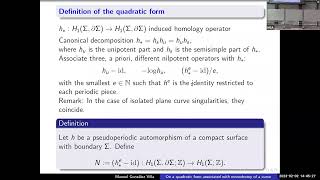
Quadratic Forms in Surface Automorphisms and Singularity Theory
Explore pseudo-periodic surface automorphisms, quadratic forms, and their applications in singularity theory. Gain insights into Milnor fibers and monodromy automorphisms.
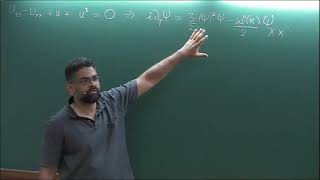
Perturbation Methods for Nonlinear PDEs - Lecture 3
Explore advanced perturbation techniques for nonlinear PDEs, focusing on multiple scales, asymptotic analysis, and the interplay between linear waves and nonlinearity in various scientific contexts.
Perturbation Methods for Nonlinear PDEs - Lecture 4
Explore perturbation methods for nonlinear PDEs, focusing on shallow water waves and damped KDV models. Learn unified approaches to adapt linear equation techniques to nonlinear contexts.
Perturbation Methods for Nonlinear PDEs - Lecture 2
Explore perturbation methods for nonlinear PDEs, focusing on nonlinear oscillators and periodic solutions. Learn techniques like inner products, perturbation series, and 2Pi periodicity to tackle complex equations.
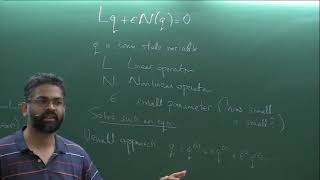
Perturbation Methods for Nonlinear PDEs - Lecture 1
Explore perturbation methods for nonlinear PDEs, focusing on adapting linear equation techniques. Learn unified approaches through examples from cold atoms, water waves, and atmospheric science.
Introduction to Optimal Transportation and Monge Ampère Type Equations - Lecture 2
Explore optimal transportation and Monge Ampère equations, covering key concepts like super differentials, isoperimetric problems, and probability measures in this advanced mathematics lecture.
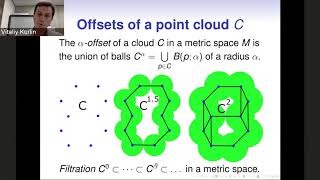
Skeletonization Algorithms With Theoretical Guarantees for Point Clouds
Explore skeletonization algorithms for point clouds, including Mapper, alpha-Reeb graphs, and Homologically Persistent Skeleton. Compare their performance on synthetic and real data sets.
Secure Distributed Matrix Multiplication
Explore information-theoretic methods for secure distributed matrix multiplication, focusing on trustworthy machine learning applications and techniques.
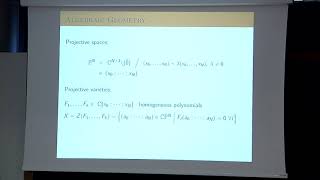
The Geometry of Tensors - Carolina Araujo
Explore tensor decomposition, its applications, and geometric interpretation. Learn about recent developments in determining tensor ranks and their significance in various fields.