Circles and Spheres via Dot Products - Part 1
Explore circles using dot products in linear algebra. Learn two approaches: quadratic and bilinear equations. Discover applications to tangents, pole/polar duality, and classical theorems in projective geometry.
Applications of the Dot Product to Planar Geometry - Part 2
Explore advanced applications of dot product in planar geometry, including linear functionals, point-normal form of lines, vector projections, isometries, and rotations.
Applications of the Dot Product to Planar Geometry - Part 1
Explore how the dot product shapes planar Euclidean geometry, introducing linear functionals, normal vectors for lines, and geometric projections in linear algebra.
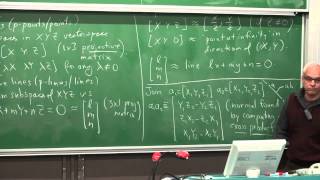
Duality, Polarity and Projective Linear Algebra in Differential Geometry - Lecture 10
Explore projective geometry's impact on differential geometry, focusing on conics, projective linear algebra, and duality between points and lines in the projective plane.
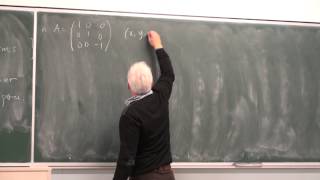
Duality, Polarity and Projective Linear Algebra - Differential Geometry Lecture 11
Explores projective geometry, quadratic forms, and pole-polar duality in relation to the unit circle. Connects these concepts to Lorentz/Einstein/Minkowski geometry and Apollonius' work.
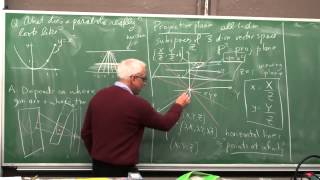
Projective View of Conics and Quadrics - Differential Geometry Lecture 9
Explore projective geometry's application to conics and quadrics, using homogeneous coordinates to unify the study of algebraic curves and surfaces in plane and space.
The Rotation Problem and Hamilton's Discovery of Quaternions - Part 2 - Famous Math Problems 13b
Explore 3D rotations, their composition, and algebraic representation. Learn about Euler's theorem, vector operations, and the foundations for understanding quaternions in graphics and rocket science.
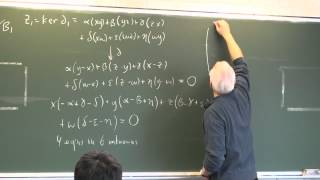
More Homology Computations in Algebraic Topology - Lecture 2
Explore homology computations for the 2-sphere using tetrahedron and delta-complex models. Learn how linear algebra applies to topological problems and simplify calculations with semi-simplicial complexes.
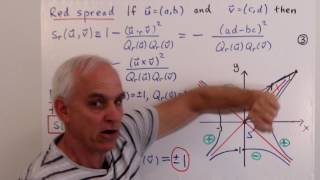
Colored Spreads and Generalizations in Rational Trigonometry - Lecture 2
Explore colored spreads in planar geometries, visualizing red and green spreads using cross products and determinants. Learn about generalized dot products and Pythagoras' theorem in different geometries.
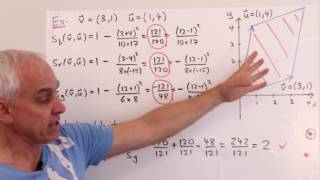
Coloured Spreads and Generalizations in Rational Trigonometry - Lecture 1
Explore colored spreads theorem, planar dot products, and geometric interpretations of quadrances in blue, red, and green geometries. Gain insights into rational trigonometry and linear algebra concepts.
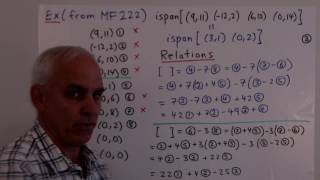
Relations Between Multisets - Abstract Algebra Math Foundations - Lecture 225
Explore integral linear spans and relations between msets, drawing parallels to linear algebra's rank-nullity theorem. Learn to obtain relations using the Hermite normal form algorithm.
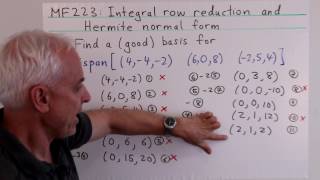
Integral Row Reduction and Hermite Normal Form - Math Foundations 223
Explores integral row reduction algorithm for finding a basis of integral linear space, paralleling Euclid's algorithm. Introduces Hermite normal form for msets of vexels in abstract algebra context.
Bases and Dimension for Integral Linear Spaces - Math Foundations 222
Explores algorithm for finding simplified bases of integral linear spaces, adapting Gaussian elimination to work with integral combinations. Introduces key concepts in abstract algebra through practical computation.
Lattice Relations and Hermite Normal Form - Abstract Algebra Math Foundations 224
Explore lattices and integral linear spans of vexels, including the Hermite normal form algorithm for understanding lattice structure and relations between elements in a spanning set.
Linear Spaces and Spans II - MathFoundations 220
Introduction to integral linear spaces as abstract algebraic objects, exploring their applications in mathematics, chemistry, and physics. Foundational concepts for linear algebra using vexel language for concrete examples.
Linear Spaces and Spans I - Abstract Algebra Math Foundations 219
Introduction to linear spaces and spans, generalizing natural numbers with addition to form spans of multisets. Explores fundamental concepts in abstract algebra and linear algebra.
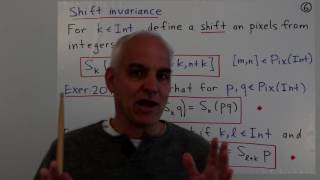
Algebra with Maxels from Integers - Data Structures Math Foundations 209
Exploring maxel theory as an extension of matrix theory, introducing shift invariance and partial identity maxels to restructure linear algebra with integer indices.
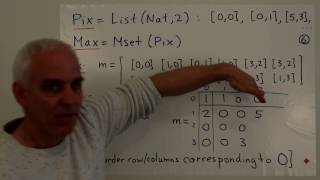
Integral Vectors and Matrices via Vexels and Maxels - Data Structures Math Foundations
Explore integral vectors and matrices through vexels and maxels, expanding on previous concepts with a multiset framework for more flexible indexing and generalized representations.
The Perspective Image of a Square - Famous Math Problems 18a
Explore projective geometry concepts like quadrilaterals, quadrangles, duality, and cross ratios in relation to perspective images of squares. Novel approach using planar vector cross products.
Extending Archimedes' Parabolic Area Formula to Cubics - Algebraic Calculus
Extending Archimedes' parabolic area formula to cubics using Algebraic Calculus and projective geometry. Explores unique aspects of cubic functions and their areas without relying on infinite processes.
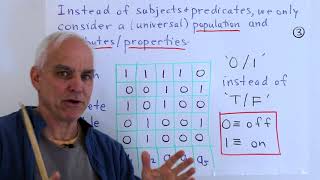
The Algebra of Boole and Boolean Algebra - Key Differences - Part 1
Introduction to the Algebra of Boole, focusing on the bifield of two elements and n-tuples. Explores its role in circuit analysis and contrasts it with Boolean algebra, highlighting implications for 20th-century mathematics.