Strong Convergence of Tensor Products of Independent G.U.E. Matrices
Explore strong convergence in tensor products of independent G.U.E. matrices with Mireille Capitaine, delving into advanced mathematical concepts and their applications.
Moduli of Bundles in Low Genus, Coble Hypersurfaces and Degeneracy Loci
Explore the geometry of moduli spaces for semistable bundles, focusing on Coble hypersurfaces and their connections to Abelian varieties, K3 surfaces, and cubic fourfolds.
Homeomorphisms of Euclidean Space
Explore recent advances in understanding the topological group of homeomorphisms of Euclidean space, including methods and emerging conjectures in geometric topology.
Sketching and Projecting
Explore sketching and projecting methods for linear systems and linear discriminant analysis, focusing on stochastic gradient approaches to achieve efficient solutions with reduced computational burden.
From Geometry to Algebra and Back Again: 4000 Years of Papers
Explore 4000 years of vector algebra history, its applications in art, science, and programming, and discover the potential of Geometric Algebra as a superior alternative.
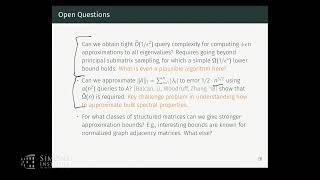
Sublinear Time Eigenvalue Approximation via Random Sampling
Explore efficient algorithms for approximating eigenvalues of large matrices using random sampling techniques, with applications in data analysis and machine learning.
Null Points and Null Lines in Universal Hyperbolic Geometry - Lecture 12
Explore null points and null lines in universal hyperbolic geometry, including rational and projective parametrization, joins and meets theorems, and a triply nil triangle.
The Circle and Projective Homogeneous Coordinates - Universal Hyperbolic Geometry Lecture 7a
Introduction to projective geometry and its relation to universal hyperbolic geometry, exploring concepts like affine spaces, perspective, and one-dimensional projective geometry.
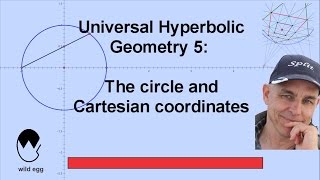
The Circle and Cartesian Coordinates in Universal Hyperbolic Geometry - Lecture 5
Explore Cartesian coordinates and the unit circle, covering key theorems on lines, points, and circles. Learn about determinants, parametrization, and the intersection of lines and circles in geometry.
Stirling Numbers and Pascal Triangles - Foundations of Linear Algebra
Explore Stirling numbers and Pascal triangles in linear algebra. Learn about falling and rising powers, change of basis, and applications to polynomial sequences. Gain insights into combinatorial and number theoretic interpretations.
More Bases of Polynomial Spaces - Lecture 21
Explore advanced polynomial bases: Lagrange, Chebyshev, Bernstein, and Spread. Learn their properties, applications in approximation, and relationships, enhancing understanding of polynomial spaces in linear algebra.
Applications of 2x2 Matrices - Wild Linear Algebra A6
Explores 2x2 matrices, focusing on coordinate changes, linear equations, vector operations, and determinants. Covers fundamental concepts and applications in linear algebra.
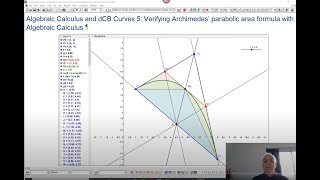
Verifying Archimedes' Parabolic Area Formula with Algebraic Calculus - AC and DCB Curves 5
Explore a novel algebraic approach to calculus, focusing on curves and geometry. Learn how to verify Archimedes' parabolic area formula using quadratic de Casteljau Bezier curves and the Fundamental theorem of Algebraic Calculus.
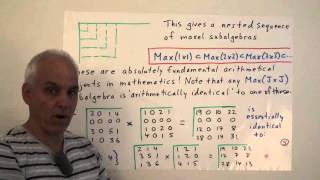
Maxel Algebra II - Data Structures in Mathematics
Exploring maxel algebra as an extension of matrix algebra, focusing on diagonal maxels and their role in projecting and restricting maxels, revealing nested matrix algebra structures.
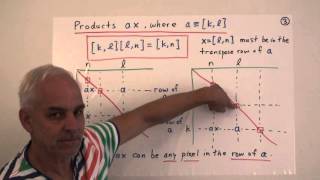
Maxel Theory - New Thinking About Matrices - Data Structures Math Foundations 168
Exploring maxel theory and its impact on linear algebra, focusing on pixel geometry and matrix multiplication for new insights into matrix algebra.
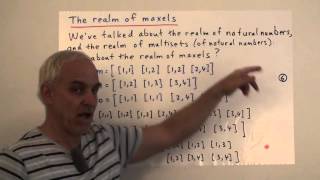
Maxel Theory: New Thinking About Matrices - Math Foundations 166
Explore Maxel theory, a novel approach to matrix theory using pixels. Learn about maxel algebra, multiplicative structure, and applications in linear algebra.
Matrices, Determinants, and the Birth of Linear Algebra - A Historical Perspective
Explore the historical development of matrices and determinants, from ancient Chinese mathematics to modern linear algebra, featuring key contributors and their groundbreaking concepts.
The Chromatic Algebra of 2x2 Matrices - Part 2
Explores chromatic algebra of 2x2 matrices, focusing on subalgebras, complexions, dot products, and the four-dimensional Dihedrons algebra. Compares to quaternions and highlights unique properties.
The Chromatic Algebra of 2x2 Matrices - Wild Linear Algebra B41
Explore chromatic algebra in 2x2 matrices, covering subalgebras, complexions, trace, determinant, and characteristic polynomials. Introduces unique dot products on 2x2 matrices.
Relativistic Dot Products and Complex Numbers in Linear Algebra - Part 2
Exploring triality of dot products and associated complex numbers in chromogeometry, organized within 2x2 matrices. Delves into interactions between three geometries.
Historical Development of Group Theory - From Number Theory to Geometry
Explore the historical development of group theory, from its roots in number theory and algebra to its impact on geometry, covering key concepts and influential mathematicians.