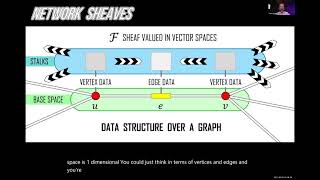
Robert Ghrist - Laplacians and Network Sheaves
Explore cellular sheaves, Laplacians, and network dynamics in algebraic topology. Learn about sheaf cohomology computation and applications in decentralized methods.
The Selberg Sieve and Large Sieve - Lecture 1
Explore the Selberg Sieve and Large Sieve in number theory, covering linear algebra, duality principles, and applications like the Bombieri-Vinogradov theorem in this advanced mathematics lecture.
Axel Målqvist - Localization of Multiscale Problems
Explore multiscale problem-solving techniques, focusing on Local Orthogonal Decomposition for PDEs. Learn about convergence, high-contrast data, and applications to time-dependent problems.
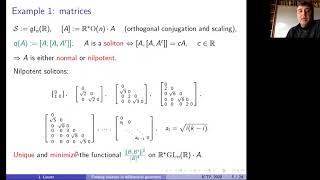
Finding Solitons in Differential Geometry
Explore solitons in differential geometry, their role in discovering distinguished geometric structures, and applications in various mathematical contexts including Lie groups and algebras.
Lorentzian Geometry - T. Drumm
Explore Lorentzian geometry, covering basic definitions, hyperbolic spaces, isometries, and advanced concepts like Margulis space-times and crooked planes.
Michael Baake - A Cocycle Approach to the Fourier Transform of Rauzy Fractals
Explore Fourier transforms of Rauzy fractals and their role in analyzing spectra of Pisot inflation tilings, with applications to diffraction theory and dynamical systems.
The Projective/Injective Ratio and GPTs
Explore tensor products in normed spaces, examining projective and injective norms' differences. Discover applications in physics, probabilistic theories, and XOR games, using geometry and random matrix techniques.
Dynamics of Smooth Surface Diffeomorphisms - Spectral Gap and Stochastic Properties
Explore surface diffeomorphisms, spectral gaps, and stochastic properties in smooth dynamics. Gain insights into symbolic models, entropy continuity, and hyperbolic systems.
Example Using Orthogonal Change-of-Basis Matrix to Find Transformation Matrix - Khan Academy
Learn to use orthogonal change-of-basis matrices for finding transformation matrices in this advanced linear algebra tutorial, enhancing your understanding of multi-dimensional mathematical concepts.

Changing Coordinate Systems to Help Find a Transformation Matrix - Linear Algebra - Khan Academy
Learn to change coordinate systems to find transformation matrices in standard coordinates, enhancing your understanding of linear algebra concepts and their practical applications.

Another Example of a Projection Matrix - Linear Algebra - Khan Academy
Learn to calculate projection matrices by first determining the orthogonal complement's matrix. This advanced linear algebra lesson explores subspace projections and their applications in multidimensional reasoning.

Representing Vectors in RN Using Subspace Members - Linear Algebra - Khan Academy
Explore vector representation in Rn using subspace members and orthogonal complements. Learn how any Rn vector can be uniquely expressed as a sum of vectors from subspace V and its orthogonal complement.

Orthogonal Complements - Alternate Coordinate Systems (Bases) - Linear Algebra - Khan Academy
Explore orthogonal complements as subspaces in linear algebra. Learn key concepts for understanding multi-dimensional representations and their applications in science and engineering.

Rowspace and Left Nullspace - Matrix Transformations - Linear Algebra - Khan Academy
Explore rowspace and left nullspace concepts in matrix transformations, enhancing your understanding of multi-dimensional mathematical reasoning in linear algebra.

Determinant and Area of a Parallelogram - Matrix Transformations - Linear Algebra - Khan Academy
Explore the relationship between 2x2 matrix determinants and parallelogram areas in linear algebra, enhancing understanding of matrix transformations and geometric interpretations.

Showing That Inverses Are Linear - Matrix Transformations - Linear Algebra
Explore the linearity of inverse transformations in matrix algebra, enhancing your understanding of linear algebra concepts and their applications in multidimensional reasoning.
Determining Whether a Transformation Is Onto - Linear Algebra - Khan Academy
Learn to determine if a transformation is onto in linear algebra, exploring key concepts and techniques for analyzing function properties and vector spaces.
Spectral Graph Theory - Lecture 1
Explore spectral graph theory, covering self-adjoint matrices, Rayleigh equalities, graph isomorphism, Cayley graphs, and automorphism groups. Gain insights into complex systems and network analysis.
The Grothendieck Inequality by Gadadhar Misra
Explore the Grothendieck inequality, its consequences, and related concepts in mathematics. Learn about max cut problems, cut norms, and proofs, including Kirvine's approach to this fundamental inequality.
Random Matrix Theory and Its Applications - Lecture 3
Explore advanced random matrix theory concepts, including complex quaternionic matrices, rotationally invariant ensembles, and applications to disordered systems in this in-depth lecture.
Random Matrix Theory and its Applications - Lecture 2
Explore advanced concepts in random matrix theory, including linear algebra basics, operators, transformations, eigenvectors, and various matrix ensembles, with applications in statistical physics.