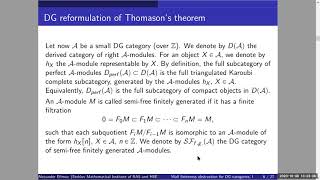
Wall Finiteness Obstruction for DG Categories I
Explore Wall finiteness obstruction theorem for DG categories, its applications to phantom DG categories, and implications for algebraic geometry, including results on Barlow surface and stratified varieties.
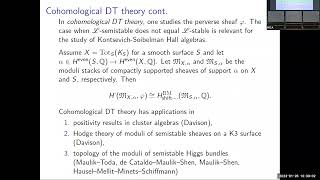
Homological Mirror Symmetry - Categorical Donaldson-Thomas Theory of C^3 and Beyond
Explore advanced concepts in Donaldson-Thomas theory, including categorifications, refinements, and applications to C^3 and beyond, with a focus on categorical invariants and correspondences.
Quadratic Forms and Hermite Constant, Reduction Theory by Radhika Ganapathy
Explores techniques for computing densest lattice packings, including quadratic forms, Hermite constants, and reduction theory. Covers perfect forms, eutactic lattices, and Voronoi's algorithm for listing perfect forms.

Proof - Invertibility Implies a Unique Solution to F(x)=Y - Linear Algebra - Khan Academy
Explore the proof of how invertibility guarantees a unique solution to f(x)=y for all y in the co-domain of f, enhancing your understanding of linear algebra concepts.

Visualizing a Column Space as a Plane in R3 - Vectors and Spaces - Linear Algebra
Explore how to visualize column space as a plane in R3, determining planar equations and understanding multi-dimensional concepts in linear algebra.
Null Space and Column Space Basis - Vectors and Spaces - Linear Algebra - Khan Academy
Learn to determine null space and column space basis for matrices, essential concepts in linear algebra for understanding vector spaces and transformations.

Defining the Angle Between Vectors - Vectors and Spaces - Linear Algebra - Khan Academy
Learn to define and understand the concept of angles between vectors in linear algebra, enhancing your grasp of vector geometry and spatial relationships.

Linear Subspaces - Vectors and Spaces - Linear Algebra
Explore linear subspaces in Rn, a fundamental concept in linear algebra. Learn to visualize and understand multi-dimensional mathematical reasoning through vectors, matrices, and transformations.

Parametric Representations of Lines - Vectors and Spaces - Linear Algebra - Khan Academy
Explore parametric representations of lines in R2 and R3, a fundamental concept in linear algebra. Learn to visualize and understand multi-dimensional mathematical reasoning.

Vector Examples - Vectors and Spaces - Linear Algebra - Khan Academy
Explore visual understanding of basic vector operations in linear algebra. Learn to visualize and manipulate vectors in multiple dimensions, enhancing your grasp of mathematical concepts.
Introduction to Dynamical Systems - Lecture 1
Explore dynamical systems, from linear ODEs to nonlinear chaos. Learn about equilibrium points, eigenvalues, attractors, and bifurcations. Gain insights into Lorenz systems, Poincaré maps, and iterative methods.
Computer-Assisted Proofs in the Arithmetic of Quadratic Forms - IPAM at UCLA
Explore computer-assisted proofs in quadratic forms arithmetic, covering equivalence, representation, local-global principles, and modular forms. Gain insights into complex computations across mathematics.
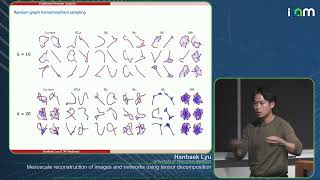
Mesoscale Reconstruction of Images and Networks Using Tensor Decomposition
Explore mesoscale reconstruction of images and networks using tensor decomposition, focusing on a unified framework, error bounds, and online CP-dictionary learning for multi-modal datasets.
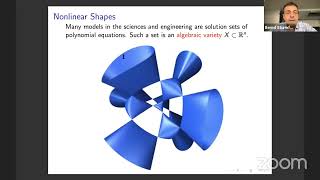
Beyond Linear Algebra
Explore advanced mathematical concepts beyond linear algebra, including critical point equations, nonlinear algebra in PDE, and geometric interpretations in optimization and statistics.
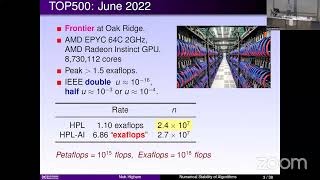
Numerical Stability of Algorithms at Extreme Scale and Low Precisions
Explore numerical stability in extreme-scale computing and low-precision arithmetic, focusing on error bounds, blocked algorithms, and probabilistic analysis for matrix computations.
Variety of Fractional Laplacians
Explore various types of fractional Laplacians, their properties, and applications in mathematical analysis through proofs, comparisons, and counterexamples.
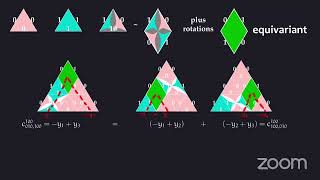
Allen Knutson- Schubert Calculus and Quiver Varieties
Explore Schubert calculus, quiver varieties, and their connections through puzzle rules, Yang-Baxter equations, and representation theory in this advanced mathematics lecture.

Convex Sunflower Theorems and Neural Codes
Explore convex sunflower theorems and neural codes, connecting neuroscience with discrete geometry to understand place cell encoding and cognitive mapping in rat hippocampus.
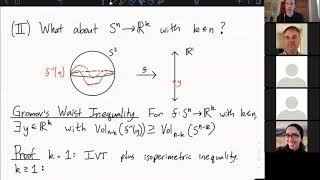
Borsuk-Ulam Theorems into Higher-Dimensional Codomains
Exploration of Borsuk-Ulam theorems in higher dimensions, generalizing results and discussing open questions related to optimal diameters and Schur polynomials.
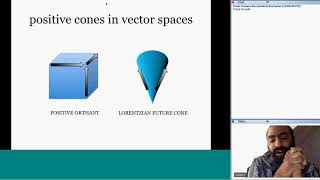
Sanjeevi Krishnan - Homological Programming
Explore algebraic topology applications in programming, covering pursuit-evasion problems, positive cones, Alexander duality, and directed topology, with insights into decomposability and computational aspects.
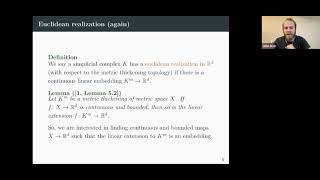
Johnathan Bush - Maps of Čech and Vietoris–Rips Complexes into Euclidean Spaces
Explore simplex-preserving maps in Čech and Vietoris–Rips complexes, their applications, and the challenge of finding such maps from various domains to Euclidean spaces.