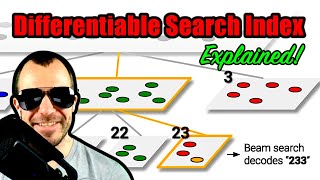
Transformer Memory as a Differentiable Search Index - Machine Learning Research Paper Explained
Explore a novel approach to information retrieval using a single Transformer model that encodes corpus information in its parameters, enabling direct query-to-document mapping without external indices.

Long Form Question Answering in Haystack
Explore long-form question answering using Haystack, covering setup, data indexing, and generating responses. Learn to implement QA systems for efficient information retrieval in organizations.
Question-Answering in NLP - Extractive QA and Abstractive QA
Explore question-answering in NLP, covering extractive and abstractive QA techniques. Learn about semantic search, ODQA, SQuAD format, and various QA approaches for efficient information retrieval and processing.

Fine-Tune Sentence Transformers the OG Way - With NLI Softmax Loss
Explore fine-tuning sentence transformers using NLI softmax loss. Learn preprocessing, PyTorch implementation, and Sentence-Transformers library usage for improved sentence embeddings in NLP applications.

HNSW for Vector Search Explained and Implemented with Faiss - Python
Demystifying HNSW algorithm for vector similarity search, explaining its foundations, implementation with Faiss, and optimization techniques for top-performing indexes in approximate nearest neighbor searches.
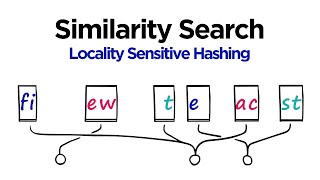
Locality Sensitive Hashing for Search with Shingling + MinHashing - Python
Learn efficient similarity search using Locality Sensitive Hashing (LSH) with shingling and MinHashing techniques in Python. Explore implementation steps, from data preprocessing to LSH tuning, for approximate nearest neighbor search.

QA Chat with a Website - OpenAI Embeddings Tutorial: Use GPT-3 API and OpenAI ADA-2 Embeddings
Learn to create a QA chatbot using OpenAI embeddings and GPT-3 API. Convert website content for similarity search, set up the environment, and implement the system step-by-step.
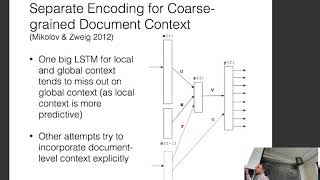
CMU Neural Nets for NLP 2018 - Document-Level Models
Explore document-level NLP models, covering language modeling, topic modeling, coreference resolution, and discourse parsing. Learn advanced techniques for analyzing and processing longer texts.
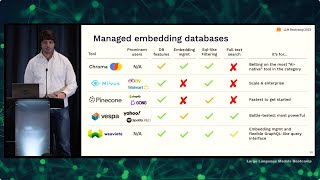
Augmented Language Models - LLM Bootcamp
Explore techniques for enhancing language models with external context: retrieval augmentation, chaining, and tool use. Learn about embeddings, databases, and practical applications in AI development.
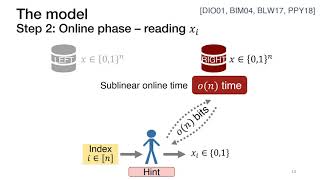
Private Information Retrieval with Sublinear Online Time
Explore efficient private information retrieval protocols with sublinear online time, focusing on communication complexity, computation complexity, and security proofs in cryptographic systems.

Ways to Solve Neural Search With Jina
Explore neural search techniques, from basics to advanced applications, using Jina for text, audio, and video. Learn to build efficient, scalable search engines with practical insights.

Wikipedia Vector Search Demo with Weaviate
Explore semantic search through Wikipedia using Weaviate, featuring demos of vector search, question answering, and applications in various domains like protein folding and natural language processing.

Search with Vectors - Simon Hughes
Explore vector-based search techniques and their applications in modern information retrieval systems for improved accuracy and efficiency.

ElasticON Public Sector - The Search for Relevance with Vector Search
Explore vector search in public sector applications, enabling semantic queries with text, images, and audio. Learn about intelligent discovery and NLP integration in Elastic's search solutions.

PaLM 2 Meets LangChain
Explore PaLM-2's integration with LangChain, covering chatbots, information retrieval, and database creation. Learn to leverage these powerful tools for advanced language processing and AI applications.

Vector-Based Methods for Similarity Search - TF-IDF, BM25, SBERT
Explore three vector-based approaches for language comparison and document similarity: TF-IDF, BM25, and Sentence-BERT. Learn key techniques for building effective search engines in AI and machine learning.

Extractive Q&A With Haystack and FastAPI in Python
Build an extractive Q&A system using Haystack, FastAPI, and BERT transformer. Implement Elasticsearch with BM25 retriever for efficient information retrieval and answer generation from text documents.
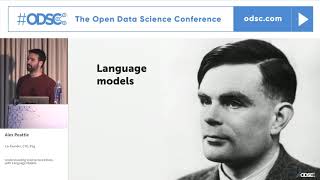
Understanding Unstructured Data with Language Models - Alex Peattie
Explore language models for unstructured data analysis, covering classification, predictive modeling, and information retrieval. Learn key concepts and practical applications in various fields.
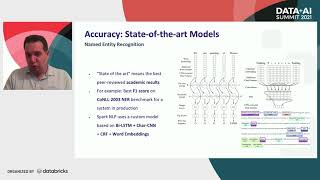
Advanced Natural Language Processing with Apache Spark NLP
Explore advanced NLP tasks using Apache Spark NLP, covering classification, named entity recognition, sentiment analysis, and more through hands-on Python notebooks and deep learning techniques.

AI and Observability Role in E-Government Ecosystem
Explore how AI and observability enhance e-government IT operations, using open-source tools for telemetry data analysis and deep learning to improve service delivery and efficiency.

Faster Approximate Pattern Matching: A Unified Approach
Explore unified techniques for faster approximate pattern matching, covering advanced algorithms and their applications in text processing and bioinformatics.