Cultural Epistemologies, Human-Nature Relationships and Biological Cognition
Explore Native American perspectives on nature, comparing epistemologies and cognitive processes between Native and Non-Native groups through cultural artifacts and developmental studies.
On Coronavirus, Crisis, and Creative Opportunity
Exploring how crises reshape opportunities, this talk examines evolutionary strategies for navigating disruptions and the potential for innovation amidst catastrophe in a post-coronavirus world.
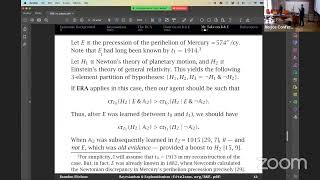
Bayesianism and Explanationism in Scientific Reasoning
Explore the philosophical approaches of Bayesianism and Explanationism, examining their principles, applications, and implications for scientific reasoning and knowledge acquisition.

Social Complexity in the Wild - Understanding Human Social Behavior
Explore the intricacies of human social behavior, from grooming to mythology, and uncover the mechanisms behind our complex interactions and societal structures.
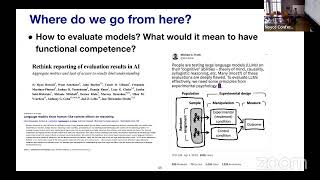
Formal and Functional Competence in Large Language Models - A Cognitive Perspective
Explore cognitive perspectives on large language models, examining formal and functional competence, linguistic confidence, and implications for AI development and evaluation.
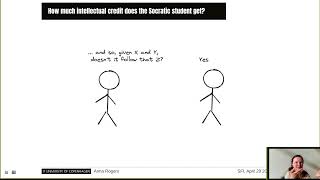
Writing Assistance or Plagiarism - How Language Models Are Changing Our View of Knowledge
Explore how language models are reshaping our understanding of knowledge, writing assistance, and plagiarism with insights from Anna Rogers in this thought-provoking discussion.
How to Know: Understanding the Complexity of Knowledge
Explore the complexity of knowledge and learning processes with cognitive scientist Celeste Kidd in this thought-provoking symposium talk from the Santa Fe Institute.
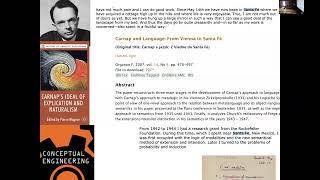
Understanding Understanding Through Conceptual Engineering
Explore philosophical insights on understanding and conceptual engineering with David Chalmers, delving into the nature of comprehension and its implications for knowledge and cognition.
Dimensions of Meaning and Understanding - Raphaël Millière
Explore dimensions of meaning and understanding, from lexical semantics to complex reasoning, with insights on knowledge acquisition and cognitive pitfalls.
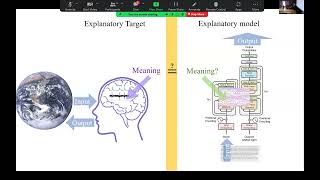
Do AI Systems Model Meaning and Understanding?
Explore the philosophical question of whether AI systems truly model meaning and understanding, delving into the nature of intelligence and consciousness in artificial systems.
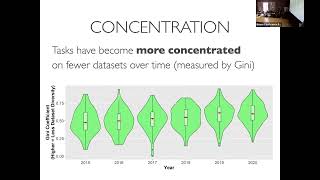
Deconstructing the Barrier of Meaning
Explore the concept of meaning and its barriers with Jacob Foster in this thought-provoking talk, delving into complex ideas and their implications for understanding our world.
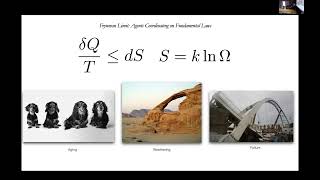
Feynman, Shannon, and Darwin Worry About Understanding
Explore how Feynman, Shannon, and Darwin's ideas intersect in the pursuit of understanding complex systems and scientific knowledge.
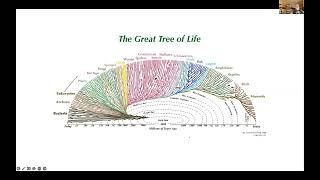
The Evolution of Understanding on Several Levels
Explore the evolution of understanding across multiple levels with philosopher Dan Dennett, delving into complex concepts and their implications for human knowledge and cognition.
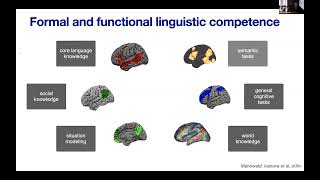
Language Understanding Goes Beyond Language Processing
Explore how language comprehension extends beyond traditional processing, delving into cognitive mechanisms and neural networks that shape our understanding of communication and meaning.
Magnificent Rebels - The First Romantics and the Invention of the Self
Explore the revolutionary ideas of 18th-century Jena, where brilliant minds like Goethe and Hegel reshaped philosophy, science, and art, redefining the concept of self and inspiring modern thought.
Balance, Criticality, and Antifragility in Complex Systems
Explore complex systems thinking and its philosophical implications with Carlos Gershenson. Delve into balance, criticality, antifragility, and the intersections between Eastern and Western philosophical traditions and modern scientific concepts.
Complex Conceptions of Time - Exploring Scientific and Literary Perspectives
Exploring time through physics, philosophy, and science fiction. Experts discuss metaphors, mathematical concepts, and narrative approaches to understanding time, challenging conventional perceptions and exploring its complexities.
Value Capture and Legibility in Complex Systems - Paul Smaldino and C. Thi Nguyen
Exploring the challenges of measurement, governance, and social science in complex systems. Discusses value capture, legibility, and expert identification in the context of emergent political economies.
The Neuroscience and Philosophy of Curious Minds - Exploring Curiosity as a Network Phenomenon
Exploring curiosity as a networked phenomenon, bridging neuroscience and philosophy to reframe how we understand desire, wonder, and discovery in both the brain and society.
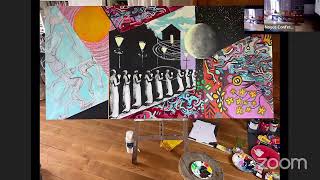
Climbing Mount Sisyphus - Artistic Exploration of Existential Meaning
Explore the intersection of art, philosophy, and science through Jan Gerrit Schuurman's perspective on Sisyphus, emphasizing the value of experience and the perpetual nature of human endeavor and creativity.
Speculative Vision - Exploring Deep Time, Technology, and Representation
Explore unique artistic projects that offer radical perspectives on deep time, technology, and representation, including holographic drawings and unconventional photography techniques.