
Rigorous Uncertainty: Science During COVID-19 with David Krakauer
Exploring COVID-19's impact through complexity science, discussing citizen-based medicine, data challenges, group size recommendations, and out-of-equilibrium thinking to reveal hidden interconnections in modern life.
Multiscale Crisis Response - Melanie Moses & Kathy Powers, Part 2
Exploring multiscale crisis response to COVID-19, examining societal polarization, scientific challenges, and institutional responses through a complexity science lens.

Good Explanations & Diseases of Epistemology
Exploring the nature of explanations, epistemology, and societal knowledge processing. Balancing understanding and prediction in science, and adapting to rapid changes in a complex world.
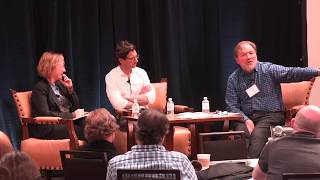
The End of Everything - A Discussion
Explore philosophical perspectives on societal collapse, decentralization, and human resilience with experts discussing the end of everything and potential new social orders.
Language Learning, Language Use, and The Evolution of Linguistic Structure
Explores the interplay between language learning, use, and evolution through experiments on artificial languages, interaction, and cultural transmission, revealing insights into linguistic structure formation.
Murray Gell-Mann and the Evolution of Human Languages - The Burden of Proof
Explore the evolution of human languages, challenging traditional linguistic theories and proposing new approaches to understanding language relationships and historical classifications.
ECoG Dog's Dream - Electroencephalosophy and Critical Neurophysiology
Explores limitations of scalp EEG for mind reading, proposes ECoG as superior alternative, and discusses potential for groundbreaking advancements in neuroscience through implantable high-density wireless ECoG systems.
The Collapse of Economies
Explore economic collapses, their causes, and recovery strategies through Venezuela's case study. Gain insights on autocatalysis, public debt, inflation, and rebuilding fragile economies.

Holding Pattern - Progress Notes on a Digressive Exhibition
Explore a digressive exhibition through progress notes, examining themes of waiting, buffering, and temporal experiences in art, literature, and culture.
Making Monsters: The Uncanny Power of Dehumanization
Explore the psychological and historical aspects of dehumanization, examining its roots, manifestations, and impact on society through various examples and theories.
A Brief History of Balance - Carlos Gershenson SFI Seminar
Explore the concept of balance across various domains, from physics to philosophy, and its implications for evolution, sustainability, and complex systems.
Autodiagnosis and the Dynamical Emergence Theory of Basic Consciousness
Explore the theory of basic consciousness, its emergence, and related concepts like energy landscapes and metastable states in this thought-provoking discussion on the nature of experience.
Could a Purely Self-Supervised Foundation Model Achieve Grounded Language Understanding?
Exploring the potential of self-supervised foundation models for grounded language understanding, discussing semantics, multi-modal streams, and causal abstraction in large networks.
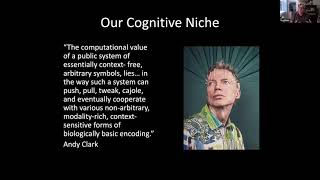
Guy Dove- Language Is a Neuroenhancement
Explore how language enhances cognitive abilities, examining embodied cognition, abstract concepts, and the elastic mind. Gain insights into human intelligence and its implications for AI development.
David Krakauer - What Is Complexity?
Explore complexity, its epistemology, and emergence with SFI President David Krakauer in this insightful lecture celebrating Complexity Explorer's 10th anniversary.
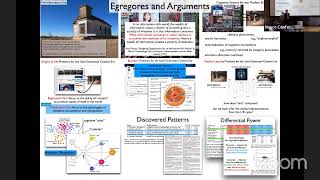
Argument-Making in the Wild
Explore the art of crafting persuasive arguments in real-world contexts, enhancing your ability to communicate effectively and influence others through logical reasoning.
Language Comprehension Requires Affordances
Explore how language comprehension is grounded in physical interactions with the world, challenging traditional views of cognition and offering insights into embodied intelligence.
Why Intelligent Reasoning Must Be Embodied
Explore the philosophical perspective on embodied intelligence and its implications for AI, presented by Lisa Miracchi from the University of Pennsylvania's GRASP Lab and MindCORE.
Learning About Possibilities Through Scientific Models
Exploring how scientists use models to study possibilities, examining epistemic and alethic possibilities, and discussing implications for model construction, assessment, and interpretation in scientific research.
Turing Test for Free Will - Determinism and Unpredictability in Decision-Making
Explore the interplay of determinism, randomness, and free will in decision-making processes. Discover a proposed 'Turing test' for free will and its implications for human and artificial intelligence.
Genetically Modified Foods - Monsters or Miracles?
Explore the science, history, and controversies surrounding genetically modified foods, examining their potential benefits and risks for global food security and environmental impact.