Introduction to Length-Constrained Expanders and Expander Decompositions
Explore length-constrained expanders and expander decompositions, powerful tools for fast graph and network optimization algorithms. Learn their applications and potential in solving complex problems.
Progressive Decoupling of Dynamics in Convex Optimal Control
Explore progressive decoupling in convex optimization for optimal control, connecting classical calculus of variations with modern convex analysis and duality concepts.
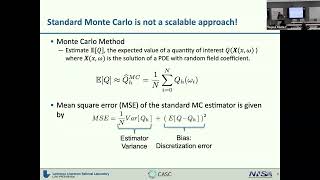
Uncertainty Quantification, Software Ecosystems, and Infrastructure Resilience - Technical Talk
Explore uncertainty quantification, exascale software ecosystems, and infrastructure resilience in this technical talk by Sarah Osborn at WiDS Livermore 2024.
NetworkX is Fast Now - Graph Analytics Unleashed
Discover NetworkX's power for graph analytics, from beginner-friendly API to accelerated backends. Learn to extract insights from data using advanced tools for scalable graph analysis.
Sampling through Exploration Exploitation in Markov Chain Monte Carlo
Explore an innovative Markov chain Monte Carlo algorithm combining global proposals and mobile moves for efficient, parallelizable sampling in various applications.

NetworkX is Fast Now - Graph Analytics Unleashed
Discover NetworkX's power for graph analytics, from beginner-friendly API to accelerated backends. Learn to extract insights from data using advanced tools for scalable graph analysis.
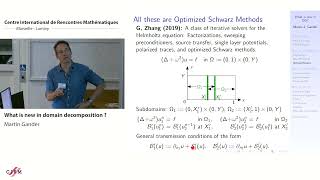
What's New in Domain Decomposition
Explore recent advancements in domain decomposition methods for solving large-scale mathematical problems efficiently and accurately.
PDEs and Stencils - SPARSE 2024
Explore PDEs and stencils in computational science, focusing on efficient numerical methods for solving partial differential equations.

TyFlow Tutorial - CUDA Cloth Bubbles + Project Files
Explore 3ds Max's TyFlow CUDA cloth features to simulate precise cloth collisions, creating glass bulbs with procedural bubbles for visually satisfying results.

Turbulence Closure Models - Reynolds Averaged Navier Stokes and Large Eddy Simulations
Explore turbulence closure models, focusing on RANS and LES approaches for approximating complex fluid dynamics. Learn key concepts and applications in scientific computing.
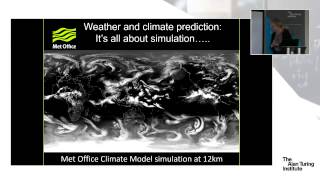
Big Data, Met Office and 21st Century Problems
Explore weather forecasting, climate prediction, and big data analysis at the Met Office. Learn about simulation techniques, ensemble forecasting, and addressing 21st-century environmental challenges.
Stars: The Ultimate Laboratory for Modern Physics - KITP Public Lecture
Explore how stars serve as laboratories for modern physics, offering insights into nuclear physics, quantum mechanics, particle physics, and turbulence, with future prospects in stellar seismology.

Modern Numerical Methods in Computational Relativity - Lecture 1
Explore modern numerical methods for solving Einstein's equations in computational relativity, essential for modeling gravitational waves from black hole and neutron star mergers.
Introduction to Numerical Relativistic Hydrodynamics - Lecture 5
Explore advanced concepts in numerical relativistic hydrodynamics, focusing on computational techniques for modeling high-energy astrophysical phenomena and gravitational wave sources.
Introduction to Numerical Relativistic Hydrodynamics - Lecture 2
Explore advanced concepts in numerical relativistic hydrodynamics, focusing on mathematical formulations and computational techniques for modeling high-energy astrophysical phenomena.
Stochastic Vector Methods for Extended Systems - IPAM at UCLA
Explore stochastic vector approaches for electronic structure in condensed matter systems, reducing complexity and enhancing efficiency in computational quantum mechanics.
Navigating the Era of Environmental Prediction with Antonio Busalacchi
Explore Earth System Prediction's evolution, from post-WWII insights to modern numerical forecasting. Learn about the critical gap in sub-seasonal to decadal decisions and the challenges of integrating diverse Earth System components.
Solving Molecular Analysis of Cancer: From DNA to Proteins
Explore molecular cancer analysis using open-source networking for real-time data sharing. Learn about high-speed data flows, optimized databases, and privacy considerations in precision medicine.
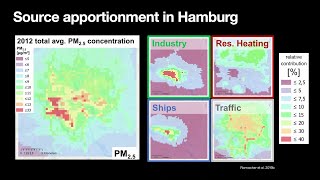
Numerical Air Quality Modeling Systems: From Emissions to Exposure
Exploring high-performance computing in air pollution modeling, from emissions to human exposure. Insights into data challenges, scientific approaches, and policy implications for addressing this global health threat.
The Digital Revolution of Earth System Modelling
Explore the cutting-edge advancements in Earth system modeling and their impact on climate science with insights from a leading expert at ECMWF.
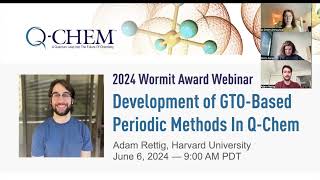
PBC Development in Q-Chem - 2024 Wormit Award
Explore advancements in Q-Chem's PBC package for periodic systems, including hybrid DFT speedup and MPI parallelization. Learn about current functionality and future development directions.