
Visualization and Analysis of HPC Simulation Data with VisIt
Explore HPC simulation data visualization using VisIt software, focusing on techniques for analyzing large-scale scientific datasets in high-performance computing environments.
Designing High-Performance Scalable Middleware for HPC, AI, and Data Science in Exascale Systems and Clouds
Explore high-performance middleware design for exascale systems, focusing on MVAPICH2 project's features and performance in HPC, AI, and data science applications across various platforms.
Real-time Trade Data Processing and Machine Learning at Giga-Scale with Hazelcast and FINOS Perspective
Explore scalable real-time trade data processing using Hazelcast and FINOS Perspective. Learn to architect high-performance applications combining streaming data, reference data, and machine learning for front and back office use-cases.

Depend Upon Docker for AI
Explore Docker's role in Data Science, Machine Learning, and AI, including GPU processing techniques and Industrial AI demos, presented by experts from Baker Hughes.
Unlimited Data Science Libraries in One Container Image - Dynamic Environment Modules for Kubernetes
Explore how to leverage environment modules in Kubernetes for data science, enabling dynamic access to thousands of libraries and packages while solving container management challenges.
Faster, Safer, Serverless - Empowering Apache Spark Standalone Cluster on Kubernetes
Explore a K8s-native Serverless Spark Service that enhances speed and simplicity, featuring a new K8s operator for cluster creation and job submission, with rapid responsiveness and ML training integration.
Tales at Scale - Analytics at 1000 QPS and Beyond
Explore high-performance analytics techniques for handling 1000+ queries per second, covering Apache Druid, CPU/IO optimization, and scaling strategies for heterogeneous workloads.
Inference at Scale with Apache Beam
Learn to deploy and scale machine learning models efficiently using Apache Beam for distributed inference on CPUs and GPUs, with practical insights on parallelizing workloads.
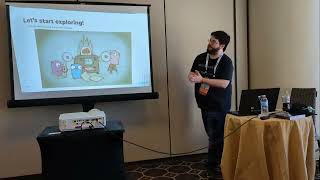
Apache Arrow and Go: A Match Made in Data
Explore Apache Arrow's Go implementation, covering Arrow and Parquet libraries, Flight server/client, C Data API integration, and performance optimization techniques.

Machine Learning with Apache Beam
Explore Apache Beam for distributed data pipelines in machine learning, covering inference, data processing, and training with hands-on demos for parallelizing ML workloads.
Reaching Lightspeed Data Science - ETL, ML, and Graph with NVIDIA RAPIDS
Accelerate data science workflows using GPUs and RAPIDS. Learn performance gains, easy migration, and new possibilities in ETL, ML, and graph analytics.

Kaggle Notebooks - Introduction to Cloud-Based Data Science Platforms
Explore Kaggle notebooks for seamless data access, free GPU usage, and efficient machine learning model development without complex local setups.
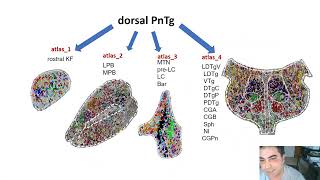
A Spatially-Resolved Transcriptional Atlas of the Murine Dorsal Pontine Tegmentum
Explore a groundbreaking transcriptional atlas of the murine dorsal pontine tegmentum using snRNA-seq and MERFISH, with interactive visualization for real-time data analysis and insights.
Acceleration of Bioinformatics Workloads Through Hardware-Algorithm Co-Design and Processing-in-Memory Technologies
Explore hardware-algorithm co-design and processing-in-memory technologies for accelerating bioinformatics workloads, focusing on genomic sequence analysis and mapping techniques.

Fast and Optimal Low-Rank Tensor Regression via Importance - Garvesh Raskutti, UW-Madison
Explore low-rank tensor regression using importance sketching for efficient high-dimensional data analysis, with theoretical guarantees and practical applications in neuroimaging.

Welcome to Ray Tracing
Introduction to ray tracing techniques for generating photo-realistic digital imagery, covering setup, rendering, performance optimization, and GPU acceleration using C++ and Vulkan.
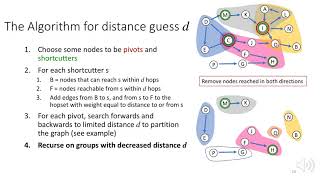
Efficient Construction of Directed Hopsets and Parallel Approximate Shortest Paths
Explore efficient algorithms for constructing directed hopsets and parallel approximate shortest paths, enhancing graph analysis and routing applications.
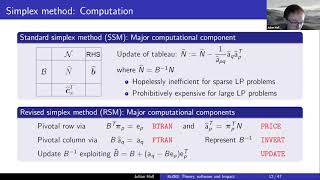
HiGHS - Theory, Software and Impact
Explore the theory, software, and impact of HiGHS optimization solver, covering simplex methods, hyper-sparsity, parallel solutions, and performance across various problem types.
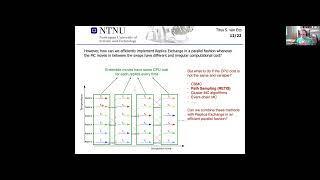
Exchanging Replicas with Unequal Cost, Infinitely and Permanently
Innovative replica exchange method for parallel simulations with varying computational costs, enhancing efficiency in Monte Carlo algorithms and path sampling techniques.
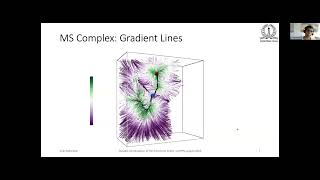
Scalable Computation of the Extremum Graph
Explore scalable computation of extremum graphs, a simplified topological descriptor for scalar functions, with applications in visualization and shape analysis. Learn efficient parallel algorithms for large datasets.
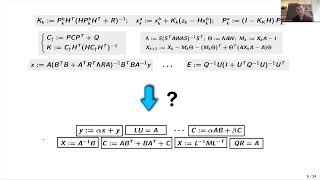
The Linear Algebra Mapping Problem and How Programming Languages Solve It
Explore the Linear Algebra Mapping Problem and its solutions in programming languages. Gain insights into high-performance computing and matrix operations for scientific applications.