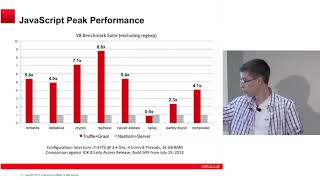
Graal and GPU Offload - Architecture and Implementation
Explore Graal architecture, GPU offloading, and HSAIL backend for Java performance optimization. Learn about Truffle, JavaScript peak performance, and special considerations for GPU compilation.

The Vector API in JDK 17 - Enhancements and Future Directions
Explore Java's Vector API enhancements in JDK 17, enabling data parallel computation with SIMD hardware. Learn implementation, future plans, and connections to Project Valhalla.
The Vector API - Inside Java Podcast 7
Explore the new Vector API with Java experts John Rose and Paul Sandoz, discussing SIMD, Project Panama, and advancements in Java performance optimization.
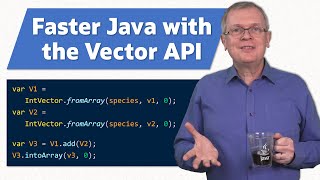
Writing Fast Java Code with the Vector API - JEP Café 18
Explore Java's Vector API for SIMD-based parallel computing, boosting performance through CPU optimization. Learn creation, manipulation, and efficient use of vectors for various computations.

Vector API - SIMD Programming in Java
Explore SIMD programming in Java with the Vector API, enabling platform-agnostic, data-parallel operations for enhanced performance and efficiency in your applications.
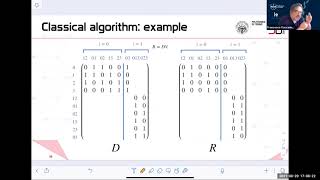
Parallel Decomposition of Persistence Modules Through Interval Bases
Exploring parallel decomposition of persistence modules using interval bases, with applications in Topological Data Analysis and connections to the Hodge Laplacian.

CUDA Toolkit 12.2 - New Accelerated Computing and Security Enhancements
Explore CUDA 12.2's new features: Hopper GPU support, confidential computing, heterogeneous memory management, and MPS prioritization enhancements for efficient, secure, and accelerated application development.
Confidential Containers for GPU Compute - Incorporating LLMs in AI Lift-and-Shift Strategy
Explore confidential containers for GPU-accelerated AI, integrating LLMs and Kubernetes for secure, high-performance computing while maintaining data privacy in cloud-native environments.
Exploit Parallelism for AI Workloads with WASM and OpenMP
Explore optimizing AI workloads using WebAssembly and OpenMP for multithreaded, shared memory, and vectorized operations, focusing on challenges and benefits in cloud computing environments.
Overcoming Challenges in Serving Large Language Models - SREcon23 Europe/Middle East/Africa
Explore hosting GPT models in Kubernetes, covering GPU sharding, tensor parallelism, and model optimization. Learn trade-offs between latency, accuracy, and resource allocation, with a live demo showcasing performance.

Apache RocketMQ - Trillion-Scale Messaging in Practice
Explore Apache RocketMQ's journey, features, and future in distributed messaging. Learn about its performance, core functionalities, and applications in large-scale systems like Alibaba's shopping festival.

From Battlegrounds to Fairways - Terrain Procedural Tools in Frostbite
Explore Frostbite's innovative terrain procedural framework, enabling efficient creation of diverse game environments through automated workflows and GPU-based compositing for faster artist iteration.
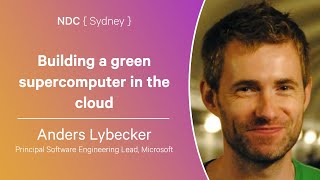
Building a Green Supercomputer in the Cloud
Explore green software principles and best practices for reducing carbon emissions in high-performance computing, using a case study of wind turbine simulations scaling to 400k cores and petabytes of data.
Ray on Kubernetes - Powering Quantitative Research at Scale
Discover how Ray on Kubernetes revolutionizes quantitative research with scalable infrastructure supporting 100,000 CPU cores, spot instances, and seamless GPU integration for high-performance trading operations.

LANL's Journey Toward Computational Storage - Exploring Data Reduction Techniques for Petabyte-Scale Simulations
Explore LANL's innovative approaches to handling massive simulation data through computational storage techniques, focusing on efficient data reduction and analytics optimization for petabyte-scale operations.
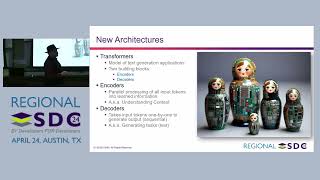
AI at the Intersection of Storage and Networking
Explore the technical implications of AI's rapid rise in storage and networking architectures, examining key challenges and future developments through an expert industry perspective.

Leveraging Computational Storage for Simulation Science Storage System Design
Explore how computational storage innovations at Los Alamos National Laboratory overcome bottlenecks in simulation science, featuring implementations with ZFS offloads, flash key-value storage, and SQL-like processing.
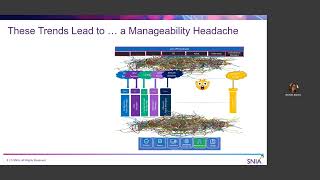
Scaling Management of Storage and Fabrics in Composable Disaggregated Infrastructures
Explore standards-based solutions for managing composable infrastructures, focusing on DMTF, SNIA, OFA, and CXL™ collaboration for efficient storage and fabric management at scale.
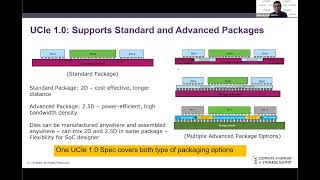
UCIe: An Open Standard for Package-Level Innovations in Computing Systems
Explore UCIe open standard for package-level innovations, covering key metrics, adoption criteria, and usage models for high-performance computing and heterogeneous processing integration.
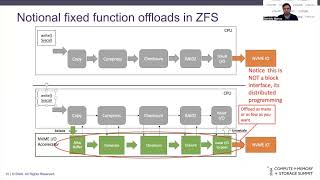
Improving Storage Systems for Simulation Science with Computational Storage
Explore how computational storage enhances HPC systems for simulation science, focusing on improved efficiency, transparent implementation, and real-world applications for petabyte-scale datasets.
Fabric Attached Memory: Hardware and Software Architecture for HPC Systems
Explore fabric-attached memory architecture and software solutions for handling large datasets in HPC clusters, focusing on AI and data analytics workloads using CXL and Arkouda-based applications.