Beyond Testset Performance - Strategies for Clinical Deployment
Strategies for deploying AI in clinical settings, addressing challenges beyond test performance. Explores model reliability, distribution shifts, and human-AI collaboration for real-world medical applications.
Domain Adaptation with Invariant Representation Learning - What Transformations to Learn?
Explore domain adaptation in machine learning, focusing on invariant representation learning and its challenges. Learn about novel techniques for optimal feature mapping across domains.

Efficiently Modeling Long Sequences with Structured State Spaces - Albert Gu
Explore structured state space models for efficient long sequence modeling across modalities, featuring S4's innovative approach to handling extended dependencies in various data types.
Weakly-Supervised, Large-Scale Computational Pathology for Diagnosis and Prognosis - Max Lu
Explore machine learning models for histopathology analysis, enabling large-scale cancer diagnosis and prognosis without manual annotations. Learn about innovative approaches in computational pathology.
Optimizing for Interpretability in Deep Neural Networks - Mike Wu
Explore techniques for making deep neural networks more interpretable through regularization, focusing on medical applications in critical care and HIV treatment. Insights on balancing model performance with human-understandable decision processes.

Deep Learning Methods for Electrocardiograms and Echocardiograms
Explore cutting-edge deep learning methods for ECG and echocardiogram analysis, outperforming traditional algorithms and offering insights into cardiovascular imaging interpretation.
GANs in Medical Image Synthesis, Translation, and Augmentation - Jason Jeong
Explore GANs in medical imaging for synthetic data generation, addressing scarcity and imbalance issues. Learn about applications in CT, MRI, and disease detection, with insights on challenges and future directions.
Adversarial Debiasing With Partial Learning - Medical Image Studies
Explore adversarial debiasing techniques to reduce racial disparities in medical AI models for chest X-rays and mammograms while maintaining overall performance and trustworthiness.

Assignment Control Plots for Causal Inference Study Design - Rocky Aikens
Explore visual tools for causal inference study design, focusing on assignment-control plots to analyze covariate distribution and improve observational and experimental studies.
Towards Generalist Imaging Using Multimodal Self-Supervised Learning - Mars Huang
Exploring multimodal self-supervised learning for generalist medical imaging AI, addressing limitations of supervised learning and clinical context integration in automated image analysis.
MedAI - Training Medical Image Segmentation Models with Less Labeled Data - Sarah Hooper
Innovative semi-supervised method for training medical image segmentation models using minimal labeled data, achieving comparable accuracy to fully supervised approaches while significantly reducing labeling requirements.
Observational Supervision for Medical Image Classification
Exploring gaze data as a novel supervision source for training deep learning models in medical image classification, focusing on chest X-rays and brain MRI scans for improved efficiency and accuracy.
Multimodal Medical Research of Vision and Language - Jean-Benoit Delbrouck
Explore multimodal medical research combining vision and language, focusing on innovative tasks like Medical Visual Question Answering and Radiology Report Generation using advanced AI architectures and pre-training techniques.
Self-Training - Weak Supervision Using Untrained Neural Nets for MR Reconstruction - Beliz Gunel
Exploring untrained neural networks for MR reconstruction, comparing self-training and weak supervision methods to improve performance with limited data while addressing slow inference times.
Multimodal Opportunistic Risk Assessment for Ischemic Heart Disease - Juan Manuel
Innovative approach integrating body composition biomarkers from CT scans with electronic medical records to enhance ischemic heart disease risk assessment, outperforming current clinical risk scores.
Mandoline - Model Evaluation under Distribution Shift
Explores a novel framework for evaluating machine learning models under distribution shifts, using slice-based reweighting to improve performance estimation on target distributions.

Heart Disease in Asian Americans - How to Lower Your Risk
Explore heart disease risks for Asian Americans and learn practical strategies to improve cardiovascular health through lifestyle modifications and cultural considerations.

Managing Chronic Conditions: Medications, Health Behaviors, and Self-Care
Comprehensive strategies for managing chronic conditions, combining medical care with lifestyle changes. Learn to set health goals and thrive despite ongoing health challenges.
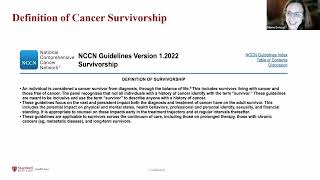
Stanford Medicine Cancer Survivorship Roundtable
Cancer survivors share experiences, coping strategies, and insights on regaining control and improving life quality post-diagnosis, offering valuable perspectives for those on similar journeys.
Active Surveillance of Prostate Cancer with Yushen Qian, MD
Explore prostate cancer diagnosis, risk assessment, and treatment options with Dr. Qian. Learn about PSA levels, biopsies, staging, and the differences between active surveillance and watchful waiting.
Treating Prostate Cancer - Active Surveillance, Surgery, Radiation Therapy, and New Focal Therapies
Explore prostate cancer treatments from active surveillance to innovative focal therapies. Learn about surgery, radiation, and new options like HIFU, MRgFUS, TULSA, and cryoablation for targeted, nerve-sparing tumor elimination.