Repeatable Execution
Explore a formal method for optimizing application logging, distinguishing between pure and impure code to make informed decisions on what to log for effective troubleshooting in production environments.
Functional Correctness - Haskell-ing Your Way to Reliable Code
Explore functional programming with Haskell to create reliable, maintainable software. Learn key concepts like referential transparency and pure functions through practical examples and approachable explanations.
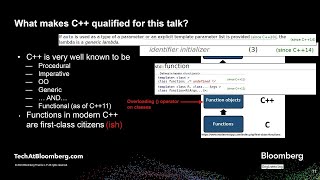
Monads in Modern C++ - Lecture
Demystify monads in C++ through theory and practical examples, exploring their increasing relevance in modern programming paradigms and real-world applications.
The Evolution of Effects in Haskell - From Monads to Higher-Order Effects
Explore the evolution of effectful programming in Haskell, from monads to higher-order effects. Gain insights into harmonizing pure functional programming with real-world computational effects.

GHC Status Report - Haskell Compiler Updates and Improvements
Explore GHC's latest developments, including quality-of-life improvements, WebAssembly support, dependent types, and linear types in this comprehensive status report.
Beyond Functional Programming: A Taste of Verse - Lambda Days 2023
Explore Verse, a new functional logic language for the metaverse, featuring innovative concepts beyond traditional functional programming paradigms.
The Imperatives Must Go! - Functional Programming Techniques in Modern C++
Explore functional programming techniques in C++ to write clearer, shorter, and faster code. Learn about STL's functional parts, algebraic data types, and upcoming FP features in the next C++ standard.
Discrimination is Wrong - Improving Productivity in Haskell Library Design
Explore advanced Haskell library design, optimizing discrimination techniques for O(n) operations. Dive into category theory, encodings, system-level concerns, and laziness properties.
Caught in a Web of Functions - Building Composable Web Frameworks with Haskell
Explore how to break down web frameworks into composable functions, using Haskell's WAI library to demonstrate better approaches to functional programming and library design.
Production Haskell - Building and Deploying Haskell Applications
Discover practical insights into implementing Haskell in production environments, covering deployment strategies, testing approaches, and real-world application development techniques.
The Human Side of Haskell - Understanding Social and Technical Challenges
Explore the human aspects and practical implications of Haskell programming through real-world experiences and insights into functional programming adoption in software development teams.