Staging with Class - A Specification for Typed Template Haskell
Explore multi-stage programming in Haskell, focusing on typed code quotation and its interaction with type classes. Learn about staged type class constraints and their formalization in source and core calculi.
Functional Programming in Education
Exploring the role of functional programming in tertiary education, suggesting improvements using typed languages like Haskell, and recommending resources for modern programming education.
Denotational Design - From Meanings To Programs
Explore denotational design for functional programming libraries, focusing on precise mathematical models to define APIs and guide implementations, illustrated with examples like FRP and image synthesis.
Property-based State Machine Testing
Introduction to property-based state machine testing in Haskell using hedgehog library. Explores techniques for testing web applications, including content creation, deletion, constraints, and authentication.
Teaching New Tricks to Old Programs Part 2
Explore advanced functional programming techniques for reinterpreting existing code, including hardware circuits, automatic differentiation, and interval analysis, using Haskell and GHC plugins.
Teaching New Tricks to Old Programs Part 1
Explore new interpretations for functional programs, including hardware circuits and automatic differentiation. Learn techniques for overloading lambda and organizing interpretations in Haskell.
Propagators Part 2
Explores advanced concepts in propagator algorithms, blending frameworks to optimize termination and consistency in various computational domains like CRDTs, Datalog, and constraint programming.
Reviving 1990's Digital Dress-Up Dolls with Smooch
Explore the revival of 1990s digital dress-up dolls using JavaScript and Haskell. Dive into the Kisekae Set System's specifications, custom image format, and scripting language for a nostalgic journey through digital art history.
Functional Programming in Python and Even Haskell Part 1
Explore functional programming concepts in Python and Haskell, enhancing your coding skills with advanced techniques and paradigms.
Full-Stack Haskell - From Prototype to Production
Explore full-stack Haskell development, from backend reliability to frontend GUIs. Learn about overcoming obstacles, leveraging strong typing, and expanding Haskell's practical applications in professional projects.
Effective Haskell
Explore Haskell's power with experts Rebecca Skinner and Emily Pillmore. Learn about GHC, laziness, MTL, and practical applications. Gain insights on embracing failure and finding joy in coding.
GHC Language Extensions
Explore common GHC language extensions in Haskell, their use cases, and potential risks. Learn about syntactic sugar, type class-related extensions, and how to use them effectively.
Strongly Typed System F in GHC
Explore implementing polymorphic strongly typed abstract syntax in Haskell, covering variable binding representations and pushing the boundaries of dependently typed programming in GHC.
The Reflex Architecture
Explore Reflex-dom for Haskell web apps using Functional Reactive Programming. Learn state management, widget type signatures, and architectural patterns familiar to Redux and Elm developers.

Haskell Code Exploration with Emacs
Explore Haskell code efficiently with Emacs using offline documentation, local resources, and specialized packages. Learn about literate programming and reindexing techniques for enhanced productivity.
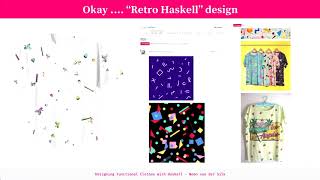
Designing Functional Clothes with Haskell
Learn to create unique clothing patterns using Haskell's "diagrams" library. Explore composable graphics, mathematical structures, and build an open-source fashion design pipeline for functional and stylish apparel.
Functional Programming in C++
Explore functional programming concepts and their implementation in C++, comparing with Haskell. Learn about pure functions, closures, lazy evaluation, and more in this comprehensive talk.
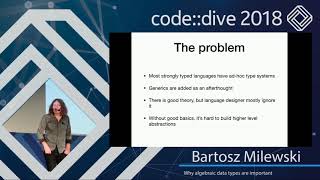
Why Algebraic Data Types Are Important
Explore type theory, category theory, and logic in functional programming, focusing on algebraic data types and their role in enhancing code reliability and expressiveness.
Boosting MPL with Haskell Elements
Explore advanced C++ template metaprogramming techniques inspired by Haskell, including let expressions, monads, list comprehension, and error handling, to enhance Boost.MPL and improve code readability and organization.
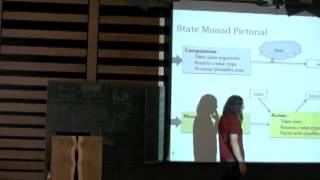
Haskell - The Pseudocode Language for C++ Template Metaprogramming
Explore functional programming concepts in Haskell to improve C++ template metaprogramming skills. Learn to read and write complex metaprograms using Haskell as pseudocode for C++.
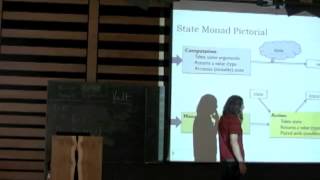
Haskell - The Pseudocode Language for C++ Template Metaprogramming - Part 2
Explore functional programming concepts in Haskell to enhance C++ template metaprogramming skills. Learn to write and analyze complex metaprograms using Haskell as pseudocode.