Building Haskell Programs with Fused Effects
Explore fused-effects library for Haskell: a powerful, flexible alternative to monad transformers, offering improved expressiveness without performance loss. Learn its history, benefits, and practical applications.
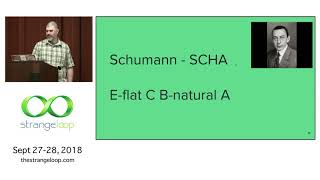
Musical Steganography - Hiding Things in Music
Explore techniques for concealing messages in music, from Bach's compositions to modern digital methods. Learn to apply steganographic principles using TidalCycles and Haskell.
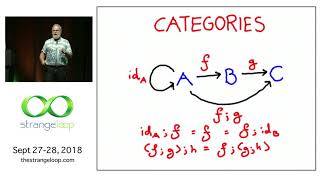
Categories for the Working Hacker
Explore category theory's relevance to developers through Java, Haskell, and blockchain languages. Learn how categories model basic data types and their connection to logic and computing.
Proof Theory Impressionism - Blurring the Curry-Howard Line
Exploring approaches to bridge the gap between proof assistants and production languages, focusing on Rust and its potential for incorporating provable system capabilities.
Point-Free or Die - Tacit Programming in Haskell and Beyond
Explore tacit programming in functional languages, its benefits, drawbacks, and applications. Learn eta-reduction, develop intuition, and examine its use in libraries and specialized languages.
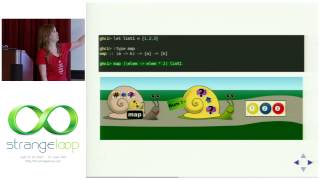
Coder Decoder - Functional Programmer Lingo Explained, with Pictures
Demystifies functional programming jargon using Haskell examples and visuals. Explores concepts like currying, lenses, and monads, demonstrating their application in a simple web app.
Safe and Secure Drivers in High-Level Languages
Explore writing PCIe drivers in modern languages like Rust and Go, focusing on safety, security, and performance. Learn techniques for user-space implementation and hardware isolation.
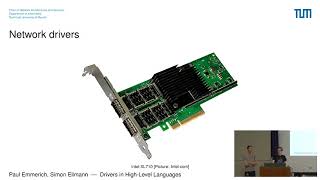
Treiber in High-Level Programmiersprachen
Netzwerktreiber-Implementierung in verschiedenen Hochsprachen: Vergleich von Sicherheitsfeatures, Performance und Komplexität für Intel 10 Gbit/s Karten in Rust, Go, OCaml, Haskell, C#, Python und Swift.

Building Secure Systems in Haskell
Explore building secure web applications using Haskell's LIO and Hails framework, focusing on data privacy protection through language-level information flow control and declarative policy specification.
Side Effects Are a Public API
Explore techniques for isolating and representing side effects as intents, improving code testability and maintainability in Python and functional programming paradigms.
Dependent Types in Haskell
Explore dependent types in Haskell, their influence on GHC, and practical applications through an extended example. Learn about current capabilities, challenges, and surprises in language design.
Hackett - A Metaprogrammable Haskell
Explore Hackett, a language combining Haskell's type system with Racket's macro system. Learn about interleaved macroexpansion and typechecking, and discover new possibilities for metaprogramming and DSLs.
Towards Annex - A Fact Based Dependency System
Explore a novel approach to dependency management using fact-based systems, functional programming, and datalog principles for improved flexibility, reproducibility, and context-aware artifact queries.
Functional Patterns for the Object Oriented
Explore functional programming patterns in OO languages, comparing Haskell approaches with traditional OO solutions. Learn about lambda expressions, stream processing, tuples, and pattern matching.
Eta Lang - Haskell on JVM
Explore Eta, a Haskell implementation for JVM, its performance, and integration with Java. Learn about tail call optimizations and potential use cases for combining Haskell/Eta with Java components.
Modern Software Development with Haskell
Explore Haskell's unique features for writing declarative, compositional, efficient, and safe software in this introduction to advanced purely functional programming.
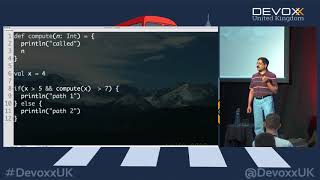
Let's Get Lazy - Exploring the Real Power of Streams
Explore lazy evaluations and Stream API in Java for efficient coding. Learn from Haskell and Scala examples to harness the power of lambdas and achieve optimal performance in your programs.
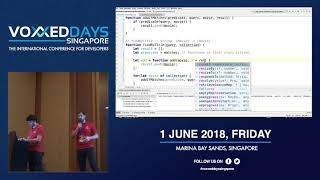
From Javascript to Haskell - Functional Programming Made Simple
Demystifying functional programming concepts through live coding, transforming imperative code to functional. Explore key principles like higher-order functions, closures, and currying for clearer, more efficient code.
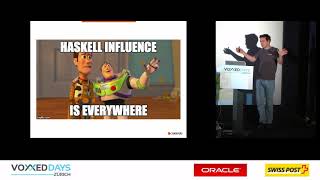
What Haskell Taught Us When We Were Not Looking
Explore Haskell's influence on JVM languages, its unique constructs, and potential future impacts. Discover how functional programming concepts can enhance your coding skills and broaden your programming perspective.
Hashing Modulo Alpha Equivalence
Explore efficient hashing techniques for identifying identical subtrees in program syntax, focusing on alpha-renaming robustness and asymptotic efficiency in functional programming languages.
Let's Get Lazy - Exploring the Real Power of Streams
Explore the power of lazy evaluations and Streams in Java for efficient programming. Learn how to leverage lambda expressions and avoid unnecessary computations.