
Looking for Malicious Hardware Implants with Minimal Equipment
Explore hardware security threats, detection methods, and threat modeling with minimal equipment. Learn to identify unexpected features and understand the challenges of hardware implants and interdiction.
Securing Bare Metal Hardware at Scale
Explore advanced techniques for securing firmware in large-scale hardware deployments, addressing challenges and future trends in protecting against persistent backdoors and exploits.

Adventures in Hardware Hacking or Building Expensive Tools on a Budget
Explore hardware hacking techniques like CT scanning and chip decapping for non-destructive device analysis, circuit reconstruction, and vulnerability identification in embedded systems and access control.
One Glitch to Rule Them All - Fault Injection Attacks Against the AMD Secure Processor
Explore fault injection attacks on AMD's Secure Processor, revealing vulnerabilities in CPU security and discussing implications for system integrity and trust.
Secret Flaws of In-DRAM RowHammer Mitigations
Unveiling secret flaws in DRAM RowHammer mitigations, exploring Target Row Refresh implementation, and introducing TRRespass: a RowHammer fuzzer for creative hammering patterns to bypass protections.
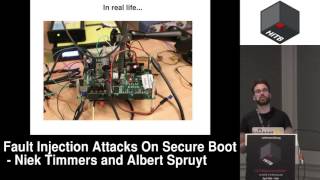
Fault Injection Attacks on Secure Boot
Exploring fault injection attacks on secure boot, this talk introduces techniques, impacts, and practical mitigation strategies for embedded systems security, with real-world examples and key takeaways.
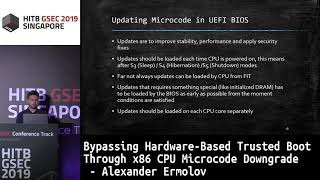
Bypassing Hardware-Based Trusted Boot Through x86 Downgrade
Exploiting microcode loader vulnerability to downgrade CPU microcode, enabling attacks on Intel security technologies like Boot Guard and TXT by loading older, vulnerable versions of Authenticated Code Modules.

Auditable & Provable Privacy of Smart Speakers
Explore smart speaker privacy vulnerabilities, including skill squatting and eavesdropping, and learn about potential solutions like hardware mic disconnects and user awareness.
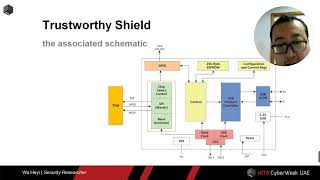
Trustworthy Shield – A Cheap TPM Module for Older Systems
Explore a cost-effective TPM module for older systems, enhancing security without hardware changes. Learn about trusted computing technology and its applications in IoT and embedded systems.

Eight Crazy Ways to Foil Hardware Attacks - For All Budgets
Explore cost-effective strategies to protect embedded devices from hardware attacks. Learn about common vulnerabilities, defense mechanisms, and design decisions for optimal security in IoT and industrial control systems.
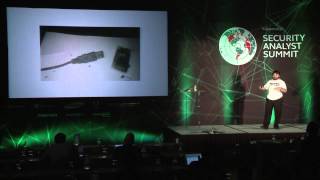
Tools of NSA Playset
Explore NSA's surveillance tools, including retroreflectors, USB implants, and Thunderbolt exploits. Learn about their capabilities and implications for cybersecurity.
Finding Government and Vendor Hardware Backdoors
Explore techniques for identifying hidden backdoors in government and vendor hardware, covering pentesting, security appliances, and various operating systems.
Page Cache Attacks - Microarchitectural Attacks on Flawless Hardware
Explore microarchitectural attacks on flawless hardware, focusing on page cache vulnerabilities. Learn about state-of-the-art techniques, countermeasures, and implications for system security.

When Lightning Strikes Thrice - Breaking Thunderbolt 3 Security
Explore Thunderspy attacks that compromise Thunderbolt security, revealing vulnerabilities in device authentication and DMA protection across Thunderbolt 1, 2, and 3 interfaces.

HPE iLO5 Firmware Security - Go Home Cryptoprocessor, You're Drunk!
Explore vulnerabilities in HPE Gen10 servers' iLO5 management technology, focusing on the "silicon root of trust" and its implications for server security.
PCIe Device Attacks - Beyond DMA - Exploiting PCIe Switches, Messages and Errors
Explore advanced PCIe security threats targeting switches and Translation Layer Packets. Learn about novel attack vectors beyond traditional DMA exploits in high-bandwidth peripheral connections.
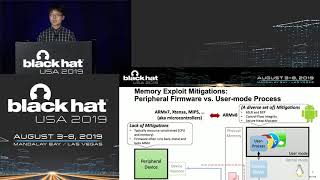
PeriScope - An Effective Probing and Fuzzing Framework for the Hardware-OS Boundary
Explore PeriScope, a Linux-based framework for analyzing device-driver interactions, enabling passive monitoring and active fuzzing to enhance hardware-OS boundary security.

Intel VISA - Through the Rabbit Hole
Explore Intel's internal architecture, PCH devices, and security-sensitive data access. Learn to read signals from internal buses and discover hidden components within Intel chips.

PicoDMA - DMA Attacks at Your Fingertips
Explore PicoDMA, a compact FPGA-based platform for DMA attacks. Learn about its capabilities, hardware, and potential security implications using the affordable PicoEVB board.
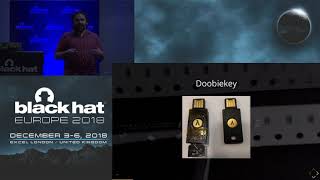
A Measured Response to a Grain of Rice
Explore hardware security vulnerabilities, implants, and detection challenges in modern devices. Learn about potential threats and protective measures in this comprehensive overview.

I, for One, Welcome Our New Power Analysis Overlords
Introduces ChipWhisperer-Lint, an open-source tool for automating power analysis attacks on devices using ChipWhisperer hardware, enhancing security testing capabilities.