Algebraicity of BG and BunG - Talk 3
Delve into algebraic stacks theory, exploring classifying stack BG and Bun_{G,X}, with focus on GL_n groups and smooth projective curves, including Weil's automorphic interpretation.
The Harder-Narasimhan Filtration and Stability Conditions for Vector Bundles
Delve into the mathematical theory of stability conditions and Harder-Narasimhan filtration for vector bundles, exploring their applications in geometric invariant theory and moduli spaces.
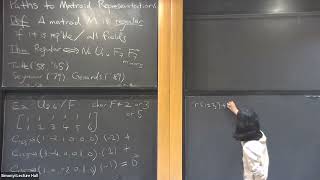
Paths to Matroid Representations
Delve into advanced matroid theory, exploring representation theorems, connectivity statements, and orthogonal matroids through historical developments and modern algebraic approaches.
Symmetries and Quantum Mechanics: Class Functions and Number of Irreducible Representations - Lecture 7
Explore the fundamental concepts of group representation theory in quantum mechanics, focusing on class functions and irreducible representation enumeration.
Symmetries and Quantum Mechanics: Irreducible Representations, Characters, and Schur's Lemma
Delve into advanced quantum mechanics concepts, exploring group representation theory, irreducible representations, characters, and Schur's lemma in theoretical physics applications.
The Square Lattice via Group D4 and Its Hypergroups - Diffusion Symmetry
Explore hypergroups and their connection to symmetry in the square lattice, focusing on the D4 group and its character table. Learn about orthogonality relations in hypergroup character tables.
A New Paradigm for Mathematics and Physics - Diffusion Symmetry
Exploring diffusion symmetry as a new paradigm for understanding symmetry in mathematics and physics, offering insights into group theory, character tables, and fusion rule algebras.
Simple Groups, Lie Groups, and the Search for Symmetry I - Math History - NJ Wildberger
Explore the history of group theory, from simple groups to Lie groups, and their role in describing symmetry in geometry. Discover remarkable mathematical objects and the classification of finite simple groups.
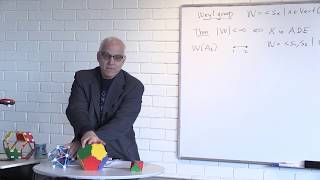
Geometric Graph Theory - Weyl Groups, Root Systems and Quadratic Forms
Explore geometric graph theory through the Mutation Game, examining root systems, Weyl groups, and quadratic forms. Discover how graphs generate unique geometrical structures and reflection groups.
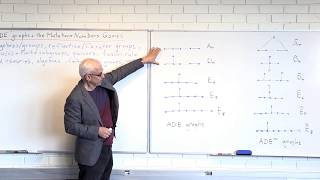
The Ubiquity of ADE Graphs, and the Mutation and Numbers Games - Math Seminars
Explore ADE graphs' mathematical significance, mutation games, and connections to advanced fields like Lie algebra, root systems, and physics in this insightful seminar on combinatorial structures.
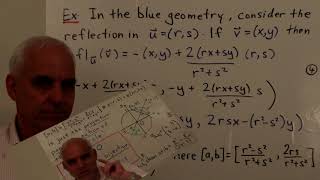
The Group of Blue Planar Isometries - WildTrig: Intro to Rational Trigonometry - N J Wildberger
Explore Euclidean isometries from a rational perspective, focusing on grounded isometries and deriving formulas for projections, reflections, and compositions in planar geometry.
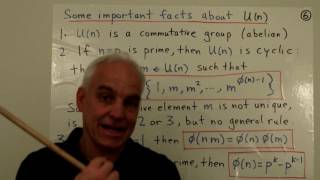
Reciprocals, Powers of 10, and Euler's Totient Function II - Data Structures Math Foundations
Explore unit groups, Euler's totient function, and number theory concepts. Learn how to calculate repeated cycles for fractions using algebraic techniques and group theory principles.
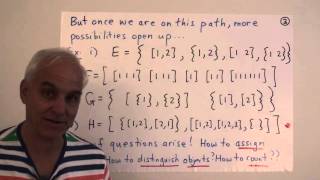
Higher Data Structures - Data Structures in Mathematics Math Foundations
Explore advanced mathematical data structures, including nested combinations of lists, ordered sets, multisets, and sets. Learn their applications in combinatorics, graph theory, and other mathematical fields.
High-Dimensional Expanders - How I Learned to Stop Worrying and Love Group-Theoretic Constructions
Explore high-dimensional expanders, focusing on 2-dimensional cases, graphs of constant link, and group-theoretic constructions. Gain insights into advanced mathematical concepts and recent research developments.
Linear Algebra With Polynomials - Wild Linear Algebra A
Explore polynomials in linear algebra, covering interpolation, regression, and isomorphism. Learn to apply geometric approaches to transformations and connect polynomial spaces with vector spaces.
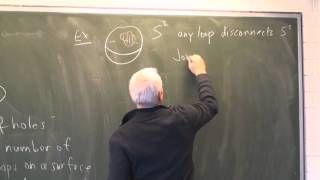
Two-Dimensional Objects - The Torus and Genus - Algebraic Topology
Explore surfaces like cylinders and tori, understanding their properties and connections to complex function theory. Learn about genus and how planes cover different surfaces.
Lots of Group Isomorphism Examples
Explore group homomorphisms and isomorphisms through practical examples, applying the first isomorphism theorem to deepen understanding of abstract algebra concepts.
Primitive Roots Modulo N and the Structure of U-N
Explore primitive roots modulo n and their application in determining the structure of U(n), the group of units modulo n, in this advanced number theory discussion.
What Is It Like to Be a Pure Mathematician?
Explore the life of a pure mathematician, delving into abstract algebra, group theory, and partitions. Gain insights into the field's challenges, problem-solving approaches, and the beauty of elegant proofs.
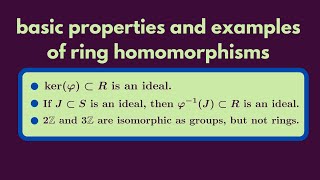
Abstract Algebra - Properties and Examples of Ring Homomorphisms
Explore ring homomorphisms' properties and examples, including proofs and comparisons of isomorphic groups versus rings in abstract algebra.

Representations of Finite Groups - A Few More Common Examples
Explore representations of finite groups including cyclic, dihedral, quaternions, and symmetric groups. Gain insights into advanced abstract algebra concepts and their applications.