
An Introduction to Smooth Manifolds
The course will start with a brief outline of the prerequisites from topology and multi-variable calculus. After that a large class of examples, including Lie groups, will be presented. The course will culminate with proof of Stokes' theorem on manifolds.
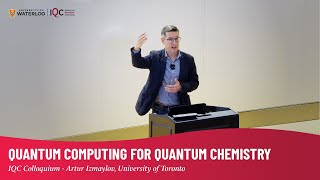
Quantum Computing for Quantum Chemistry
Explore quantum computing's potential in solving complex quantum chemistry problems, focusing on electronic structure and Hamiltonian partitioning techniques.
Methods for Studying Abelian Actions and Centralizers - Lecture 5: Transitive Centralizer and Fibered Partially Hyperbolic Systems
Explore transitive centralizers and fibered partially hyperbolic systems in dynamical systems. Gain insights into advanced concepts in smooth ergodic theory and their applications to centralizer rigidity.
Methods for Studying Abelian Actions and Centralizers - Lecture 3
Explore two methods for studying abelian actions and centralizers: linearization and non-linearization. Delve into cohomology concepts and their applications in dynamical systems analysis.
Methods for Studying Abelian Actions and Centralizers - Lecture 6
Explore centralizer rigidity and classification in accessible examples of dynamical systems. Gain insights into the non-generic situations where smooth centralizers form larger groups, particularly in algebraic systems.
Geometrical Anatomy of Theoretical Physics
Comprehensive exploration of advanced mathematical concepts in theoretical physics, from set theory to Lie groups, manifolds, and fiber bundles, with applications in quantum mechanics and symmetries.
Current Algebra and Generalised Cartan Geometry
Dive into advanced mathematical concepts exploring current algebra and generalized Cartan geometry, examining their interconnections and applications in mathematical physics.
An Introduction to Geometry and Dynamics on Semisimple Lie Groups - Lecture 3
Explore semisimple Lie groups, their structure, discrete subgroups, and asymptotic behavior through advanced mathematical concepts and theorems.
Introduction to Geometric Control Theory - Lecture 4
Explore geometric control theory's advanced concepts, focusing on mathematical foundations and practical applications in dynamic systems and optimization.
Introduction to Geometric Control Theory - Lecture 3
Explore advanced concepts in geometric control theory, focusing on mathematical principles and applications in dynamic systems and optimization.
Introduction to Geometric Control Theory - Part II
Explore advanced concepts in geometric control theory, focusing on mathematical principles and applications in dynamic systems and optimization.
Introduction to Geometric Control Theory - Lecture 1
Explore geometric control theory fundamentals with expert Andrei Agrachev, covering key concepts and applications in this comprehensive lecture from ICTP Mathematics.

Ergodic and Mixing Properties of Horocycle Flows - Lecture 1
Delve into the mathematical foundations of horocycle flows and their time-changes, exploring ergodic theory, mixing properties, and applications in hyperbolic geometry through advanced theoretical concepts.
Simple Groups, Lie Groups, and the Search for Symmetry I - Math History - NJ Wildberger
Explore the history of group theory, from simple groups to Lie groups, and their role in describing symmetry in geometry. Discover remarkable mathematical objects and the classification of finite simple groups.
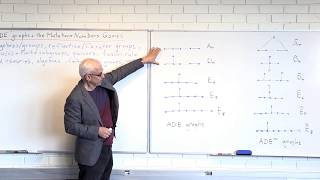
The Ubiquity of ADE Graphs, and the Mutation and Numbers Games - Math Seminars
Explore ADE graphs' mathematical significance, mutation games, and connections to advanced fields like Lie algebra, root systems, and physics in this insightful seminar on combinatorial structures.
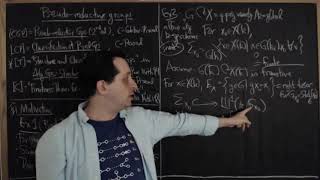
Pseudo-Reductive Groups by Brian Conrad
Explore pseudo-reductive groups with Brian Conrad, covering definitions, properties, and key theorems in this advanced mathematics lecture on algebraic group theory.
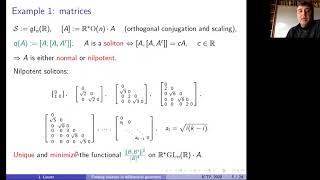
Finding Solitons in Differential Geometry
Explore solitons in differential geometry, their role in discovering distinguished geometric structures, and applications in various mathematical contexts including Lie groups and algebras.
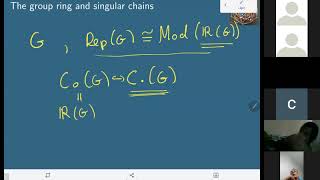
Singular Chains on Lie Groups and the Cartan Relations
Explore the connection between Lie group representations and infinitesimal descriptions using Cartan relations, with applications to Chern-Weil theory and higher local systems on classifying spaces.
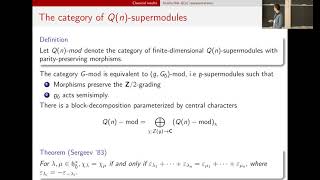
Finite-Dimensional Representations of the Queer Lie Supergroup Q-N
Explore finite-dimensional representations of Q(n), including G-modules, Qn modules, Vera's theorem, and the typical lemma in supergeometry and bracket structures.
Fundamentals of Lie Groupoids and Algebroids - Lecture Series
Introducción a la teoría de Lie de grupoides y algebroides, explorando sus definiciones, propiedades y aplicaciones en diversas estructuras geométricas.
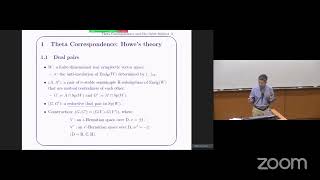
Theta Correspondence and the Orbit Method
Exploring theta correspondence and orbit method in representation theory, focusing on implications for unitary representations of classical groups and special unipotent representations.