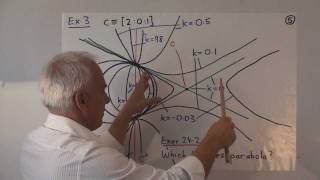
Visualizing Quadrance with Circles - Universal Hyperbolic Geometry - NJ Wildberger
Explore quadrance in universal hyperbolic geometry through circles, examining their appearance as ellipses, parabolas, or hyperbolas with different centers, enhancing understanding of this fundamental concept.
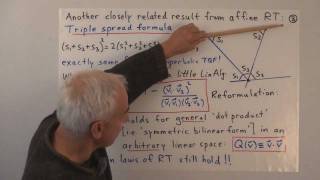
The Triple Quad Formula in Universal Hyperbolic Geometry
Explores the Triple quad formula in hyperbolic geometry, its proof, and related concepts. Compares with Euclidean geometry and discusses algebraic challenges, providing exercises for deeper understanding.
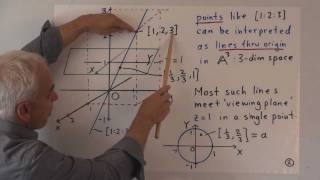
Pythagoras' Theorem in Universal Hyperbolic Geometry
Explore the hyperbolic version of Pythagoras' theorem, its importance in geometry, and the concept of quadrance. Learn about planar coordinates, formulas, and proofs in Universal Hyperbolic Geometry.
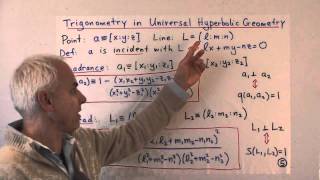
Quadrance and Spread - Universal Hyperbolic Geometry
Introduces algebraic definitions of quadrance and spread in Universal Hyperbolic Geometry, comparing with Rational Trigonometry and exploring main laws and exercises in this advanced mathematical framework.
Apollonius' Circle Construction Problems - Famous Math Problems
Explore Apollonius' circle construction problems, their historical significance, and related geometric concepts. Learn about circle geometry, constructions, and their relevance in modern mathematics.
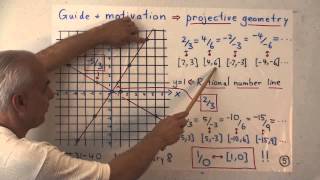
Extending Arithmetic to Infinity - Real Numbers and Limits Math Foundations
Explore extending arithmetic to infinity using rational numbers and projective geometry. Learn about integral points, theorems, and distributive laws in this mathematical journey.
Computing Homology Groups - Algebraic Topology - NJ Wildberger
Explore homology groups in algebraic topology, focusing on examples like circles and disks. Learn about connectivity, loops, and higher-dimensional holes in spaces.
Simplices and Simplicial Complexes - Algebraic Topology
Explore higher-dimensional geometry through simplices and simplicial complexes. Learn about convex combinations, orientations, and the fundamental concept of homology in algebraic topology.
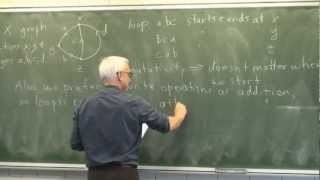
An Introduction to Homology - Algebraic Topology
Explore higher-dimensional topology through homology groups, cycles, and spanning trees. Learn to compute and characterize independent cycles in graphs using algebraic techniques.
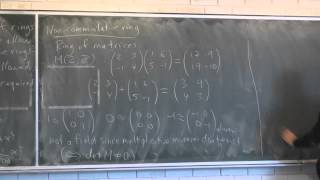
An Informal Introduction to Abstract Algebra
Informal introduction to abstract algebra, covering fields, rings, and vector spaces. Explores key concepts and examples, from basic number systems to advanced constructions, providing essential background for algebraic topology.

Differential Geometry - Math History - NJ Wildberger
Explore the foundations of differential geometry, from planar curves to Gaussian curvature, and its impact on modern physics. Learn about key concepts and historical contributions in this mathematical field.
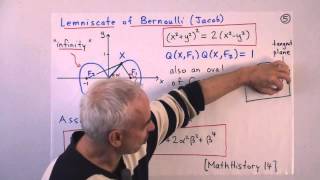
Newton's Method and Algebraic Curves - Real Numbers and Limits Math Foundations
Explore Newton's method for algebraic curves, examining Fermat curves and Bernoulli's Lemniscate. Learn about Taylor expansions, tangent planes, and iterative techniques for approximating curve intersections.
Elementary Projective Geometry - Elementary Mathematics Explained
Explore elementary projective geometry, focusing on line geometry and basic concepts like joins, meets, and quadrangles. Learn through hands-on constructions and discover fascinating correspondences in geometry.
Pappus and Pascal - Elementary Mathematics Explained
Explore Pappus' and Pascal's theorems in projective geometry, learning key concepts and historical context. Gain insights into reading mathematics and appreciating these fundamental results.
Rational Trigonometry in Three Dimensions - Universal Hyperbolic Geometry
Extending rational trigonometry to 3D using vectors and dot products. Explores quadrance, spread, and key trigonometric laws. Introduces solid spread and determinants for three vectors.
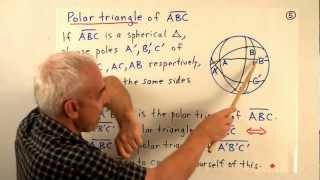
Perpendicularity, Polarity and Duality on a Sphere - Universal Hyperbolic Geometry
Explore perpendicularity, polarity, and duality on a sphere, including polar triangles and point-plane duality. Gain insights into elliptic geometry and the relationships between geometric elements.
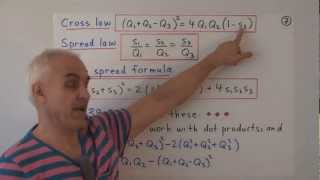
Rational Trigonometry - An Overview - Universal Hyperbolic Geometry
Introduces rational trigonometry using vectors, replacing distance and angle with quadrance and spread. Covers key concepts, formulas, and laws, offering a purely algebraic approach to trigonometry and geometry.
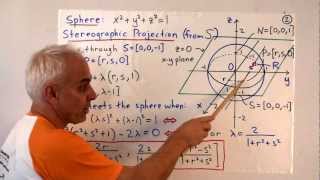
Parametrizing and Projecting a Sphere - Universal Hyperbolic Geometry
Explore stereographic and gnomonic projections of a sphere, including rational parametrization, coordinate systems, and their applications in elliptic geometry.
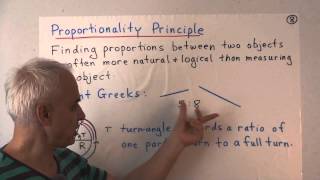
Areas and Volumes for a Sphere - Universal Hyperbolic Geometry
Explore Archimedes' sphere formulas, rational turn angles, and Harriot's theorem. Learn key principles in spherical geometry and discover new ways to conceptualize angles and areas.
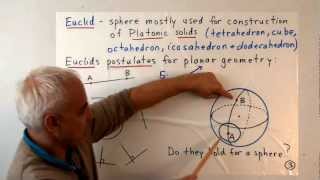
Spherical and Elliptic Geometries - Universal Hyperbolic Geometry
Explore spherical and elliptic geometries, from ancient Greek astronomy to modern concepts. Learn about longitude, latitude, measurement techniques, and key theorems in non-Euclidean spaces.
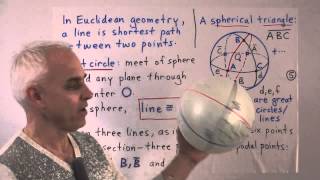
Spherical and Elliptic Geometries - An Introduction
Explore spherical geometry fundamentals: great circles, antipodal points, triangles, and circles. Learn key concepts and visualize ideas with physical models, connecting to 3D space and Euclidean geometry.