Addition in Practice - Elementary Mathematics Explained
Explore addition laws, even/odd numbers, and their geometric representations. Learn associative and commutative properties, and discover practical applications in arithmetic and counting problems.
Hyperbolic Geometry Is Projective Relativistic Geometry - Full Lecture
Explore hyperbolic geometry as projective relativistic geometry, covering key concepts, models, and theorems. Gain insights into quadrance, spread, trigonometry, and unique results like the Jumping Jack theorem.
Triangle Geometry Old and New - An Introduction to Hyperbolic Triangle Geometry
Explore classical and hyperbolic triangle geometry, covering perpendicularity, midpoints, and bilines. Learn about orthocenters, incenters, circumcenters, and more through visual illustrations without complex formulas.
Laurent Polynumbers - The New Years Day Lecture - Arithmetic and Geometry Math Foundations
Explore Laurent polynumbers, their arithmetic, and relation to rational polynumbers. Learn about the foundational importance of rational numbers and polynumbers in mathematics.
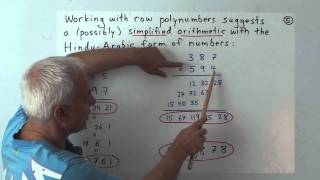
Row and Column Polynumbers - Arithmetic and Geometry Math Foundations
Explore two-dimensional arithmetic with polynumbers, introducing bipolynumbers and their associated polynomials in alpha and beta variables. Learn simplified arithmetic and multiplication techniques.
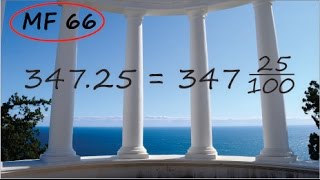
Decimal Numbers - Arithmetic and Geometry Math Foundations
Explore decimal numbers, their representation in the Hindu-Arabic system, and conversion between fractions and decimals. Learn about notation, structure, and practical applications in mathematics.
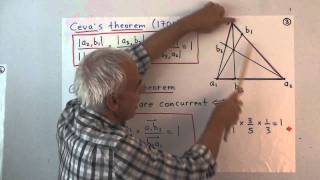
Menelaus, Ceva and the Laws of Proportion - Universal Hyperbolic Geometry
Explore classical theorems of Menelaus and Ceva in universal hyperbolic geometry, along with new results on triangle proportions and alternate spreads. Learn about ratios, distances, and quadrances in triangular geometry.
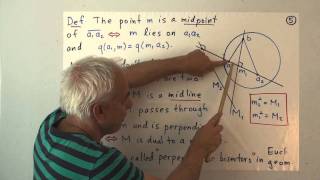
Isosceles Triangles in Hyperbolic Geometry - Universal Hyperbolic Geometry - NJ Wildberger
Explore isosceles triangles in hyperbolic geometry, including special formulas, midpoint construction, and related theorems. Gain insights through proofs, exercises, and applications of the cross law.
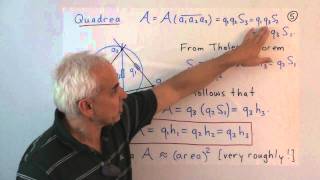
Thales' Theorem, Right Triangles + Napier's Rules - Universal Hyperbolic Geometry
Explores Thales' theorem and Napier's rules in universal hyperbolic geometry, focusing on right triangles. Covers key concepts like quadrea, spreads, and proofs, with practical exercises for deeper understanding.
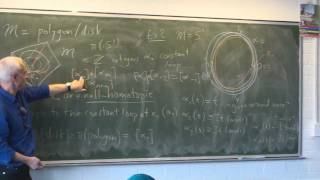
The Fundamental Group - Algebraic Topology
Explore the fundamental group in algebraic topology, covering homotopic paths, loop multiplication, and equivalence classes. Understand key concepts for surfaces like disks and circles.
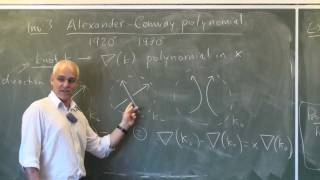
Knots and Surfaces I - Algebraic Topology - NJ Wildberger
Explore knot theory's origins, basic concepts, and key invariants in this introductory lecture on algebraic topology, covering Reidemeister moves, crossing numbers, and the Alexander-Conway polynomial.
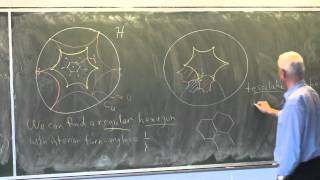
The Two-Holed Torus and 3-Crosscaps Surface - Algebraic Topology - NJ Wildberger
Explore hyperbolic geometric structures of two-holed torus and 3-crosscaps surface through tessellations, hexagons, and the Beltrami Poincare model in this advanced algebraic topology lecture.
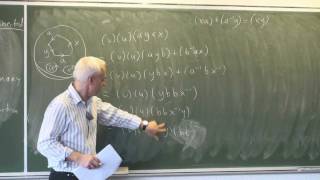
An Algebraic ZIP Proof of the Classification - Algebraic Topology - NJ Wildberger
Algebraic approach to classifying two-dimensional surfaces using spheres with holes, introducing a notation for manipulating edges between holes on spheres. Explores Conway's ZIP proof in a novel way.
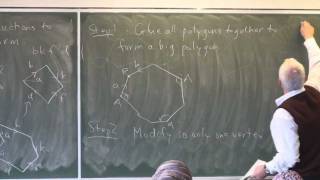
Classification of Combinatorial Surfaces - Algebraic Topology - NJ Wildberger
Introduction to the classification of connected compact combinatorial surfaces in algebraic topology, covering key concepts like polygons, vertices, traversing, Euler number, and orientability.
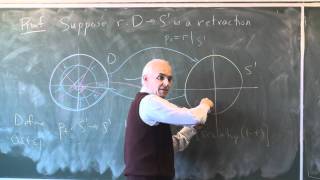
More Applications of Winding Numbers - Algebraic Topology - NJ Wildberger
Explore winding numbers, degree of circle functions, and key theorems in algebraic topology. Learn about retractions, fixed points, and Borsuk's Lemma in this advanced mathematics lecture.
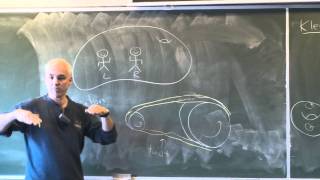
Non-Orientable Surfaces - The Mobius Band - Algebraic Topology
Explore non-orientable surfaces like the Möbius band, understanding their unique properties and applications in algebraic topology. Learn about crosscaps and key deformations.
The Klein Bottle and Projective Plane - Algebraic Topology - NJ Wildberger
Explore the Klein bottle, projective plane, and Platonic solids in this algebraic topology lecture. Learn about Euler's formula and its proof using triangulation and sphere flow.
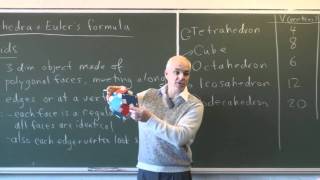
Polyhedra and Euler's Formula - Algebraic Topology
Explore Platonic solids, Euler's formula, and spherical geometry in this engaging lecture on algebraic topology, featuring proofs and insights into fundamental mathematical concepts.
Two-Dimensional Objects - The Torus and Genus - Algebraic Topology
Explore surfaces like cylinders and tori, understanding their properties and connections to complex function theory. Learn about genus and how planes cover different surfaces.
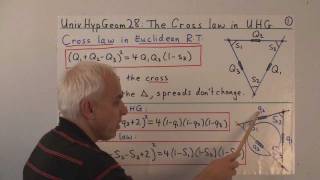
The Cross Law in Universal Hyperbolic Geometry - Universal Hyperbolic Geometry - NJ Wildberger
Explores the Cross law in Universal Hyperbolic Geometry, proving it with a polynomial identity and demonstrating its application to equilateral triangles. Includes exercises and comparisons to Euclidean geometry.
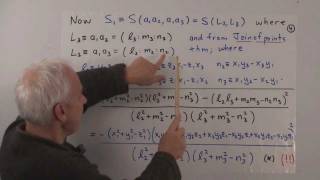
The Spread Law in Universal Hyperbolic Geometry - Universal Hyperbolic Geometry
Explores the Spread law in universal hyperbolic geometry, including its definition, relation to Euclidean geometry, proof, and implications. Covers key concepts like quadrance, spread duality, and quadrea.