The J Function, SL(2) and the Jacobi Identity - Universal Hyperbolic Geometry
Explores connections between hyperbolic geometry, matrix algebra, and Lie theory, demonstrating how the Jacobi identity proves the concurrence of triangle altitudes in projective geometry.
Parallels and the Double Triangle - Universal Hyperbolic Geometry
Explores parallels, double triangles, and perspective centers in Universal Hyperbolic Geometry, offering new insights into Euclid's parallel postulate and its historical implications.
Medians, Midlines, Centroids and Circumcenters - Universal Hyperbolic Geometry
Explore triangle geometry in universal hyperbolic geometry, covering medians, midlines, centroids, and circumcenters. Discover unique properties and connections in this algebraic framework.
Reflections and Projective Linear Algebra - Universal Hyperbolic Geometry
Explore reflections in hyperbolic geometry through projective linear algebra. Learn about null points, reflection matrices, and the sl(2) Lie algebra. Gain insights into fundamental symmetries and their mathematical representations.
Midpoints and Bisectors - Universal Hyperbolic Geometry
Explore midpoints and bisectors in hyperbolic geometry, including reflections, perpendicularity, and geometric constructions. Learn key differences from Euclidean geometry in this advanced mathematical exploration.
Non-Euclidean Geometry - Math History - NJ Wildberger
Explore the complex history and modern interpretations of non-Euclidean geometry, challenging traditional narratives and proposing new perspectives on this fundamental mathematical concept.
Apollonius and Polarity Revisited - Universal Hyperbolic Geometry
Explores Apollonius' polarity in hyperbolic geometry, focusing on null points, quadrangles, and the relationship between poles and polars. Includes explicit formulas and computational examples.
Theorems Using Perpendicularity - Universal Hyperbolic Geometry
Explore perpendicularity in hyperbolic geometry, including duality, triangles, and the Base center point. Learn a general theorem approach and investigate concepts using Standard Triangle 1.
Orthocenters Exist - Universal Hyperbolic Geometry
Explores orthocenters in universal hyperbolic geometry, introducing key concepts like triangles, altitudes, and Desargues' theorem. Culminates in defining orthic line, orthostar, and ortho-axis in hyperbolic triangle geometry.
Duality and Perpendicularity - Universal Hyperbolic Geometry
Explore perpendicularity in universal hyperbolic geometry, including duality, altitudes, and key theorems. Learn about unique aspects like perpendicular points and their applications in geometric analysis.
Computations with Homogeneous Coordinates - Universal Hyperbolic Geometry
Explore algebraic definitions of points and lines in hyperbolic geometry, learn key theorems, and understand their applications in computational geometry and Cartesian coordinates.
Projective Geometry - Math History - NJ Wildberger
Explore the origins and development of projective geometry, from Pappus to Desargues and Pascal, and its fundamental role in mathematics and 3D space understanding.
Analytic Geometry and the Continuum - Math History - NJ Wildberger
Explores Cartesian geometry's development, merging numbers and geometry, and discusses issues with the continuum, irrational numbers, and decimal expansions, including pi's continued fraction approximations.
Analytic Geometry and the Continuum - Math History - NJ Wildberger
Explore Cartesian geometry's development, merging numbers and geometry. Delve into conics, cubics, Bezout's theorem, and the continuum, discussing ancient Greek influences and challenges with irrational numbers and pi.
First Steps in Hyperbolic Geometry - Universal Hyperbolic Geometry
Explore fundamental concepts of universal hyperbolic geometry, including perpendicularity, quadrance, spread, and key theorems, with a focus on projective study of circles and relativistic geometry.
Apollonius and Harmonic Conjugates - Universal Hyperbolic Geometry 2 - NJ Wildberger
Explore harmonic conjugates in geometry, including their relation to circles, conics, and quadrangles. Learn about harmonic ranges, pencils, and vector combinations in this advanced mathematical discussion.
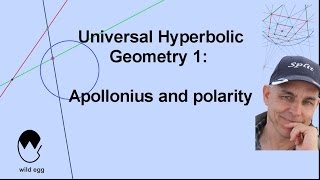
Apollonius and Polarity - Universal Hyperbolic Geometry
Explore Apollonius' polarity concept in hyperbolic geometry, focusing on the crucial role of circles and their relationship to points and lines in the projective plane.
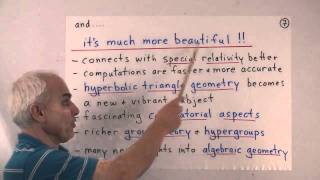
Universal Hyperbolic Geometry - NJ Wildberger
Discover a revolutionary approach to hyperbolic geometry, simplifying complex concepts using high school algebra and projective geometry, with connections to Einstein's special relativity theory.
Greek Geometry - Math History - NJ Wildberger
Explore ancient Greek geometry, from Euclid's Elements to Apollonius' conics, covering key concepts, constructions, and the Platonic solids in this comprehensive lecture on mathematical history.
Pythagoras' Theorem - Math History - NJ Wildberger
Explore Pythagoras' theorem's historical significance, Greek mathematical thinking, and its connections to ancient Babylonian mathematics and modern geometry.
Two-Dimensional Surfaces - The Sphere - Algebraic Topology
Explore the two-dimensional sphere's significance in algebraic topology, including its relation to stereographic projection and the inversive plane in Euclidean geometry.