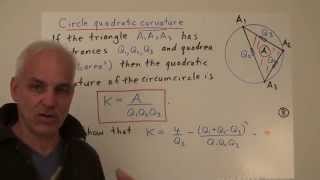
The Triple Spread Formula, Circumcircles and Curvature - Rational Geometry Math Foundations
Explores the Triple spread formula in Rational Trigonometry, relating it to circumcircles and curvature. Connects projective geometry with one and two-dimensional geometries through core circles and quadratic curvature.
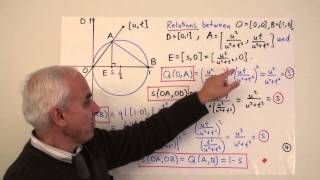
Relativistic Velocity, Core Circles and Paul Miller's Protractor - Rational Geometry
Exploring Paul Miller's protractor for efficient spread measurement in projective geometry, linking projective and affine measurements through core circles and the Triple quad formula.
Seminar - Some Fundamental Formulas from Metrical Algebraic Geometry
Explore fundamental formulas in metrical algebraic geometry, connecting classical theorems to modern discoveries. Gain insights into affine and projective variants applicable across various fields.
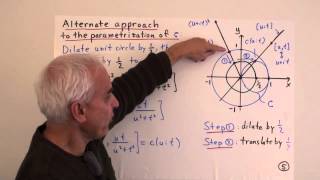
Relativistic Velocity, Core Circles, and Paul Miller's Protractor - Rational Geometry
Explores core circles in rational geometry, connecting projective and Euclidean geometry. Covers parametrization, quadrances, and theorems, bridging abstract concepts with practical applications.
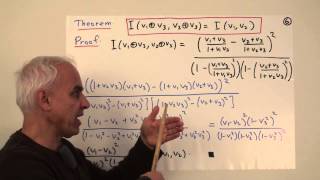
Relativistic Velocity, Core Circles and Paul Miller's Protractor - Rational Geometry
Explore core circles in rational geometry, connecting projective and Euclidean concepts. Learn about relativistic velocity addition and its implications for Einstein's special theory of relativity.
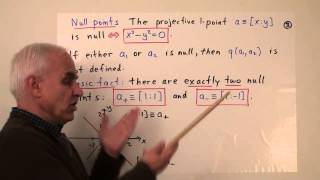
Isometry Groups of the Projective Line III - Rational Geometry Math Foundations
Exploring relativistic geometry in one dimension, extending projective geometry to incorporate Einstein's special theory of relativity and its impact on physics and mathematics.
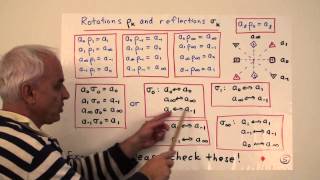
Isometry Groups of the Projective Line - Rational Geometry Math Foundations
Exploring finite field geometry: isometries, rotations, and reflections on the projective line, revealing connections to relativistic geometry and offering a new perspective on Euclidean concepts.
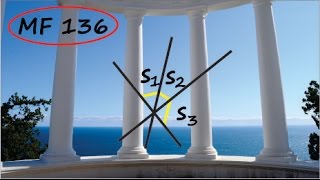
The Projective Triple Quad Formula - Rational Geometry Math Foundations
Explores the projective Triple Quad Formula in rational geometry, relating three projective quadrances formed by projective 1-points. Highlights similarities to the Triple spread formula and its mathematical significance.
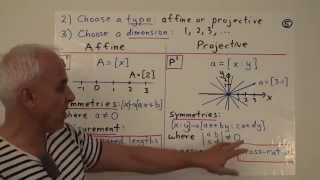
NJ's Pizza Model for Organizing Geometry - Rational Geometry Math Foundations
Explore a systematic approach to organizing metrical geometry using a pizza-making analogy. Learn about various geometries, their interconnections, and key concepts in this comprehensive overview.
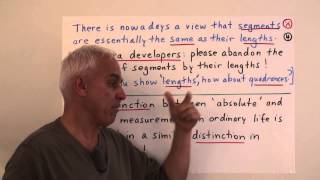
Absolute Versus Relative Measurements in Geometry - Rational Geometry Math Foundations
Explore the distinction between absolute and relative measurements in geometry, focusing on proportions and ratios. Learn about ancient Greek approaches and their relevance to modern mathematics.
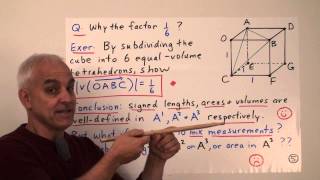
Higher Dimensions and the Roles of Length, Area, and Volume - Rational Geometry Math Foundations
Explore higher dimensions and the fundamental role of squared measurements in geometry. Discover how quadrance, quadrea, and quadrume offer more general and invariant alternatives to traditional length, area, and volume.
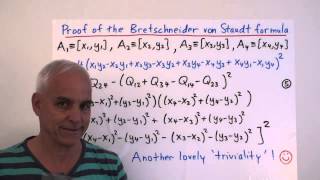
The Bretschneider Von Staudt Formula for a Quadrilateral - Rational Geometry Math Foundations
Explore the Bretschneider von Staudt formula for quadrilateral area, its history, and rational geometric formulations. Learn about generalizations of Archimedes' theorem and the importance of rational expressions in geometry.
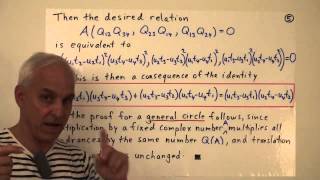
Ptolemy's Theorem and Generalizations - Rational Geometry Math Foundations
Explores Ptolemy's theorem in rational geometry, extending it to finite fields and relativistic planar geometry. Demonstrates how classical results can yield broader insights when formulated without infinite processes.
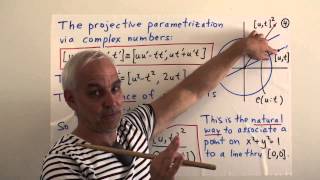
The Projective Line, Circles and a Proof of the CQQ Theorem - Rational Geometry Math Foundations
Explore projective parametrization of the unit circle, derive formulas for areas of triangles and quadrilaterals, and delve into circle geometry with applications to other conics.
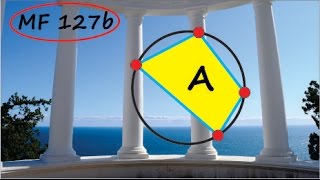
The Cyclic Quadrilateral Quadrea Theorem - Rational Geometry Math Foundations
Explore the Cyclic Quadrilateral Quadrea theorem, combining Brahmagupta's and Robbins' formulas for convex and non-convex cyclic quadrilateral areas. Includes numerical examples and algebraic analysis.
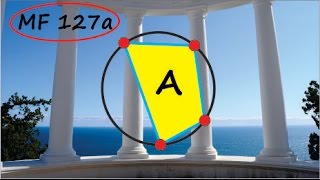
The Cyclic Quadrilateral Quadrea Theorem - Rational Geometry Math Foundations
Explores the Cyclic Quadrilateral Quadrea theorem, combining Brahmagupta's and Robbins' formulas for cyclic quadrilateral areas. Includes examples, tips, and a critical look at real number thinking in geometry.
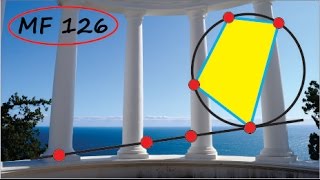
Brahmagupta's Formula and the Quadruple Quad Formula - Rational Geometry Math Foundations
Explore Brahmagupta's formula and the Quadruple Quad Formula, connecting classical geometry with modern insights. Learn about cyclic quadrilaterals, factorization, and rational number precision in geometry.

Brahmagupta's Formula and the Quadruple Quad Formula - Rational Geometry Math Foundations
Explore Brahmagupta's formula for cyclic quadrilateral areas and the Quadruple Quad Formula, delving into algebraic manipulations and rational geometry concepts for a deeper understanding of quadrilateral properties.
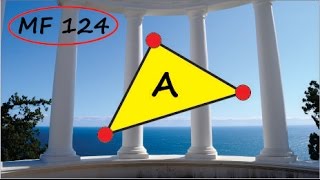
Heron's Formula, Archimedes' Function, and the TQF - Rational Geometry Math Foundations
Explore Heron's formula and Archimedes' theorem for triangle area calculation using rational quantities, revealing connections between one-dimensional and higher-dimensional geometry.
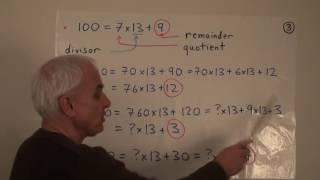
Back to Gauss and Modular Arithmetic - Data Structures in Mathematics Math Foundations
Explore modular arithmetic and its applications in number theory. Learn about congruences, divisibility, and efficient calculation of remainders without long division.
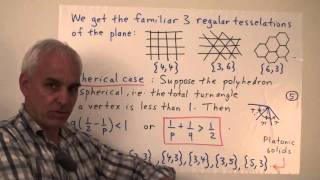
The Classification of Platonic Solids I - Universal Hyperbolic Geometry
Exploring the classification of Platonic solids using modern notation and turn angles. Examines planar, spherical, and higher-dimensional cases, highlighting mathematical constructions and challenges in Euclid's proof.