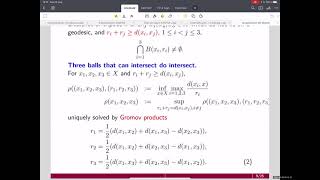
Geometry and Topology of Data
Explore geometric and topological properties of data sets, including curvature concepts and their relation to hyperconvexity, offering new insights into Topological Data Analysis.
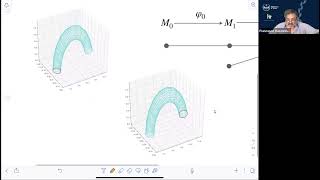
Parallel Decomposition of Persistence Modules Through Interval Bases
Explore parallel decomposition of persistence modules using interval bases, enhancing Topological Data Analysis with distributed computation and Hodge decomposition techniques.
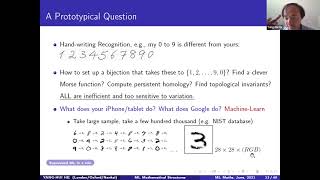
Universes as Bigdata- From Geometry, to Physics, to Machine-Learning
Explore the intersection of string theory, geometry, and machine learning in physics, examining how AI aids mathematical research across various fields.
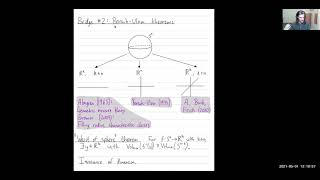
Bridging Applied and Quantitative Topology
Survey of emerging connections between applied and quantitative topology, focusing on Vietoris-Rips complexes and their applications in computational topology, geometric group theory, and dataset shape approximation.
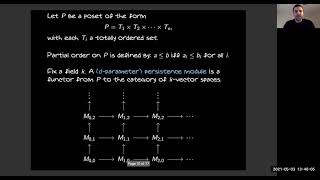
L-P Metrics on Multiparameter Persistence Modules
Explores generalizations of p-Wasserstein distance for multi-parameter persistence modules, introducing d_I^p and d_M^p metrics. Examines their properties and applications in topological data analysis.
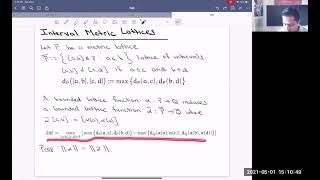
Edit Distance and Persistence Diagrams Over Lattices
Functorial pipeline for persistent homology: from filtered simplicial complexes to persistence diagrams. Addresses multiparameter persistent homology and functoriality of persistence diagrams.
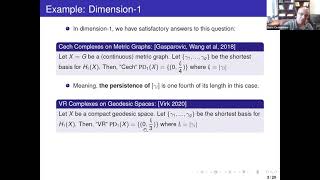
Geometric Approaches on Persistent Homology
Explore geometric interpretations of persistence diagrams, focusing on quantitative descriptions of homology class size and persistence, with analysis of power filtration on unweighted graphs.
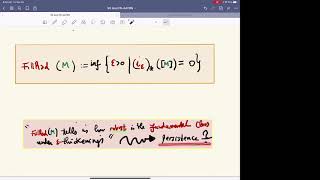
Vietoris-Rips Persistent Homology, Injective Metric Spaces, and The Filling Radius
Explore geometric persistent homology, its isomorphism with Vietoris-Rips filtration, and applications in characterizing persistence barcodes, bounding intervals, and connecting to filling radius.
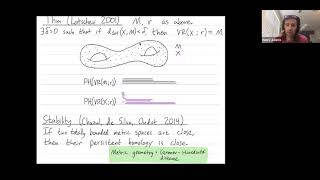
Vietoris-Rips Thickenings - Problems for Birds and Frogs
Explore open problems in Vietoris-Rips complexes, connecting diverse mathematical areas. Suitable for both broad theorists and problem-solving specialists in applied algebraic topology.
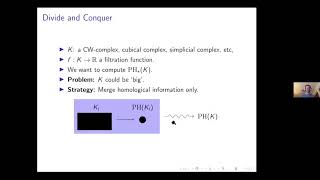
The Persistence Mayer-Vietoris Spectral Sequence
Explore the persistent Mayer-Vietoris spectral sequence, its applications in parallelizing persistent homology computations, and its ability to provide locality-enriched persistence barcodes.
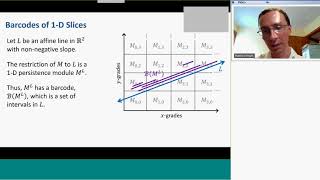
Visualizing 2 Dimensional Persistent Homology
Explore techniques for visualizing 2D persistent homology, a powerful tool in topological data analysis, to gain insights into complex datasets and their underlying structures.
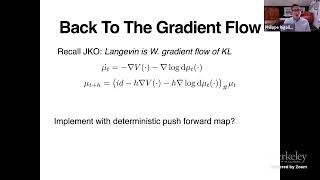
Geometric Aspects of Sampling and Optimization
Explore geometric perspectives on sampling and optimization techniques, uncovering insights for data science applications and algorithm design.
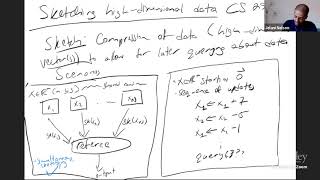
Sketching High-Dimensional Data
Explore techniques for efficiently summarizing and analyzing large datasets in high-dimensional spaces, focusing on probability, geometry, and computational methods.
Helmut Bölcskei - Lossy Compression on General Data Structures
Explore lossy compression for data on manifolds and fractals, with bounds on rate-distortion function and quantization error. Applications in data science and image processing.
Algebraic Perspectives of Persistence
Explore algebraic approaches to persistent homology, focusing on the stability of persistence diagrams and their relation to input data changes in topological data analysis.
Novel Computational Perspectives of Persistence
Explore innovative computational approaches to persistence in algebraic topology, focusing on advanced techniques and their applications in data analysis and topological research.
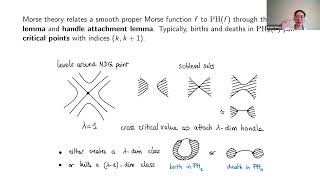
Generalized Morse Theory of Distance Functions to Surfaces for Persistent Homology
Unifying distance fields, persistent homology, and Morse theory to quantify complex shape textures, with applications in characterizing vascular structures in leukemia samples.

Google Earth Pro Fundamentals and Advanced Features Course
Learn to navigate Google Earth Pro, plan trips, create custom maps, and explore advanced features like recording tours and analyzing geographical data.
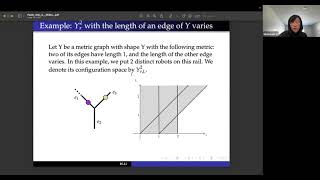
Two-Parameter Persistent Homology of Second Configuration Spaces in Star Graphs
Explore configuration spaces in robot motion planning, focusing on 2-parameter persistent homology of second configuration spaces of star graphs with restraint parameters.
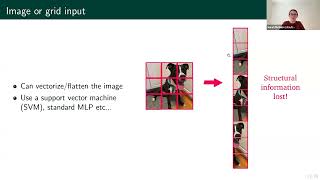
Classification of Euler Characteristic Transforms Using CNNs - 5/9/24
Explore how Euler Characteristic Transforms and CNNs can be used for shape classification, with a focus on leaf datasets. Learn about ECT-CNN pipeline, rotation equivariance, and practical applications.
Exploring Variational Functions - Calculus of Variations and Geometric Measure Theory
Dive into variational problems and bounded Hessian functions with Luigi Ambrosio. Explore the intersection of Calculus of Variations and Geometric Measure Theory, inspired by machine learning insights.