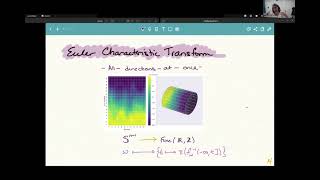
The Directional Transform
Explore the directional transform in topological data analysis, its applications in understanding complex structures, and its potential for enhancing machine learning models and data shape quantification.

A Topological Study of the Space of Planar Pentagons
Exploring topology of planar pentagons as a model for molecular conformation spaces, using topological data analysis for dimensionality reduction and visualization.
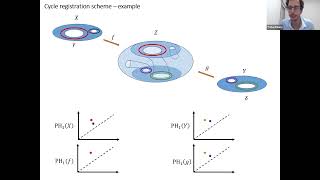
Persistent Cycle Registration and Topological Bootstrap
Novel approach for comparing persistent homology representations, utilizing spatial placement of persistent cycles. Demonstrates application in topological inference to differentiate signal from noise in point cloud data.
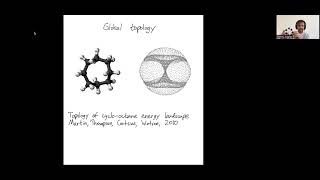
Henry Adams - Topology in Machine Learning
Explore persistent homology in machine learning, covering applications in materials science, computer vision, and agent-based modeling. Learn how topology relates to dataset geometry and explainable AI.
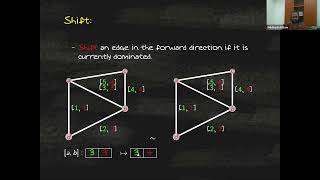
Swap, Shift and Trim to Edge Collapse a Flag Filtration
Exploring efficient algorithms for reducing flag filtrations in persistent homology, with focus on edge collapse techniques and their applications in computational topology.
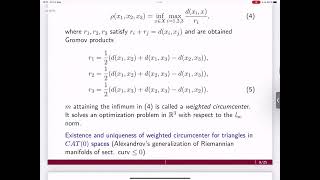
Geometry and Topology of Data
Explore hyperconvexity and generalized curvature in metric spaces, linking topological data analysis with geometric concepts for a deeper understanding of data structures.
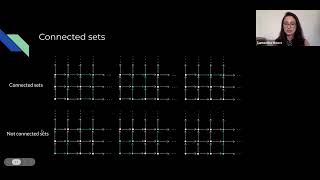
The Generalized Persistence Diagram Encodes the Bigraded Betti Numbers
Explore how generalized persistence diagrams encode bigraded Betti numbers in 2-parameter persistence modules, with implications for RIVET software and interval decomposable modules.
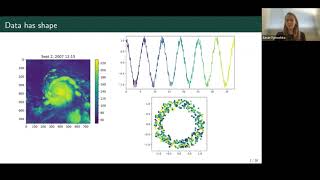
Topological Time Series Analysis for Hurricanes and Dynamical Systems
Explore topological data analysis applications in studying hurricane satellite imagery and dynamical system bifurcations using persistent homology and zigzag persistence techniques.
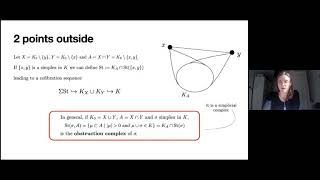
Homotopical Decompositions of Simplicial and Vietoris Rips Complexes
Explore homotopical decompositions of simplicial complexes, focusing on obstruction complexes and their applications in topological data analysis, with insights on Vietoris-Rips complexes.
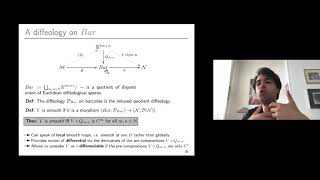
Differential Calculus on Persistence Barcodes
Explore differential calculus on persistence barcodes, covering differentiability concepts, lifts to ordered barcodes, and applications in topological data analysis.
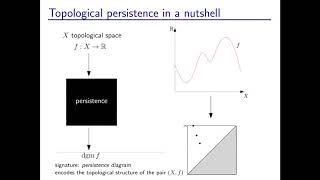
On the Metric Distortion of Embedding Persistence Diagrams into RKHS
Explores embedding Persistence Diagrams into Reproducing Kernel Hilbert Spaces, analyzing metric properties and stability guarantees for machine learning applications in Topological Data Analysis.
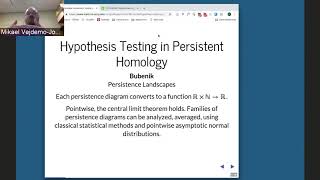
Multiple Hypothesis Testing with Persistent Homology
Exploring methods for multiple hypothesis testing in persistent homology, including family-wise error rates and false discovery rates, with applications to Mapper complex validation.
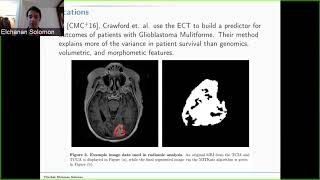
An Intrinsic Persistent Homology Transform
Explores an intrinsic persistent homology transform for metric spaces, focusing on metric graphs. Discusses injectivity results and compares to related constructs in topological data analysis.

Topological Data Analysis of Collective Motion
Explore topological data analysis for collective motion in nature, examining bird flocks, fish schools, and insect swarms through innovative mathematical models and simulations.
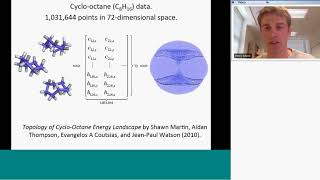
The Vietoris Rips Complex of the Circle
Explore the Vietoris-Rips complex of the circle, its homotopy types at different thresholds, and implications for persistent homology in topological data analysis.
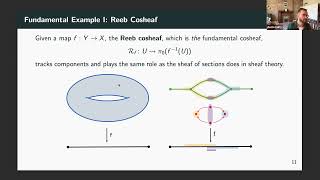
Exemplars of Sheaf Theory in TDA
Exploring sheaf theory applications in topological data analysis through four case studies, covering level set persistence, merge trees, and innovative approaches to persistent homology.
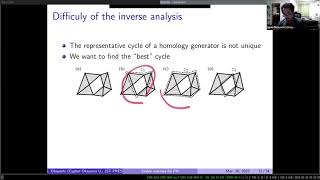
Ippei Obayashi - Stable Volumes for Persistent Homology
Explore stable volumes in persistent homology: a novel method to identify robust topological structures in data, overcoming instability issues and revealing minimal building blocks.
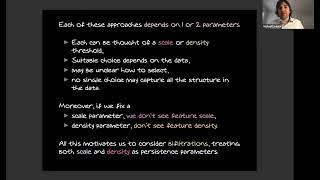
Stability of 2-Parameter Persistent Homology
Explores stability results for 2-parameter persistent homology, covering multicover bifiltration, subdivision bifiltrations, and degree bifiltrations. Discusses computational aspects and implications for practical applications.
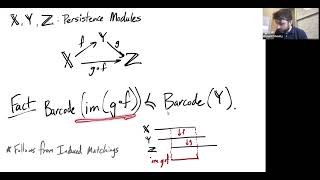
Don Sheehy - Persistent Homology of Lipschitz Extensions
Explore persistent homology of Lipschitz functions, analyzing sublevel set filtrations and barcodes from sample data. Learn about sub-barcodes and their theoretical guarantees in topological data analysis.
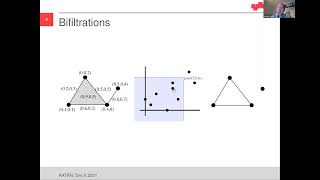
Multi-Parameter Persistent Homology is Practical
Explore practical applications of multi-parameter persistent homology in topological data analysis, focusing on efficient algorithms for large datasets and recent computational advancements.
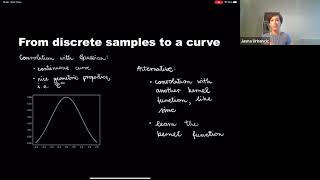
Optimizing Embedding Using Persistence
Explore optimizing Takens-type embeddings of time series using persistent (co)homology. Learn practical approaches for finding good embeddings and discuss the space of embeddings and open questions.