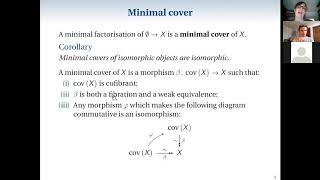
Invariants for Tame Parametrised Chain Complexes
Explore invariants for tame parametrised chain complexes in applied algebraic topology, focusing on explicit constructions, comprehensive frameworks, and discriminative power in topological data analysis.
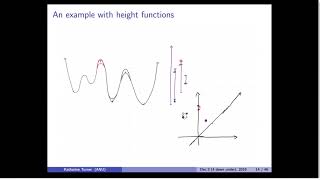
Why Should Q=P in the Wasserstein Distance Between Persistence Diagrams?
Explore Wasserstein distance in persistence diagrams, focusing on q=p choice. Covers geometric implications, stability results, algebraic versions, and computational advantages for central tendencies.
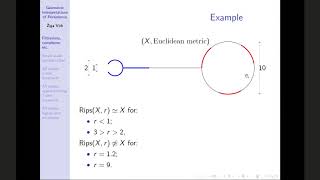
Geometric Interpretation of Persistence
Explore geometric interpretations of persistence in algebraic topology, covering space reconstruction, one-dimensional persistent homology classification, and detection of contractible geodesics using higher-dimensional features.
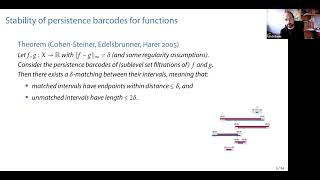
Persistence in Functional Topology
Explore functional topology's evolution, connecting persistent homology to critical point theory and calculus of variations. Gain insights into Morse's theory and its application to minimal surfaces.

Conversation on the Paper "Persistent Extension and Analogous Bars" by Yoon, Ghrist, Giusti
Explore persistent homology extensions and analogous bars in topological data analysis, discussing novel methods for comparing persistence barcodes and their applications in data science.
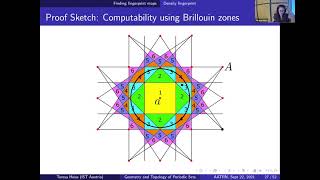
Geometry and Topology of Periodic Point Sets, for Example Crystals
Explore geometric and topological tools for characterizing crystalline materials, including Brillouin zones and persistent homology, and discuss challenges in defining persistent homology for periodic point sets.
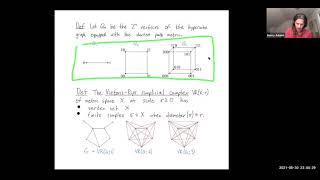
Henry Adams - Vietoris-Rips Complexes of Hypercube Graphs
Explore Vietoris-Rips complexes of hypercube graphs, their homotopy types, and applications in genetic recombination and persistent homology. Discover formulas, open questions, and conjectures in this fascinating area of applied algebraic topology.
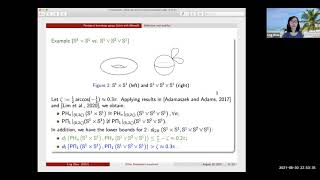
Other Persistence Invariants - Homotopy and the Cohomology Ring
Explore persistent homotopy groups and cohomology rings, focusing on fundamental groups, rational homotopy, and cup-length diagrams. Learn about new tools complementing persistent homology in topological data analysis.
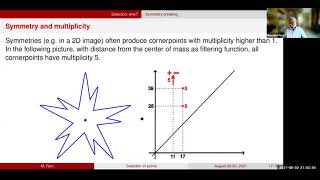
Massimo Ferri - Selection of Points in Persistence Diagrams
Explore point selection in persistence diagrams, including Kurlin's criterion and the Ziqqurat method, for noise reduction and improved data analysis in topological data analysis.
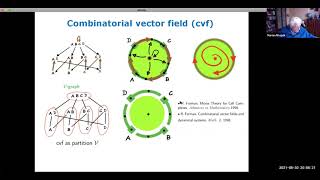
Marian Mrozek - Combinatorial vs. Classical Dynamics: Recurrence
Explore combinatorial dynamics in data science, its ties to classical dynamics, and applications in computer-assisted proofs. Learn about topological invariants and recent developments in recurrent behavior analysis.
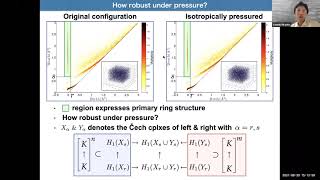
On Characterizing Rare Events in Persistent Homology
Explore rare events in persistent homology, focusing on indecomposables in multi-parameter settings. Learn about large deviation principles and laws of large numbers in topological data analysis.
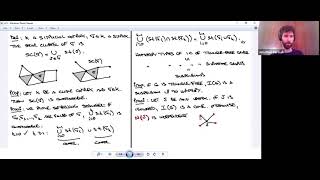
Star Clusters in Clique Complexes and the Vietoris-Rips Complex of Planar Sets
Explore star clusters in simplicial complexes and their applications to independence complexes and Vietoris-Rips complexes of planar sets, with insights on homotopy information and related conjectures.
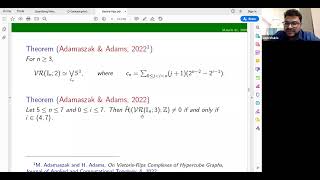
Vietoris-Rips Complexes of Hypercube Graphs
Explore Vietoris-Rips complexes of hypercube graphs, their collapsibility, and applications in genetic trees and persistent homology. Gain insights into simplicial complexes and topological data analysis.

Approximation of Compact Metric Spaces by Finite Samples
Explore topological data analysis through finite approximations of compact metric spaces, connecting Shape Theory and Persistence for robust feature extraction from noisy datasets.

Discrete Homotopy Theory and Applications
Explore discrete homotopy theory's evolution, applications in topology, geometry, and group theory. Learn simplified approaches to fundamental groups and covering spaces, with insights into various mathematical domains.
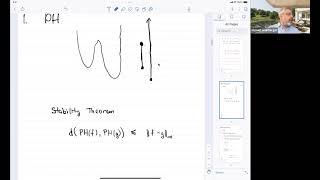
Shmuel Weinberger - PH(X^Y) and the Geometry of Function Spaces
Exploring persistent homology in function spaces through geometric considerations, focusing on examples that illuminate this central topic in algebraic topology.
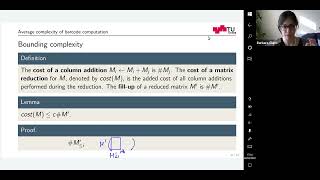
Barbara Giunti - Average Complexity of Barcode Computation for Vietoris-Rips Filtrations
Explore algorithmic complexity of persistent homology in random Vietoris-Rips filtrations, focusing on boundary matrix fill-up and its implications for computational efficiency.
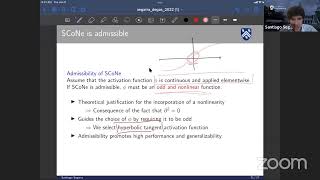
Principled Simplicial Neural Networks for Trajectory Prediction
Learn advanced techniques for trajectory prediction using simplicial neural networks, exploring their principles and applications in data science and signal processing.

Neural Diffusion PDEs, Differential Geometry, and Graph Neural Networks
Explore neural diffusion PDEs, differential geometry, and graph neural networks in this advanced webinar by Michael Bronstein, bridging theoretical concepts with practical applications in data science.
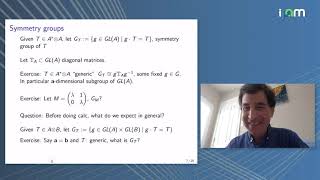
Introduction to the Geometry of Tensors
Explore the geometric perspective of tensors, their applications, and how this viewpoint enhances understanding in various fields. Gentle introduction suitable for beginners.

Minimal Cycle Representatives in Persistent Homology Using Linear Programming
Explores optimization techniques for selecting minimal cycle representatives in persistent homology, comparing effectiveness and computational costs of various algorithms using linear programming methods.