Topology of Complexes and Distributed Computing
Exploring simplicial models in distributed computing, focusing on chromatic subdivisions and Weak Symmetry Breaking, with insights into combinatorial-simplicial questions and related mathematical challenges.
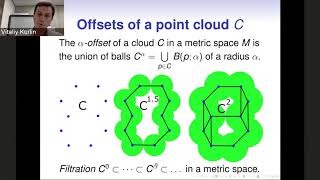
Skeletonization Algorithms With Theoretical Guarantees for Point Clouds
Explore skeletonization algorithms for point clouds, including Mapper, alpha-Reeb graphs, and Homologically Persistent Skeleton. Compare their performance on synthetic and real data sets.
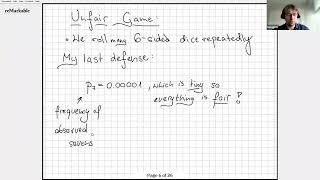
Topology of Surprisal - Information Theory and Vietoris-Rips Filtrations
Explore the fusion of information theory and Vietoris-Rips filtrations, focusing on Kullback-Leibler divergence and its applications in deep learning, with insights on overcoming non-symmetry challenges.
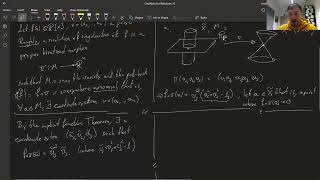
Techniques of Resolution of Singularities in Quasianalytic Classes - Lecture 1
Explore advanced mathematical concepts in singularity resolution within quasianalytic classes, presented by Andre Belotto da Silva from Université de Paris.
Optimal Transportation, Monge-Ampère Equations and Riemannian Ricci Bounds - Lecture 1
Explore optimal transportation, Monge-Ampère equations, and Riemannian Ricci bounds in this advanced mathematics lecture by L. Ambrosio from Scuola Normale Superiore di Pisa.
Introduction to the Geometry of Tensors
Explore tensor geometry and its applications in physical and data sciences through a gentle introduction, emphasizing how geometric perspectives advance practical implementations.
Geometry, Optimization and Generalization in Multilayer Networks
Explore the interplay of geometry, optimization, and generalization in multilayer networks, focusing on representation learning and its applications in deep learning architectures.
A Fibrational Framework for Modal Simple Type Theories
Explore modal extensions of homotopy type theory, focusing on fibrational frameworks for modal simple type theories and their applications in topology, geometry, and spectra.
Discrete and Codiscrete Modalities in Cohesive HoTT
Explore discrete and codiscrete modalities in Cohesive Homotopy Type Theory, examining their applications in topology, differential geometry, and synthetic formalizations of mathematical concepts.
Kathlén Kohn - The Geometry of Linear Convolutional Networks
Explore the geometry of linear convolutional networks, their function spaces, and optimization challenges. Gain insights into critical points, polynomial representations, and architectural impacts.
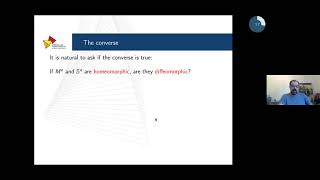
Exotic Spheres and Singularities - Math Associates Seminar
Explore the fascinating journey from exotic spheres to Milnor's Fibration Theorem, a cornerstone in singularity theory, and its impact on complex hypersurface geometry and topology.
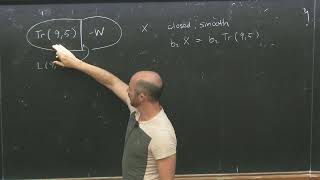
Lattices in Low-Dimensional Topology
Explore advanced concepts in low-dimensional topology, focusing on lattice structures and their applications in geometric and topological analysis.
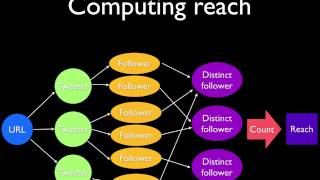
Storm: Realtime Distributed Computing with Nathan Marz - ETE 2012
Explore Storm for real-time data processing, covering concepts, development, deployment, fault-tolerance, and practical applications in distributed computing environments.

OpenGL and CUDA-Based Tessellation
Explore advanced tessellation techniques using CUDA to overcome OpenGL limitations, enabling higher-order surfaces, custom UV coordinates, and trimming curves for improved visual quality in graphics rendering.
Generating Security Policies with eBPF - Hands-on Walkthrough
Explore eBPF-based solutions for capturing security events and generating policies. Learn to leverage tools like seccomp, Inspektor Gadget, and Tetragon for comprehensive system protection.
See It to Believe It: Bringing Observability to Container Builds
Explore an open framework using tetragon to enhance runtime visibility and automated attestation for Tekton-based CI pipelines, focusing on container build security and integrity assurance.

eBPF for Observability: The Good, the Bad, and the Ugly
Explore eBPF's role in zero-instrumentation observability, examining its features, use cases in open-source tools, and limitations for enhanced system monitoring and performance analysis.
Securing the Superpowers: Who Loaded That eBPF Program?
Explore eBPF technology's power and security implications. Learn about auditing, monitoring, and enforcing eBPF program loading on Linux systems using Tetragon for enhanced system protection and accountability.
Securing CI/CD Systems Through eBPF
Explore eBPF technology for securing CI/CD pipelines, enhancing visibility, ensuring integrity, and preventing malicious activities across various platforms. Learn implementation strategies and real-world applications.
Tetragon: A Kubernetes Observability and Security Tool
Explore Tetragon, an innovative tool for enhancing Kubernetes observability and security, presented by expert John Fastabend.
Paint the Picture - Detecting Suspicious Data Patterns in Encrypted Traffic with eBPF and KTLS
Explore eBPF and kTLS for detecting sensitive data patterns in encrypted Kubernetes traffic, enhancing security monitoring without operational complexity or application impact.