
Real-Time Security: Using eBPF for Preventing Attacks
Explore eBPF's potential for preventative security in cloud-native environments, covering NetworkPolicy enforcement, system call limitations, and advanced attachment points like BPF LSM.

Code-It-Yourself 3D Graphics Engine - Triangles and Projection - Part 1
Learn to build a 3D graphics engine from scratch, covering triangles, projection matrices, and basic rotation. Gain hands-on experience in creating a rotating cube using fundamental 3D graphics concepts.
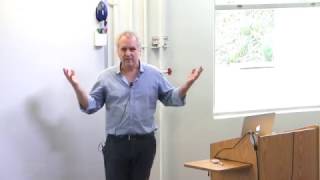
On Gradient-Based Optimization - Accelerated, Distributed, Asynchronous and Stochastic
Explore advanced gradient-based optimization techniques for machine learning, including accelerated, distributed, asynchronous, and stochastic methods, with insights from differential geometry and nonconvex optimization.
Distributed Computing through Combinatorial Topology
Explore distributed computing through combinatorial topology, learning key concepts and their applications to solve distributed problems using algebraic topology techniques.
Topology of Complexes Arising in Models for Distributed Computing
Explore simplicial models in distributed computing, focusing on chromatic subdivisions and their applications to problems like Weak Symmetry Breaking, leading to new mathematical questions.
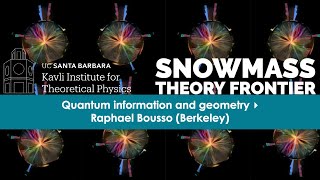
Quantum Information and Geometry - Raphael Bousso (Berkeley)
Explore quantum information and geometry with Raphael Bousso from Berkeley in this 25-minute talk from the 2022 Snowmass Theory Frontier Conference, discussing recent advances and future opportunities in high-energy physics theory.
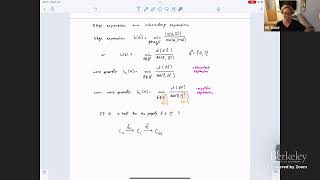
High-Dimensional Expanders - Lecture 2
Explore high-dimensional expanders with Irit Dinur, delving into advanced concepts and applications in analysis and theoretical computer science.
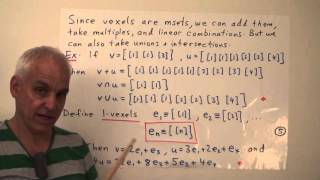
Singletons, Vexels, and the Rank of a Maxel - Data Structures in Mathematics
Explores vexels as multisets of singletons, analogous to maxels, to structure vector space theory. Introduces concepts like singleton multiplication, friezes, and maxel rank, offering a broader perspective on linear spaces.
Alan Turing and the Other Theory of Computing and Can a Machine Be Conscious?
Explore Turing's lesser-known 1948 paper on numerical computation and its impact on complexity theory. Discover how it unifies two major traditions in computational theory.
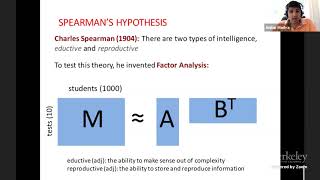
Recent Progress in High-Dimensional Learning
Explore recent advancements in high-dimensional learning, covering factor analysis, phylogenetic reconstruction, and hidden Markov models, with applications in genetics and machine learning.
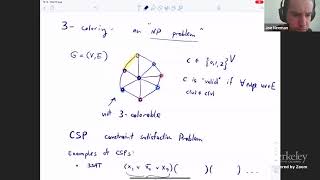
Crash Course on Probabilistically Checkable Proofs - Introduction
Explore probabilistically checkable proofs, including recoloring, constraint satisfaction, and the PCP theorem. Learn about verifier parameters and hardness of approximation in this comprehensive introduction.
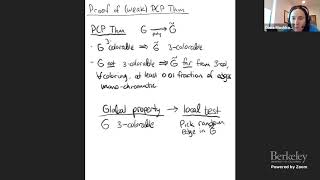
Crash Course on Probabilistically Checkable Proofs - PCP
Explore probabilistically checkable proofs, their formulation, global vs local tests, and computational implications in this comprehensive lecture on advanced theoretical computer science concepts.
An LLL Algorithm for Module Lattices
Explore an LLL algorithm for module lattices, covering key concepts, previous works, and algorithm details. Gain insights into lattice geometry and computational challenges.
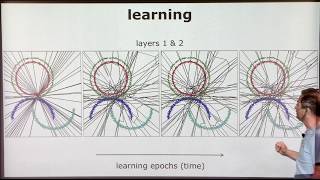
Mad Max - Affine Spline Insights into Deep Learning
Explore deep learning through spline theory, focusing on max-affine splines and their role in neural networks, data memorization, and network complexity.
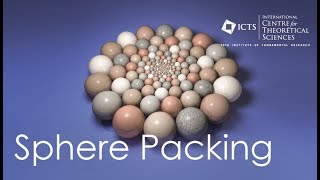
Introduction to Sphere Packing Problems by Abhinav Kumar
Explore sphere packing in geometry, covering its history, applications, and recent advances. Learn about lattices, codes, bounds, and energy minimization in various dimensions.
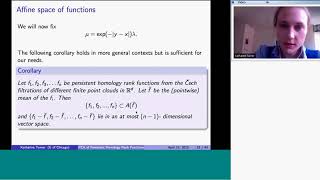
Katharine Turner - PCA of Persistent Homology Rank Functions with Case Studies
Explore persistent homology rank functions through PCA, featuring case studies and insights into topological data analysis techniques.
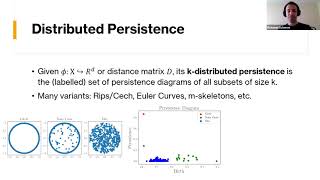
Dimensionality Reduction via Distributed Persistence - DIPOLE
Explore dimensionality reduction with DIPOLE, a novel approach combining local metric and global topological preservation for improved data visualization and analysis.
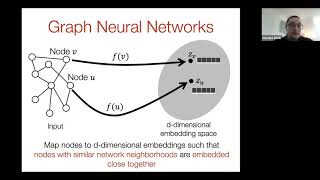
Graph Representation Learning and Its Applications to Biomedicine
Graph representation learning techniques for biomedical applications, focusing on SubGNN for disentangled subgraph embeddings and their use in predicting disease treatments and safe drug combinations.
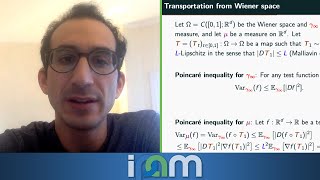
The Brownian Transport Map - IPAM at UCLA
Explore Lipschitz transport maps between probability measures, focusing on the Brownian transport map's construction, properties, and applications to Euclidean functional inequalities.
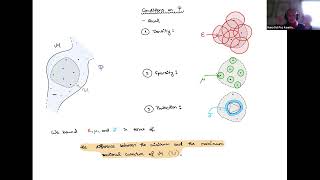
Curvature Variation Based Sampling for Delaunay Triangulations of Manifolds
Explore adaptive sampling for Delaunay triangulations of Riemannian manifolds, focusing on curvature variation and quality bounds for successful triangulation. Learn about geometric realizations and manifold triangulation techniques.
Introduction to Optimal Transportation and Monge Ampère Type Equations - Lecture 2
Explore optimal transportation and Monge Ampère equations, covering key concepts like super differentials, isoperimetric problems, and probability measures in this advanced mathematics lecture.