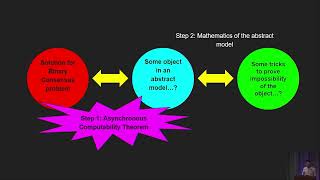
The Asynchronous Computability Theorem - Distributed Systems and Algebraic Topology
Explore the connection between distributed systems protocols and algebraic topology, proving consensus impossibility in asynchronous wait-free models through combinatorial structures.
Entanglement of Sections - IPAM at UCLA
Explore quantum information in parameter families through examples, presented by Microsoft Research's Michael Freedman at IPAM's workshop on topology and quantum error correction.
3D Transforms in CSS - Creating Complex Shapes and Animations
Explore advanced 3D transforms in CSS, creating complex shapes with shading, animations, and transformations. Learn techniques for building intricate geometric solids and dynamic visual effects.

Geometry Aware Imitation Learning in Robotics
Explores geometry-aware imitation learning for robots, enabling precise movement planning and skill acquisition from demonstrations. Discusses handling non-Euclidean data using differential geometry tools.

Tetragon Kubernetes Policy Filtering - Cloud Native Live
Explore Tetragon for Kubernetes policy filtering, enhancing security and observability in cloud-native environments through advanced system-level telemetry and policy enforcement.
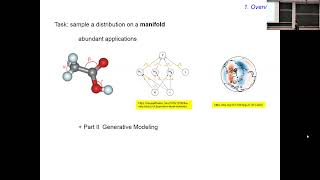
Non-Euclidean Generative Modeling
Explore advanced generative modeling techniques beyond Euclidean spaces with Georgia Tech's Molei Tao, delving into innovative approaches for complex data structures.
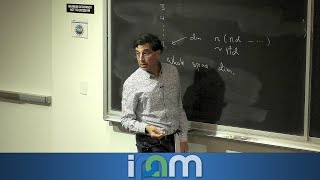
Geometry of Tensor Networks and Tensor Invariants
Explore geometric aspects of tensor networks and invariants, focusing on their applications in mathematics and theoretical physics.
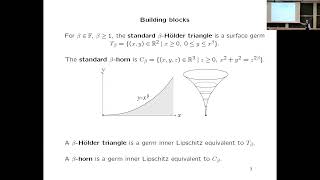
Lipschitz Geometry and Combinatorics of Abnormal Surface Germs
Explore Lipschitz geometry and combinatorics of abnormal surface germs in this advanced mathematics talk by Andrei Gabrielov from Purdue University.
Impromptu Chat About Hahn-Banach Theorem in Lean
Explore the intricacies of HB implementation in Lean with Mario Carneiro in this impromptu discussion, gaining insights into advanced mathematical formalization techniques.
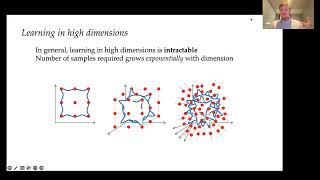
Geometric Deep Learning - Graph Neural Networks and Differential Equations
Explore Graph Neural Networks, symmetry principles, and connections to differential equations, geometry, and topology in this comprehensive introduction to Geometric Deep Learning.
Brewing the Kubernetes Storm Center - Open Source Threat Intelligence for Cloud Native Ecosystems
Explore open-source threat intelligence for cloud-native ecosystems. Learn to validate threat models, quantify risks, and make informed defensive decisions using Kubernetes-based environments and real-world data.
Random Tessellation Forests: Overcoming the Curse of Dimensionality
Explore random tessellation forests in machine learning, overcoming dimensionality challenges through innovative partitioning methods and directional distributions for improved statistical performance.
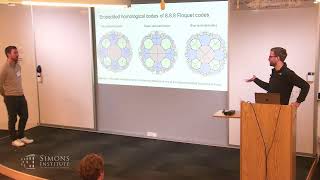
Constructions and Performance of Hyperbolic and Semi-Hyperbolic Floquet Codes
Explore innovative Floquet codes derived from hyperbolic surfaces, offering efficient quantum error correction with improved distance scaling and potential for near-term experimental implementation.
Homological Quantum Rotor Codes - Logical Qubits from Torsion
Explores advanced quantum coding theory, focusing on homological quantum rotor codes for encoding logical information. Discusses applications in superconducting devices and potential hardware implementations.
Bee-Lieve in the Metadata: Pollenating Build Attestations on Kubernetes with Tetragon and EBPF
Explore how Tetragon and eBPF can secure Kubernetes build systems, producing verifiable metadata to ensure package integrity and protect against potential attacks.
Extension Complexity of Random Polytopes
Explores extension complexity of random polytopes, discussing results for fixed-dimension convex hulls of random points on unit sphere or ball. Joint work with Kwan and Zhao.
Tensors, State-Sum Topological Field Theories and the Evaluation of Extruded Graphs
Explore three-dimensional topological field theories, tensor network models, and graph evaluations in relation to state-sum constructions and surface defects.
Finite Crystallization via Stratification in Two-Dimensional Square Lattices
Explore new techniques for proving 2D crystallization in square lattices using stratification methods and bond graph analysis for finite particle systems.
Metric Flow Matching for Smooth Interpolations on the Data Manifold
Explore Metric Flow Matching for smooth interpolations on data manifolds. Learn about conditional paths, Riemannian metrics, and geodesic interpolants. Discover applications in LiDAR navigation and cellular dynamics modeling.

Manifold Diffusion Fields - Learning Generative Models of Continuous Functions on Riemannian Manifolds
Explore Manifold Diffusion Fields for generating continuous functions on Riemannian manifolds. Learn about spectral geometry, intrinsic coordinate systems, and applications in AI for drug discovery.
Taylor Expansion and Game Semantics - Exploring Isomorphisms in Lambda Calculus
Explore the isomorphism between Taylor expansion of λ-terms and pointer concurrent games interpretation, extending previous results on resource terms and game semantics.