
Can Quantum Machines Execute Complex Adaptive Strategies More Efficiently?
Explore quantum-enhanced agents' potential to execute complex adaptive strategies with reduced computational costs and improved efficiency in real-time decision-making scenarios.
Introduction to Artificial Intelligence - Game Theory - Lecture 9
Explore game theory concepts and applications in AI, focusing on advanced strategies and decision-making in multi-agent environments.
Intro to Artificial Intelligence - RL Monte Carlo Methods - Lecture 17
Explore Monte Carlo methods in reinforcement learning, applying algorithmic techniques to solve AI problems in gaming environments.
Introduction to Artificial Intelligence - Bandit Algorithms - Lecture 16
Explore bandit algorithms in AI, learning key techniques for optimizing decision-making in uncertain environments through practical applications and examples.
Parables on the Power of Planning in AI - From Poker to Diplomacy
Explore AI breakthroughs in games like poker, Go, and Diplomacy. Discover the crucial role of search/planning algorithms and their potential applications in improving machine learning models.
Synthesis of Privacy-Preserving Systems
Explore privacy-preserving system synthesis, addressing hidden signals, budget constraints, and incomplete information while satisfying specifications and protecting secrets.
Multi-agent Games with Finite-horizon Goals
Explore complexity in multi-agent systems with finite-horizon goals, examining mathematical properties, use cases, and representation challenges in game theory and distributed systems analysis.

Applications of Game Theory to Computational Social Science
Explore game theory applications in computational social science, focusing on algorithmic ranking, social welfare, and the monoculture paradox in digital systems.
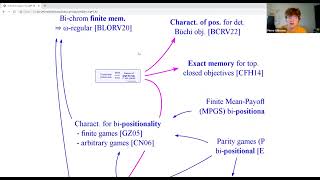
Infinite Duration Games, Memory and Graphs - Part 2
Delve into advanced concepts of infinite duration games, exploring memory structures and graph theory through rigorous mathematical analysis and computational complexity perspectives.

Evolutionary Biology - Class 6
Explore evolutionary biology concepts with Hanna Kokko, delving into advanced topics and current research in the field.

Investigating Social Intelligence of Large Language Models Through Game-Based Intention Understanding
Explore how large language models demonstrate social intelligence through intention understanding in gaming contexts, focusing on situational awareness, self-regulation, and theory of mind.
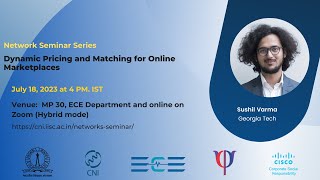
Dynamic Pricing and Matching for Online Marketplaces
Delve into advanced queueing theory and pricing strategies for online marketplaces, exploring bipartite matching networks, max-weight matching policies, and heavy traffic analysis for optimal profit and delay management.
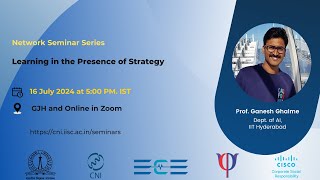
Learning in the Presence of Strategic Decision Making
Explore strategic learning challenges in machine decision-making systems, focusing on robust algorithms for handling strategic classification and representation in human-AI interactions.
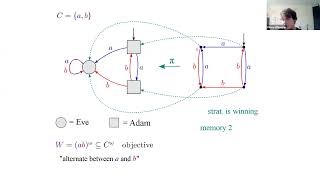
Games on Graphs - Memory Requirements and Strategy Analysis
Explore the theoretical foundations of graph-based games, focusing on strategic approaches, memory requirements, and applications in parity and mean-payoff scenarios.

Полудуплексная Коммуникационная Сложность: Разные Виды Adversary
Dive into the intricacies of half-duplex communication complexity, exploring different adversary types and their impact on complexity measures through concrete examples and theoretical analysis.
Mancala: Multiway Analysis and Game GUI Development in Wolfram Language
Explore Mancala through game graphs and multiway analysis, examining complexity and fairness across configurations while building an interactive interface.

Competitive Physics Informed Networks - Overcoming Limitations in PDE Solutions
Explore competitive physics-informed neural networks for solving PDEs with unprecedented accuracy. Learn about adversarial approaches and zero-sum games to achieve single-precision accuracy in numerical simulations.
Opponent-Shaping and Interference in General-Sum Games
Explore opponent-shaping and interference in general-sum games, delving into multi-agent reinforcement learning and its applications in AI research.
Fostering Cooperation via Fairness in AI Systems
Explore fairness in AI decision-making, addressing efficiency, elicitation, and incentives. Learn theoretical foundations for fairness in voting, resource allocation, and machine learning.
Learning to Cooperate and Compete via Self Play
Explore AI strategies for cooperation and competition through self-play, featuring insights from poker AI breakthroughs and their broader implications.
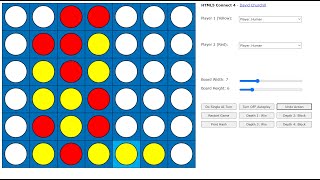
Introduction to Artificial Intelligence - Connect 4 Tournament - Lecture
Explore AI techniques and data structures for modern problem-solving, applying learned concepts to simple games in hands-on assignments.