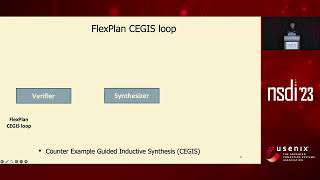
Synthesizing Runtime Programmable Switch Updates
Explores FlexPlan, a tool for safe runtime updates of programmable switches. Discusses techniques for generating step-by-step plans that maintain correctness and memory constraints during live reconfigurations.
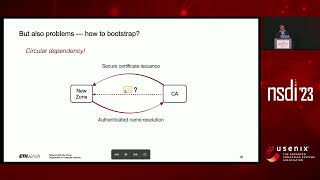
RHINE - Robust and High-performance Internet Naming with E2E Authenticity
Explores RHINE, a secure Internet naming system offering end-to-end authentication, robust trust model, and improved performance over DNSSEC. Addresses DNS vulnerabilities with novel approaches.
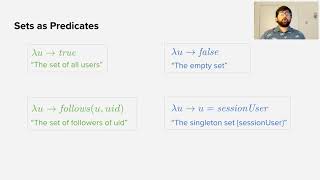
STORM - Refinement Types for Secure Web Applications
STORM: A web framework for building MVC applications with compile-time enforcement of security policies, reducing trusted code to under 1% and providing static security enforcement with minimal overhead.
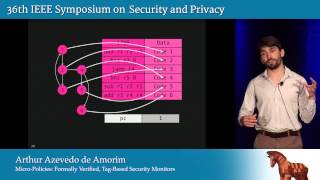
Micro-Policies - Formally Verified, Tag-Based Security Monitors
Explore formally verified tag-based security monitors for low-level policies. Learn about dynamic sealing, compartmentalization, control-flow integrity, and memory safety implementation.
An I/O Separation Model for Formal Verification of Kernel Implementations
Explore a novel I/O separation model for rigorously verifying kernel implementations, enhancing system reliability and security through advanced formal methods.
A Secure and Formally Verified Linux KVM Hypervisor
Explore a formally verified Linux KVM hypervisor, enhancing security and reliability in virtualization environments through rigorous mathematical proofs and advanced verification techniques.
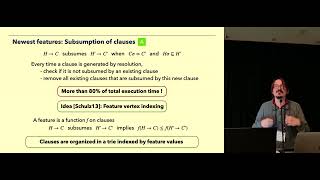
ProVerif with Lemmas, Induction, Fast Subsumption, and Much More
Explore advanced features of ProVerif for protocol verification, including lemmas, induction, and fast subsumption techniques to enhance security analysis capabilities.

Formal Verification of Secure Software Systems
Explore formal verification techniques for secure software systems, focusing on collaboration between security and development teams to enhance software quality and security.
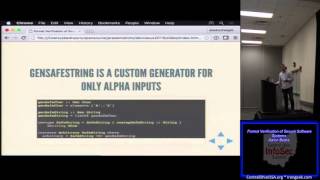
Formal Verification of Secure Software Systems
Explore formal verification techniques for secure software systems, enhancing code reliability and security through mathematical proofs and rigorous analysis methods.
Formal Verification of Masked Hardware Implementations in the Presence of Glitches
Explore formal verification techniques for masked hardware implementations, addressing glitch-related vulnerabilities in cryptographic systems to enhance security against side-channel attacks.
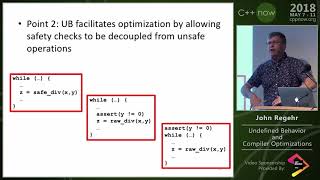
Undefined Behavior and Compiler Optimizations
Explores compiler optimizations, undefined behavior in intermediate representations, sequential memory models in C++, and the future of compiler technology, including formal verification and automatic generation.
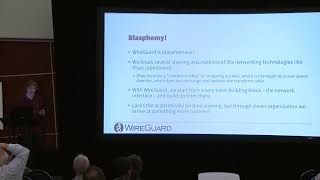
WireGuard - Next-Generation Secure Kernel Network Tunnel
Explore WireGuard, a new Linux network tunneling mechanism with formal cryptographic protocol, small codebase, and widespread deployment. Learn about its kernel integration, performance, and ecosystem impact.
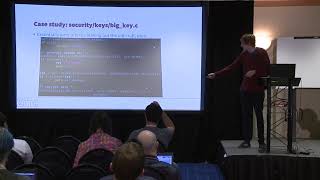
Zinc - Minimal Light-weight Kernel Cryptography API
Explore Zinc, a minimal kernel cryptography API for Linux, covering its design, implementation, and optimization strategies for enhanced security and performance.

Formal Verification Made Easy - and Fast
Explore formal verification for Linux using automata models, enabling efficient on-the-fly code generation and verification across various subsystems, enhancing reliability and performance.
Formal Runtime Error Detection in Automotive Software Development
Explore formal runtime error detection in automotive software development using inferred contracts and abstract interpretation for improved precision and scalability in module-level analysis.
CHERI Static Analysis - POCL'24
Explore CHERI static analysis techniques for enhanced memory safety and security in software development.

Automated Ambiguity Detection in Layout-Sensitive Grammars
Explore automated ambiguity detection in layout-sensitive grammars using SMT solving. Learn about local ambiguity, reachability conditions, and their application to language design.
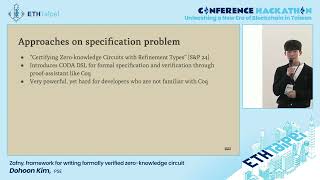
Zafny - Framework for Writing Formally Verified Zero-Knowledge Circuit
Discover how to create formally verified zero-knowledge circuits using Zafny framework, exploring its implementation and verification capabilities for blockchain applications.
Agni: Fast Formal Verification of the Verifier's Range Analysis
Explore fast formal verification techniques for range analysis in the Linux kernel's eBPF verifier, enhancing security and performance.
Pipit: Reactive Systems in F★ for Safety-Critical Control Systems
Explore Pipit, a reactive language embedded in F★ for verifying and executing control systems. Learn about its verified translation and automatic safety property proofs.

Translating Canonical SQL to Imperative Code in Coq
Explore a mechanically verified compiler translating SQL to imperative code, addressing implementation challenges and leveraging formalization advances in query compilation.