Verified Software Security Down to Gates
Explore hardware-software contracts synthesis, security vulnerability detection, and microarchitecture updates for verified software security. Gain insights into cutting-edge approaches for high-assurance computer systems design.
Haskell for Imperative Programmers
Learn functional programming with Haskell, covering basics to advanced topics like monads, concurrency, and formal verification. Ideal for developers transitioning from imperative languages.
Self-Proving Models: Learning Algorithms with Interactive Proof Systems
Explore self-proving models and interactive proof systems for ensuring AI output correctness, focusing on algorithms, learning complexity, and practical applications in computational tasks.
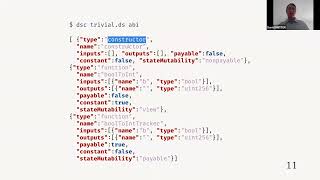
Provably Correct Smart Contracts Using DeepSEA
Explore DeepSEA's approach to creating verifiable smart contracts, focusing on proven correctness and enhanced security in blockchain development.
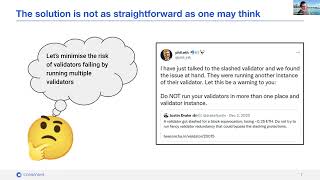
Formal Verification of Distributed Validator Technology
Dive into the formal verification methods and protocols behind Ethereum's Distributed Validators Technology, exploring mathematical proofs and security implementations.
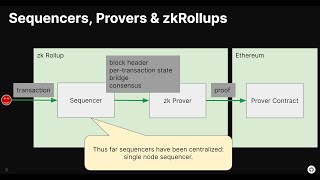
Decentralized Sequencers and QBFT: Understanding BFT Consensus Algorithms
Dive into decentralized sequencers and QBFT consensus algorithms, exploring their implementation in blockchain systems and understanding the formal verification process for enhanced security.
Translating HOL-Light Proofs to Coq
Découvrez la traduction des preuves HOL-Light vers Coq, explorant les défis et solutions pour la vérification formelle entre systèmes logiques différents.
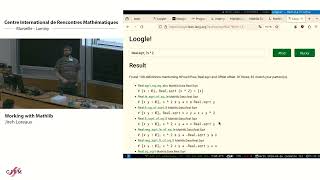
Working with Mathlib - Lecture 1
Découvrez les fonctionnalités de Mathlib et apprenez à les utiliser efficacement pour vos projets mathématiques avec Jireh Loreaux.
Slow But Steady - Achieving Real Security Within Two Decades
Explore strategies for achieving real security in software systems over two decades, focusing on incremental improvements, formal verification, and well-engineered infrastructure.
Formal Modelling and Proof in the CHERI Design and Implementation Process
Explore rigorous engineering methods for developing secure processor architecture, focusing on CHERI's hardware capabilities for fine-grained memory protection and secure compartmentalization.
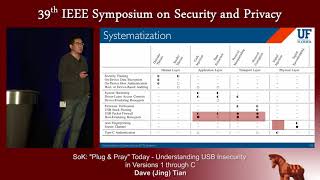
Plug & Pray Today - Understanding USB Insecurity in Versions 1 through C
Comprehensive overview of USB security vulnerabilities and defenses across multiple layers, analyzing attacks, countermeasures, and the USB Type-C Authentication protocol's limitations.
Mitigating Attacks on Software Supply Chain Using GOSH Docker Extension
Explore GOSH Docker Extension's innovative features for securing software supply chains, including container verification, decentralized signatures, DAO governance, and automated CI/CD pipeline security.
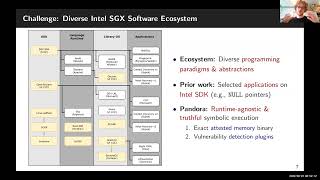
Pandora: Symbolic Validation of SGX
Explore symbolic validation techniques for Intel SGX, enhancing security in confidential computing environments.
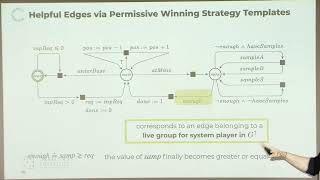
Localized Attractor Computations for Infinite-State Games
Explore symbolic methods for solving infinite-state games, focusing on localized attractor computations in sub-games to enhance efficiency and tackle complex problem instances.
System Introductions I - PVS
Introduction to PVS (Prototype Verification System) for formal specification and verification of systems, covering key features and applications in mathematical proofs and software development.
Solving Infinite-State Games via Acceleration
Explore novel symbolic semi-algorithms for solving infinite-state games with temporal winning conditions, introducing acceleration techniques to enhance fixpoint-based game-solving methods.

Timely Computation - A Formal Approach to Digital Circuit Design
Explore a formal definition of digital circuits, emphasizing compositional correctness and timing analysis through simple denotations and homomorphisms in Agda.
Quantitative Robustness for Vulnerability Assessment
Explore quantitative robust reachability for measuring bug triggering difficulty in software security. Learn about QRSE and functional E-MAJSAT for improved vulnerability assessment.
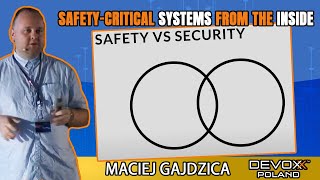
Safety-Critical Systems: Techniques for Ensuring Safety and Preventing Accidents
Explore techniques for ensuring safety in critical systems, including fail-safety, multi-CPU usage, task separation, communication safety, documentation practices, and programming language considerations.
Deciding Asynchronous Hyperproperties for Recursive Programs
Explore a novel logic for asynchronous hyperproperties, enhancing model checking for recursive programs. Gain insights into temporal logic, automata theory, and pushdown systems.
Beautiful Formalizations and Proofs in Mechanized Mathematics
Explore the aesthetics of mathematical formalization, examining how beauty in mathematics adapts to mechanization and automation, with illustrative examples of elegant definitions and proofs.