Algebraic Theorems in PVS
Explore algebraic theorems using the PVS theorem prover. Learn to formalize and verify mathematical concepts in a rigorous computational environment.
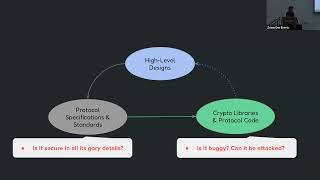
Integrating Formal Verification in Cryptographic Standards and Implementations
Explore formal verification in cryptographic standards and implementations with expert Karthik Bhargavan in this insightful conference talk from Crypto 2024.
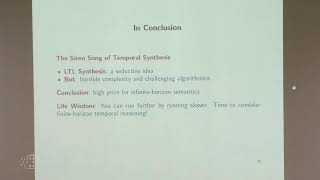
Linear Temporal Logic - From Infinite to Finite Horizon
Explore finite-horizon temporal synthesis in Linear Temporal Logic, its algorithmic advantages, and applications in reactive synthesis and infinite-horizon reasoning.
Multi-agent Games with Finite-horizon Goals
Explore complexity in multi-agent systems with finite-horizon goals, examining mathematical properties, use cases, and representation challenges in game theory and distributed systems analysis.
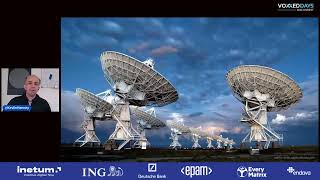
Keynote - Six Impossible Things
Explore software development limits, from integer representation to task estimation, and learn to create solutions within these constraints for more effective development.
Formalization of Nominal Equations Reasoning in PVS
Explore nominal anti-unification and equations reasoning in PVS, focusing on formalisation techniques and applications supported by Brazilian research agencies.
Verifying a Concurrent File System with Sequential Reasoning
Explore a verified, concurrent file system using GoTxn and Dafny. Learn about crash safety, concurrency, and combining interactive and automated proofs for robust systems software.
Can We Reason About the Security of Concurrent Systems Code?
Explore challenges and possibilities in reasoning about security in concurrent systems code with expert Peter Sewell.
Data Parallel Proof Verification in APL - Using Metamath for Mathematical Databases
Discover how APL enables data-parallel verification of mathematical proofs using Metamath, exploring formal verification methods, proof structures, and efficient processing of large mathematical databases.
Formal Verification of the PQXDH Post-Quantum Key Agreement Protocol for End-to-End Secure Messaging
Delve into formal verification analysis of Signal's PQXDH protocol, exploring security flaws, implementation safeguards, and protocol improvements for post-quantum secure messaging.
Formalizing Soundness Proofs of Linear PCP SNARKs
Delve into the formalization of SNARK security proofs using the Lean theorem prover, exploring soundness verification methods for linear PCP-based constructions including Groth '16.
Computer Security and Electronic Voting Systems - Security Challenges and Solutions
Explore the critical intersection of computer security and electronic voting systems through expert insights on vulnerabilities, verification technologies, and essential safeguards for trustworthy elections.

The Hidden Assumptions Behind Software Systems | Karan Kumar Singh | TEDxGreenfield Women
We trust large software systems because they are fast, reliable, and always available. But does working at scale mean they are actually correct? In this talk, the speaker explores how hidden assumptions inside modern systems can cause them to quietly drift away from the behavior we expect without c