A Verified Compiler for a Functional Tensor Language - PLDI 2024
Explore a verified compiler for functional tensor language, focusing on efficient array code production and formal correctness proof for high-performance domains like image processing and machine learning.
Testing Specifications in Dafny - Dafny'24
Explore techniques for testing specifications in Dafny, including automatic mutation testing and Spec-Testing Proofs, to enhance trust in formal verification processes.
Caesar: A Verifier for Probabilistic Programs - Dafny'24
Explore Caesar, a verifier for probabilistic programs, featuring an intermediate verification language and real-valued logic for quantitative property verification in programming.
Generation of Verified Assembly Code Using Dafny and Reinforcement Learning
Explore verified assembly code generation using Dafny and reinforcement learning, combining efficiency with automatic correctness verification for complex programming tasks.
Morello Cerise - Proving Secure Encapsulation - Work in Progress
Explore Morello Cerise's approach to proving secure encapsulation in this work-in-progress presentation on cutting-edge computer security research.
DisLog: A Separation Logic for Disentanglement
Explore DisLog, a novel separation logic for verifying disentanglement in parallel programs. Learn about its applications, benefits, and case studies in concurrent programming.
System-Level Weak Memory Models: The Need for Formalisation, ISA Semantics Integration and Model Diversity
Explore system-level weak memory models, focusing on formalization, ISA semantics integration, and model diversity in computer architecture.
Lifting Compiler Security Properties to Stronger Attackers: The Speculation Case
Explore compiler security properties against speculative execution attacks, focusing on lifting guarantees to stronger attacker models and developing a formal framework for well-formedness conditions.
Deadlock-Free Separation Logic: Linearity Yields Progress for Dependent Higher-Order Message Passing
Explore LinearActris, a novel logic ensuring deadlock and leak freedom in message-passing concurrency, combining session types and separation logic for higher-order program verification.
The Logical Essence of Well-Bracketed Control Flow
Explore the logical foundations of well-bracketed control flow in programming, introducing a Hoare-style program logic for reasoning and verification, with formalized results in the Iris framework and Coq.
Shoggoth - A Formal Foundation for Strategic Rewriting
Explore a formal foundation for strategic rewriting with Shoggoth. Learn to analyze, reason about, and prove properties of complex rewrite strategies using denotational semantics and weakest precondition calculus.
Verifying the LLVM
Explore LLVM's intermediate representation, its complexities, and the Vellvm project's approach to formal verification using Coq, aimed at ensuring compiler reliability and security.
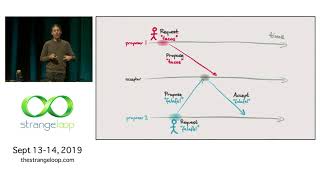
Correctness Proofs of Distributed Systems with Isabelle
Explore formal verification of distributed systems using Isabelle/HOL. Learn to prove correctness of algorithms, focusing on consensus and agreement properties in infinite state spaces.
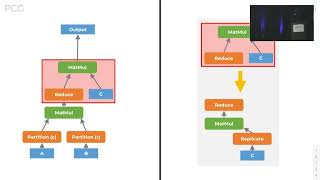
Unity - Accelerating DNN Training Through Joint Optimization of Algebraic Transformations and Parallelization
Explore Unity, a system optimizing distributed DNN training through joint algebraic transformations and parallelization. Learn about its unified parallel computation graph and hierarchical search algorithm for improved performance.
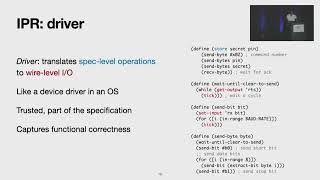
Verifying Hardware Security Modules with Information-Preserving Refinement
Explore Knox, a framework for building verified hardware security modules (HSMs) that eliminates bugs and side channels through formal verification and information-preserving refinement.
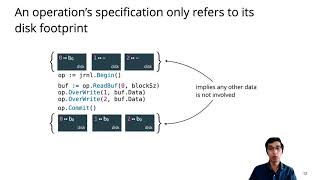
GoJournal - A Verified, Concurrent, Crash-Safe Journaling System
Explore GoJournal, a verified concurrent journaling system for storage applications. Learn about its implementation, performance, and the challenges overcome in its development and verification process.
Project Everest - Fast, Correct, and Secure Software for Deployment Now
Explore Project Everest's verified, high-performance secure communication components. Learn about F* programming, EverCrypt, EverParse, and EverQuic-transport, and their adoption in major projects.

Applicable and Achievable Formal Verification
Introductory overview of formal verification techniques in industry, focusing on safety-critical systems. Explores tools, applications, and adaptability to existing infrastructures.

How I Can Unlock Your Smart Door - Security Pitfalls in Cross-Vendor IoT Access Control
Explores security vulnerabilities in cross-vendor IoT access control, focusing on delegation chains and authorization flaws in smart home devices and cloud platforms.
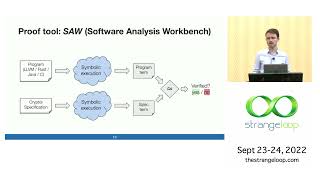
Formally Verifying Everybody's Cryptography
Explore formal verification in cryptography: its application, challenges, and impact on securing real-world systems through mathematical reasoning and advanced techniques.
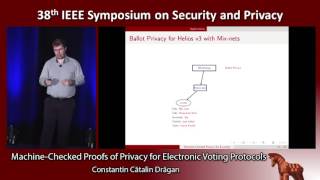
Machine-Checked Proofs of Privacy for Electronic Voting Protocols
Explore machine-checked proofs for privacy in electronic voting, focusing on the Helios protocol family. Learn about computational model analysis and formalization challenges.