Programming Devices and Services with P
Explore P, a framework for designing and validating event-driven asynchronous systems. Learn key concepts, real-world applications, and open research problems in this innovative programming approach.
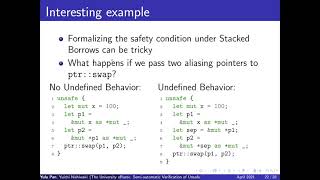
Rustv: Semi-automatic Verification of Unsafe Rust Programs
Explore semi-automatic verification of unsafe Rust programs, focusing on adapting seL4's approach, translating to Isabelle/Simpl, and formalizing safety conditions.
RustBelt: A Quick Dive Into the Abyss - Formalizing Rust's Safety Story
Explore Rust's safety mechanisms, type system, and semantic interpretations. Dive into lifetime logic, sharing predicates, and Coq implementations of Cell operations.
Verus - Verified Rust for Low-Level Systems Code
Explore Verus, a tool for full functional verification of low-level systems code in Rust. Learn about formal methods, specification writing, and proving program correctness beyond type system checks.
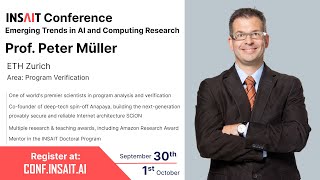
Automated Modular Program Verification - From Testing to Mathematical Proofs
Dive into automated program verification techniques to mathematically prove software correctness, exploring tools, methodologies, and real-world applications like the Scion Internet Architecture.
Melocoton - A Program Logic for Verified Interoperability Between OCaml and C
Explore Melocoton, a groundbreaking program logic for verifying interactions between OCaml and C components through OCaml's foreign function interface, featuring a formal semantics and Coq mechanization.
A Deductive Verification Infrastructure for Probabilistic Programs
Explore a novel deductive verification infrastructure for probabilistic programs, featuring an intermediate verification language and real-valued logic for quantitative property verification.
Formally Verifying Optimizations with Block Simulations
Explore formal verification of compiler optimizations using block simulations. Learn about enhancing CompCert with efficient, verified validators for advanced optimizations like LCM and SR.
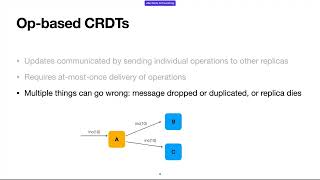
Modular Verification of Op-Based CRDTs in Separation Logic
Explore modular verification of op-based CRDTs using separation logic. Learn about Reliable Causal Broadcast and OpLib for simplified CRDT implementation and correctness proofs.
Synthesis II - Session Preview for POPL 2023
Explore advanced program synthesis techniques and their applications in software development, presented by expert Nate Foster at POPL 2023.
Algorithmic Verification - Session Preview at POPL 2023
Explore algorithmic verification techniques and their applications in program analysis, presented by expert Umang Mathur at POPL 2023's innovative session preview track.
Type Theory Session Preview - POPL 2023
Explore type theory fundamentals and recent advancements in this expert-led session preview for POPL 2023, enhancing accessibility of upcoming talks.
Probabilistic Inference - Session Preview at POPL 2023
Explore probabilistic inference concepts with expert Alexandra Silva in this POPL 2023 session preview, enhancing accessibility of advanced programming language topics.
Explainable Program Synthesis by Localizing Specifications
Explore explainable program synthesis through subspecifications, enhancing implementation understanding with logical formulas. Learn algorithms for constructing and verifying subspecifications, their properties, and impact on code comprehension.
Synthesizing Specifications - Automatic Generation of Program Behavior Descriptions
Explore automatic synthesis of program specifications using Spyro, a tool that generates precise L-properties based on user queries and domain-specific languages, applicable in various programming contexts.
Counterexample Driven Quantifier Instantiations with Applications to Distributed Protocols
Explore a novel interactive verification methodology using relational abstraction to tackle quantifier reasoning challenges in infinite-state systems, with applications to distributed protocols.
Resource-Aware Soundness for Big-Step Semantics
Explore resource-aware extensions to lambda calculus semantics and type systems, ensuring well-typed programs avoid resource exhaustion through coinductive reasoning and big-step formalization.
Predicting and Preventing Chaos with Formal Methods in TLA+ - Lambda Days 2022
Explore formal methods in TLA+ to predict and prevent chaos in distributed computing. Learn how to design robust systems beyond untestable whiteboard drawings and ad-hoc scripts.
A New Perspective on Commutativity in Verification
Explore a fresh perspective on commutativity in program proofs, focusing on its application in automated verification goals for various program types and properties.
A Universal, Sound, and Complete Forward Reasoning Technique for Machine-Verified Proofs of Linearizability
Explore a universal, sound, and complete proof method for machine-verifiable linearizability proofs. Learn about its application to complex algorithms and verification using TLAPS.
Mechanizing Refinement Types
Explore the mechanization of refinement types, combining semantic subtyping and parametric polymorphism. Learn about λRF calculus, data propositions, and metatheory proofs in LiquidHaskell and Coq.