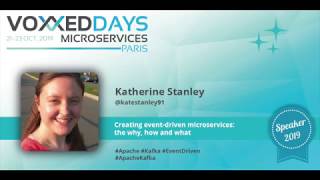
Creating Event-Driven Microservices - The Why, How, and What
Explore event-driven microservices architecture, including key patterns, Apache Kafka's role, and practical implementation strategies for building scalable and resilient systems.
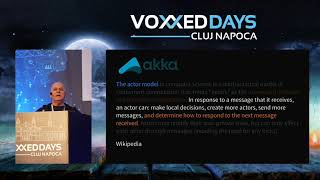
Building Stateful Clustered Microservices with Java, Actors, and Kubernetes
Explore building stateful clustered microservices using Java, actors, and Kubernetes. Learn about the actor model, resilient systems, and practical implementation in a Kubernetes environment.

Istio, Your K8S Cluster Best Friend
Explore Istio's capabilities for managing distributed systems, including circuit-breaking, retries, and blue-green deployments. Learn how it enhances Kubernetes clusters and simplifies microservices development.
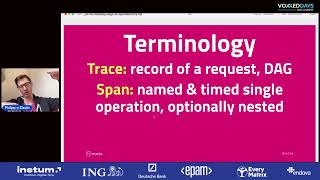
The State of OpenTelemetry
Explore OpenTelemetry's evolution, standards, and practical implementation in tracing and metrics. Learn about production-ready features, auto-instrumentation capabilities, and real-world experiences.
Exploring Stateful Microservices in the Cloud Native World
Exploring stateful microservices in cloud-native systems, focusing on data integrity, concurrency, and deployment strategies using Open Liberty and MicroProfile.
Elegant Builds at Scale with Gradle 3.0
Scaling build infrastructure with Gradle 3.0 for large projects: standardization, dependency management, caching, multi-language builds, and advanced IDE integration.

Elixir - Easy Fun for Busy Developers
Discover Elixir: Ruby-like syntax meets Erlang's power. Learn to build scalable, fault-tolerant systems with a fun, developer-friendly toolset. Ideal for Java programmers seeking robust alternatives.
It is Tough to Be an Application in 2016 - Lagom Can Help
Exploring Lagom framework for building scalable, distributed systems that meet modern application demands of high load, real-time performance, and continuous availability.
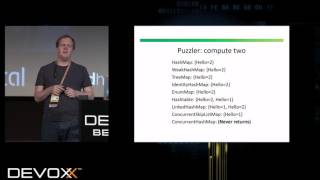
Lambda Puzzlers
Explore capturing vs non-capturing lambdas, distributed system considerations, and innovative uses of lambdas in APIs. Learn from Java expert Peter Lawrey's insights on lambda implementation and optimization.
Build Blazingly Fast, Ultra Lightweight Cloud Native Java Enterprise Applications
Develop high-performance, scalable Java microservices using reactive programming, LMAX Disruptor, Undertow server, and Kubernetes for cloud-native deployment strategies.
Micro Frontends - Extending Service-Oriented Architecture to Frontend Development
Explore service-oriented architecture for frontend development through micro frontends, enhancing software engineering processes and learning valuable lessons from StepStone's transformation journey.
Your Team as a Distributed System
Explore team leadership through distributed systems theory, applying concepts like CAP Theorem to optimize team dynamics, communication, and culture for successful scaling.
Fast Data Analytics in 2 Simple Steps
Learn to implement fast, efficient stream processing with a distributed in-memory cache using Java. Discover techniques for analyzing in-memory data and integrating external data sources for high-performance analytics.
Writing a Kubernetes Operator in Java
Explore Kubernetes operator development in Java using Quarkus and fabric8, with insights from Instana's experience creating their agent operator for custom resource management.
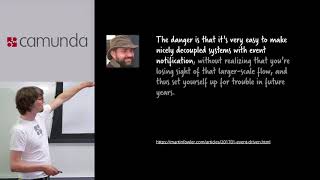
Workflow Automation in Microservice Architectures
Explore best practices for implementing BPMN and Camunda in microservices architectures, covering process slicing, engine deployment, and maintaining control in distributed systems.

The Role of Workflows in Microservices
Explore microservices architecture, focusing on cross-service workflows, visibility, error handling, and maintaining loose coupling. Learn strategies for effective orchestration and distributed systems management.
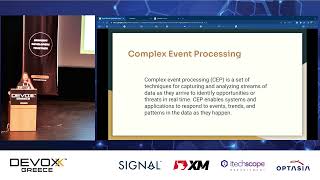
Event Streaming in the Cloud Native World with Apache Pulsar
Explore event streaming's role in modern software architecture and how Apache Pulsar enables real-time, distributed messaging for cloud-native applications and IoT/AI data pipelines.
Distributed Patterns Compared - Frameworks vs. K8s vs. Service Mesh vs. eBPF
Comparison of distributed architecture approaches: Java frameworks, Kubernetes, service mesh, and eBPF. Explores advantages, challenges, and practical applications through theory and live demos.
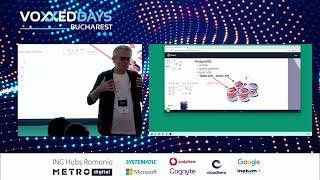
Anatomy of a Distributed SQL Database - YugabyteDB
Explore YugabyteDB's architecture, combining PostgreSQL features with distributed technologies for horizontal scaling and cloud-native performance. Learn about consensus protocols, sharding, and modern storage techniques.
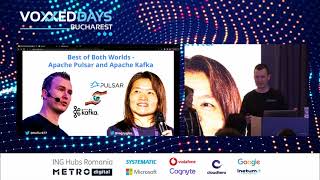
Best of Both Worlds - Apache Pulsar and Apache Kafka
Explore Apache Pulsar and Apache Kafka architectures, compare Java client implementations, and learn how to combine these streaming technologies for optimal data processing solutions.

Apache Spark Beyond Shuffling - Why it isn't Magic - but also where there is some really cool Magic
Apache Spark performance deep dive: scaling challenges, RDD operations, key skew issues, and optimization techniques for distributed data processing. Insights from an IBM Spark engineer.