Efficient Mean Estimation with Pure Differential Privacy via a Sum-of-Squares Exponential Mechanism
Explore efficient mean estimation techniques using pure differential privacy and sum-of-squares exponential mechanism, advancing statistical data analysis with privacy considerations.
The Sum-of-Squares Method
Explore advanced techniques in polynomial optimization and algorithm design, focusing on the powerful Sum-of-Squares method and its applications in various mathematical fields.
Differential Privacy and the US Census - IPAM at UCLA
Explore differential privacy's role in the 2020 US Census, its mathematical foundations, and challenges in balancing data utility with privacy protection in large-scale statistical analysis.
The Role of Interactivity in Local Differential Privacy
Explore the impact of interactivity on local differential privacy, examining its significance in data protection and privacy-preserving algorithms.
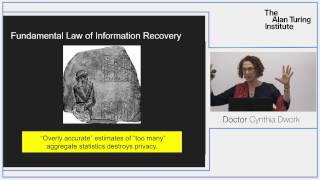
Turing Lecture - Dr Cynthia Dwork, Privacy-Preserving Data Analysis
Explore differential privacy and its role in protecting data during complex analysis. Learn about the risks of data accumulation and solutions for privacy-preserving statistical analysis of large datasets.
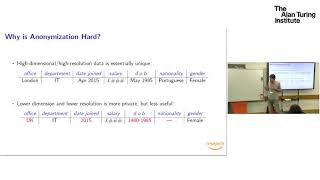
A Short Tutorial on Differential Privacy
Explore differential privacy fundamentals, applications in machine learning, and key definitions. Learn about privacy-preserving computations and various mechanisms for protecting sensitive data.
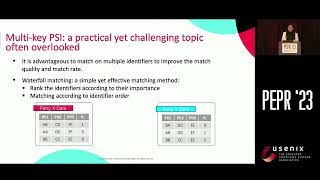
Protecting User Privacy in Private Set Intersection - A Journey Toward Mitigating User Tracking
Explore DPCA-PSI, a novel protocol enhancing privacy in Private Set Intersection. Learn how it securely computes intersection statistics while preserving differential privacy, mitigating user tracking risks in ad measurement and data sharing.
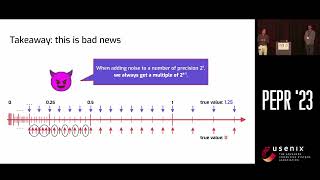
How to Break, Then Fix, Differential Privacy on Finite Computers
Exploring vulnerabilities in differential privacy implementations, focusing on precision-based attacks and proposing solutions to address floating-point behavior issues in open-source libraries.

Privacy in the Public Sector - Lessons Learned and Strategies for Success
Explore GovTech Singapore's privacy toolkit for the public sector, including challenges, strategies, and initiatives in Differential Privacy. Gain insights on building effective privacy tools for government use.
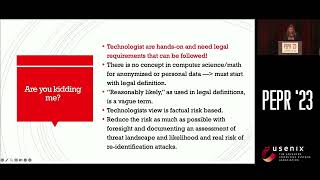
De-identified, Anonymized, or Aggregated Data - A Global Regulatory Comparison
Explores global data protection regulations, focusing on anonymized data challenges. Highlights need for common definitions, risk assessment guidelines, and regulatory clarity in privacy technologies.

Overcoming the Challenges of Data Sharing
Experts discuss advanced techniques for secure data sharing, including synthetic data, differential privacy, and federated analytics, addressing key challenges in the field.

Contraction of Markov Kernels and Differential Privacy - Part II
Explore advanced concepts in differential privacy and Markov kernels, focusing on contraction principles and their applications in trustworthy machine learning.

The Saddle-Point Accountant for Differential Privacy
Explore a novel approach to differential privacy using saddle-point techniques, enhancing privacy guarantees in machine learning algorithms and data analysis.
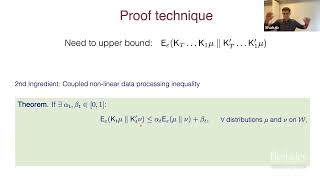
Contraction of Markov Kernels and Differential Privacy - Part I
Explore Markov kernel contraction and its connection to differential privacy in machine learning, focusing on information-theoretic approaches for trustworthy algorithms.
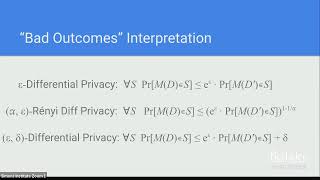
Differential Privacy & Variants
Explore differential privacy and its variants, focusing on information-theoretic methods for enhancing trustworthiness in machine learning algorithms and applications.
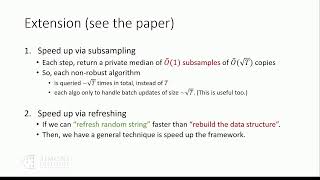
A Blackbox Reduction for Adaptive Adversaries Using Differential Privacy
Explore a novel black-box transformation using differential privacy to convert dynamic algorithms from oblivious to adaptive adversary resistance, enhancing algorithm design for dynamic graphs.
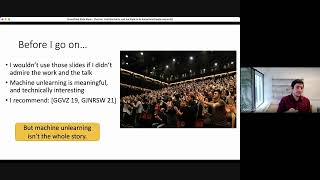
Control, Confidentiality, and the Right to be Forgotten in Differential Privacy for Machine Learning
Explore data deletion, confidentiality, and control in machine learning, focusing on differential privacy and its implications for user rights and model retraining.
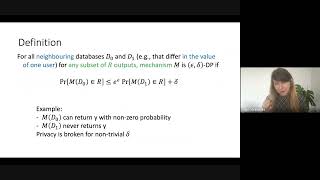
Analog vs. Digital Epsilons: Implementation Considerations for Differential Privacy
Explore implementation considerations for differential privacy, focusing on analog vs. digital epsilons in machine learning applications.
Private Convex Optimization via Exponential Mechanism - Differential Privacy for Machine Learning
Explore private convex optimization using the exponential mechanism. Learn differential privacy, noisy SGD, and isoperimetric inequality for ML applications.
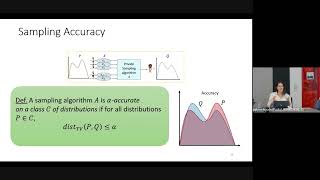
Differentially Private Sampling from Distributions - Google Algorithms Seminar
Explore private sampling from distributions, examining dataset size requirements for various distribution families and comparing private sampling to non-private learning in different parameter regimes.
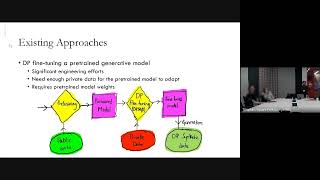
Differentially Private Synthetic Data Generation via Foundation Model APIs
Explore generating high-quality differentially private synthetic data using foundation model APIs, overcoming challenges and achieving state-of-the-art results without accessing model weights.